
When Trust Gets Expensive Again
A man sits at his computer in the hills above Berkeley, watching a video of a missile striking an elementary school. More than a hundred and fifty people are dead, most of them children, and the clip has already been seen over a million times. His job is to tell the world whether it is real. He slows it down, breaks it into frames, measures the length of the missile in pixels, charts its path, checks the shadows against the physics of the afternoon light. After a full day he writes back that he finds no compelling evidence the video is fake — and still cannot quite bring himself to call it real.
The man is Hany Farid, and for more than two decades he has been the world’s leading expert in digital forensics. Eli Saslow’s recent profile of him in the Times carries a quietly devastating headline: the deepfake expert no longer trusts his own eyes. I read it twice, and I had reason to. Years ago, when I was running a University of California field station, I sat in on Farid’s lectures and have followed his work ever since. My daughter runs a photography business. And I spend my days building an instrument meant to observe the living planet and report honestly on what it sees. The crisis in that article walked into my house through three doors at once.
The Game Detection Loses
A student in Farid’s class names the problem with the cleanness of a theorem: making a fake is easy, cheap, fast, and reliable; catching one is slow, costly, and uncertain. Is a solution coming, the student asks, or are we just screwed? Farid takes a breath. “We’re pretty screwed,” he says.
The asymmetry is the whole story. Detection is an arms race the forger always wins, because the detector arrives last — holding a finished artifact with no history attached, obliged to reconstruct the truth from the thing itself while the fake is already loose in the world. Farid notes that the half-life of a social-media post is well under two minutes; by the time his analysis is done, a fake has already hardened into fact. We built a civilization on a comfortable assumption — that a photograph was, presumptively, a picture of something that happened — and that assumption has quietly expired.
Here is what I keep wanting to say to people who close that article in despair. What is collapsing is not truth. It is one particular method of establishing it: authentication by inspection. Look at the artifact, judge it with your eyes or your forensics, decide. That method is dying, and Farid is its finest practitioner watching it die. But it was never the only method, and arguably never the best one. We do not authenticate a twenty-dollar bill by staring at it, or a scientific result by admiring its graph; we trust the system, the instrument, the unbroken chain of custody behind each.
Provenance, and Its Price
The replacement for seeing-is-believing is provenance: a traceable line back to a known origin. This is what the new content-authenticity standards are reaching for — the Coalition for Content Provenance and Authenticity, and the “Content Credentials” you may have begun to notice attached to images, a kind of cryptographic nutrition label recording who made a file, when, with what, and whether a machine was involved. It is a real and sensible idea — but partial, a little fragile, and carrying a cost that is the actual headline.
Provenance makes trust expensive again.
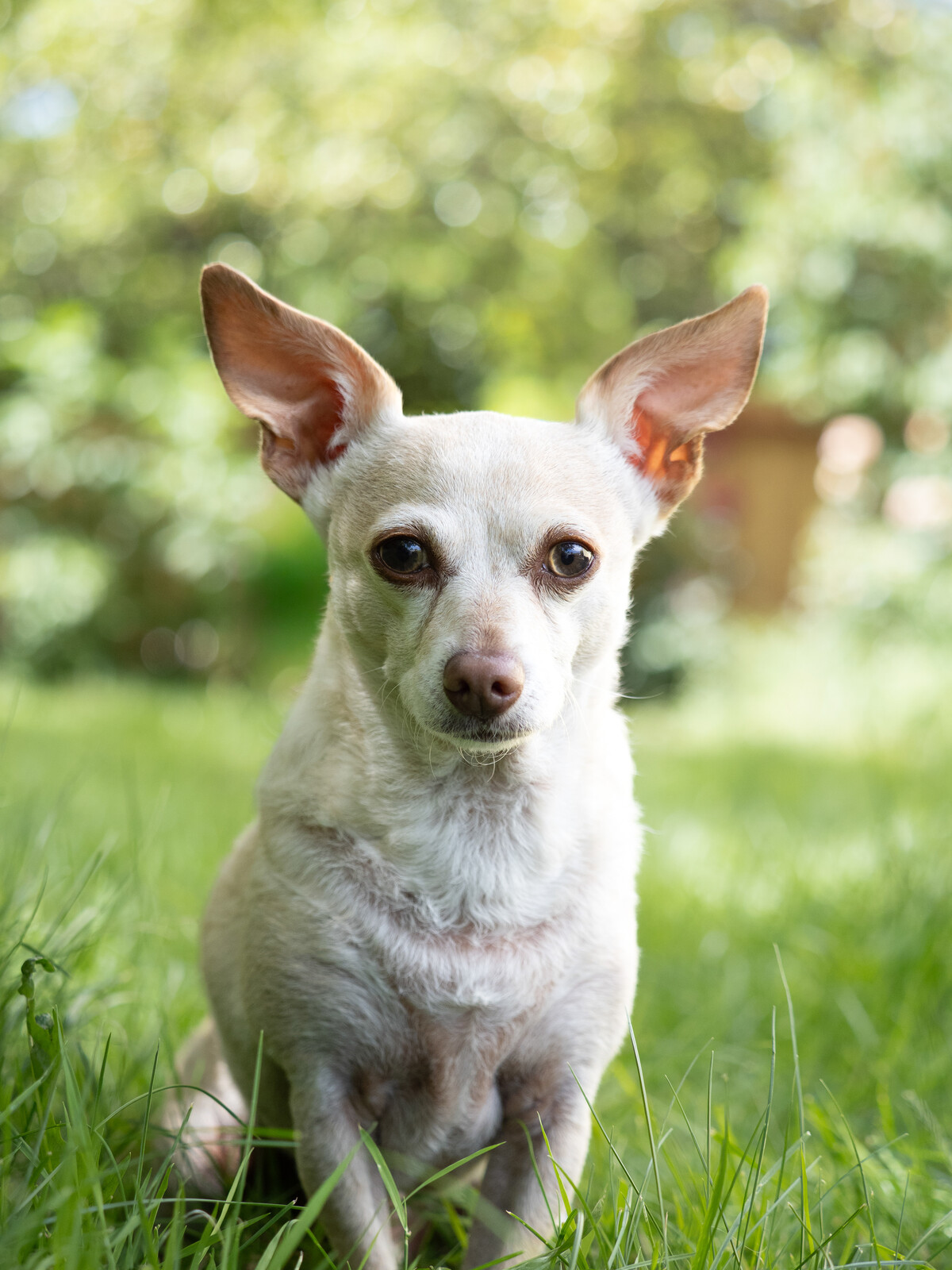
For thirty years, trust in images was free. It came bundled, unpriced, with the medium. That subsidy is the thing that has ended. Look at the photograph at the top of this essay. My daughter, Caitlin, made it — a portrait of her chihuahua, Chewy, sitting in my backyard on an afternoon in May, his outsized ears lit translucent where the sun came through them. I was there. I watched her work her camera to find the angle and wait for the dog to settle. It is as real as a photograph gets — and precisely because it is good, with its melting green background and the glow in those ears, it is exactly the sort of image a stranger online might now wave away as a render. There is the whole predicament in a single frame: the craft that once certified a photograph as real has become the very thing that makes it suspect.
So my daughter now has to prove what used to prove itself — that a human being stood in the grass, waited for the light, and pressed the shutter; that a person made this and not a prompt. The practical answer available to her today runs through Adobe’s tools, which can attach a credential at the moment she exports a finished image, signed by a chain a viewer can later check. It is the common ground at the moment, and it works well enough.
But notice what it is. Her photographs are artifacts, and provenance is stamped onto them after the fact. The credential can be stripped the instant a social platform re-encodes the image. And it cannot close what engineers call the first-mile gap: a camera pointed at a screen displaying a fake will sign the counterfeit as faithfully as it would sign the real thing. There is, as yet, no free authority issuing these certificates — tens to hundreds of dollars a year — so trust, for her, has become a line item. The open commons where a photograph was simply believed is turning into a marketplace where authenticity must be purchased and renewed, like a domain name.
Born With Provenance
My own work takes the opposite road to the same destination.
For forty years I have been building what I call a Macroscope — an instrument for seeing the very large and the very slow, the way a microscope sees the very small. It began in 1984 as a toy — an Apple IIe wired to a laserdisc, filed mentally under science fiction. Today it is a fleet of sensors, models, and visualizations spread across real landscapes, and its data has a property my daughter’s photographs do not. Its provenance is not applied afterward. It is constitutive — born at the sensor. Every reading carries its origin in its bones: a known instrument, with a known calibration, at a known place and time, in an unbroken record. The instrument is the credential.
And this, almost as a side effect, closes the gap that is breaking Farid. There is no screen between the world and the record. A calibrated soil-moisture probe cannot photograph a fake; it is bonded to the phenomenon it measures. The trust problem does not vanish; it relocates — to node integrity, calibration, and custody of the instrument, which are tractable, inspectable, decades-old engineering problems. “Is this sensor reporting honestly?” is a question you can actually answer. “Is this video real?” increasingly is not.
There is an older, deeper version of that idea in the photograph itself. Months ago, in this same Breakroom, I wrote about a Smithsonian study finding that even chihuahuas carry fragments of wolf DNA — a few million base pairs handed down across some eight hundred generations from animals that hunted the Pleistocene. Chewy weighs eight pounds and wears a sweater in the cold, yet his genome is a chain of custody written across twenty-three thousand years, and impossible to forge. A model can render a convincing chihuahua in seconds; it cannot manufacture the lineage. The synthetic has no ancestry. The small, suspect dog in the grass turns out to be the least falsifiable thing in the frame.
The Same Tide, Opposite Shores
Which brings me to the strange symmetry at the center of all this, the thing I cannot stop turning over.
The force destroying trust is the same force that built my instrument.
What made deepfakes easy, cheap, fast, and reliable is a steep, year-over-year decline in the cost of fabrication — the price of synthesizing a convincing image falling down an exponential curve. That collapse is Farid’s despair. But the cost of observation has been falling down the very same curve. Sensors, processors, and now the small models that run at the edge of the network have grown cheap enough, fast enough, and good enough that the planetary instrument I sketched as fantasy in 1984 is now merely an engineering schedule. Twenty years ago some of us were stringing crude sensor networks across islands and ridgelines — hauling batteries up slopes to watch a seabird colony breathe through a summer. It was heroic and it barely worked. The same cheapening that made that heroic then makes it ordinary now. Same tide, opposite shores. The economics that drowned the visual commons are the economics that floated my fleet. When I helped found a national center for embedded sensing two decades ago, that was, in the end, a wager on which shore the curve would reach first.
What He Was Fleeing Toward
Saslow’s profile ends with Farid fleeing — to a farm in rural Vermont, a hundred wooded acres with no neighbor in sight, where he chops wood and walks the trails and tries to feel far away. And the emails follow him into the forest. It reads, at first, like surrender. I would ask you to read it as an epistemology instead.
Farid’s wife is a vision scientist whose own research, it turns out, concerns eyes that elongate from too much screen time, and a coming epidemic of preventable blindness whose remedy is natural light and distant views. The cure for the synthetic, in other words, is the grounded, the embodied, the directly measured — the meadow of trillium, the creek spilling over mossy granite, the red-winged blackbird, the chest-high stone wall running through the trees. That is not a retreat from the problem. That is a field naturalist’s entire creed. Farid is fleeing toward the epistemology some of us chose decades ago and then wired into our instruments.
Seeing is no longer believing — and the grief is reasonable; the open visual commons we grew up inside is genuinely dying. But tracing is believing. Witnessing is believing. Measuring — with an instrument whose provenance you can audit and whose feet are planted in the actual ground — is believing. Trust did not end. It only got expensive again, which is to say it went back to being earned rather than assumed. My daughter will earn it one signed photograph at a time — beginning, as it happens, with a small dog in the grass. I will earn it one honest sensor at a time. And the world — the stubborn physical world that does not generate, does not hallucinate, and does not care what goes viral — will go on being exactly itself, available to anyone willing to go outside and measure it.
References
- - Szewczyk, R., Osterweil, E., Polastre, J., Hamilton, M., Mainwaring, A., & Estrin, D. (2004). “Habitat Monitoring with Sensor Networks.” *Communications of the ACM*, 47(6), 34–40. ↗
- - Lin, A.T., Fairbanks, R.A., Barba-Montoya, J., Liu, H.-L., & Kistler, L. (2025). “A legacy of genetic entanglement with wolves shapes modern dogs.” *Proceedings of the National Academy of Sciences*, 122(48), e2421768122. <https://doi.org/10.1073/pnas.2421768122> ↗
- - Hamilton, M.P. (2025). “The Wolf in the Living Room: Genetic Entanglement and the Family Dog.” *Science with Claude*. <https://sciencewithclaude.com/post.php?slug=the-wolf-in-the-living-room-genetic-entanglement-and-the-family-dog> ↗
- - Coalition for Content Provenance and Authenticity. *Content Credentials: Technical Specification and FAQ*. ↗
- - Saslow, E. (2026). “In the Age of A.I., the World’s Leading Deepfake Expert No Longer Trusts His Own Eyes.” *The New York Times*. ↗