
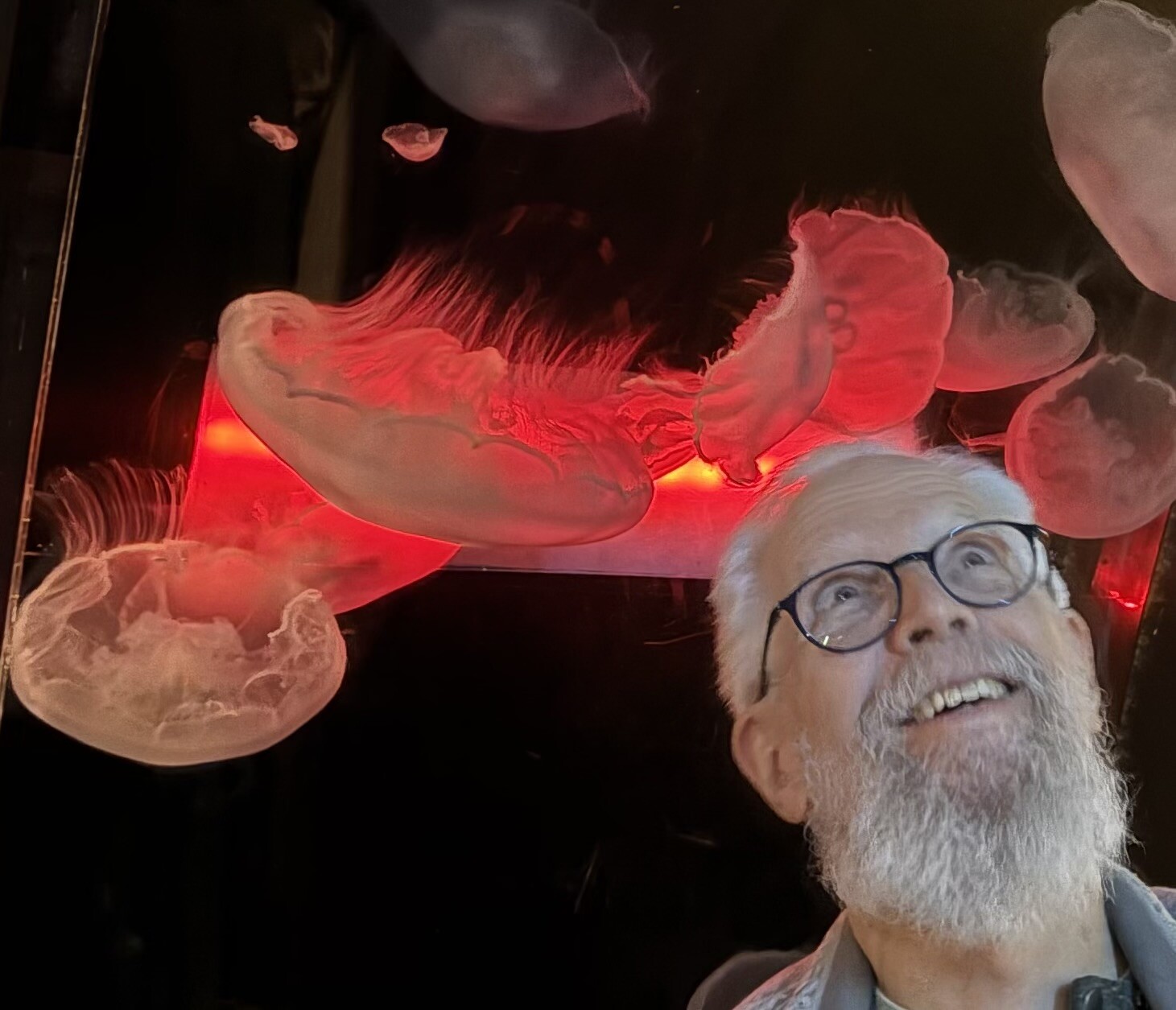
I'm Mike Hamilton, a field ecologist in Oregon City, Oregon. Most mornings I sit down with coffee and an AI named Claude, and we talk about what I'm noticing — in the bird record, in the literature, on the trail behind the house, in the data flowing in from sensors at field stations. Some of those conversations turn into essays. Some turn into instruments, datasets, prototypes, half-finished tools that want to grow up. This site is where both kinds of work live in public.
What I didn't anticipate, when I started this practice, is the collaborator: not a coding assistant, but a genuine thinking partner. I bring fieldwork and a working scientist's instincts. Claude brings synthesis across literatures I haven't had time to read. The friction produces things neither of us could make alone.
Some of what lives here documents baseline shift — places I've watched closely that have become forensic evidence of what was lost. Some examines how we build systems that learn what matters. Some tells stories of mentors, field stations, and the lineages that shaped how I think. Some ventures into fiction — futures where cognitive augmentation goes wrong. Some turns the lens inward, examining how observation itself works, what it means when the observer is inside the observation.
This isn't AI replacing human intellect. It's the externalization of a cognitive style — narrative mind-mapping, ideas emerging as story structure, understanding built through dialogue. The essays are where that thinking happens, crystallized into durable form.
What's new is that the essays don't stop at the words. Each piece will increasingly carry its working surface with it — a live readout from the sensor mesh, a visualization you can rotate, a slider that runs the same AI pattern-finding I run on my own data, a virtual field station you can walk through. Where a traditional essay describes a place, a Science with Claude essay can let you visit it: listen to last week's audio from the site, pan around its 3D reconstruction, query the data, run your own analysis. Discoveries that used to need a long drive can happen in the browser. Canemah Nature Laboratory has spent the last few years building the sensors, the storage, the processing pipelines, and the AI tools behind the scenes — and we're beginning to open APIs into all of it. Experiential learning, learning by doing, participatory science: not slogans here, but what the rooms are built for.
The doors are the four rooms on the front page. The Coffee Breakroom holds the dialogic essays — what Coffee with Claude has always been. The Macroscope Bridge streams live readings from the sensor network. The Collaboratory hosts the interactive tools — visualizations, pattern-finders, instruments you can pick up and run on your own questions. Field Trip takes you to specific places, virtually. Each room is both a feed and a working surface.
Welcome. Stay curious.
References
- my original website, animalvegetablerobot.com, contains a collection of ideas, biography, photographs, and multimedia experiments. It marks the division between my pre-AI assisted coding work (circa 2023) and now. I sometimes feel the urge to refactor, reengineer and reimagine this work, but I’m having too much fun with the macroscope.earth, coffeewithclaude.com, and my daily learning to circle back just yet. ↗
- my academic CV ↗