
What the Land Holds — Part One: Tied Down with Hazel
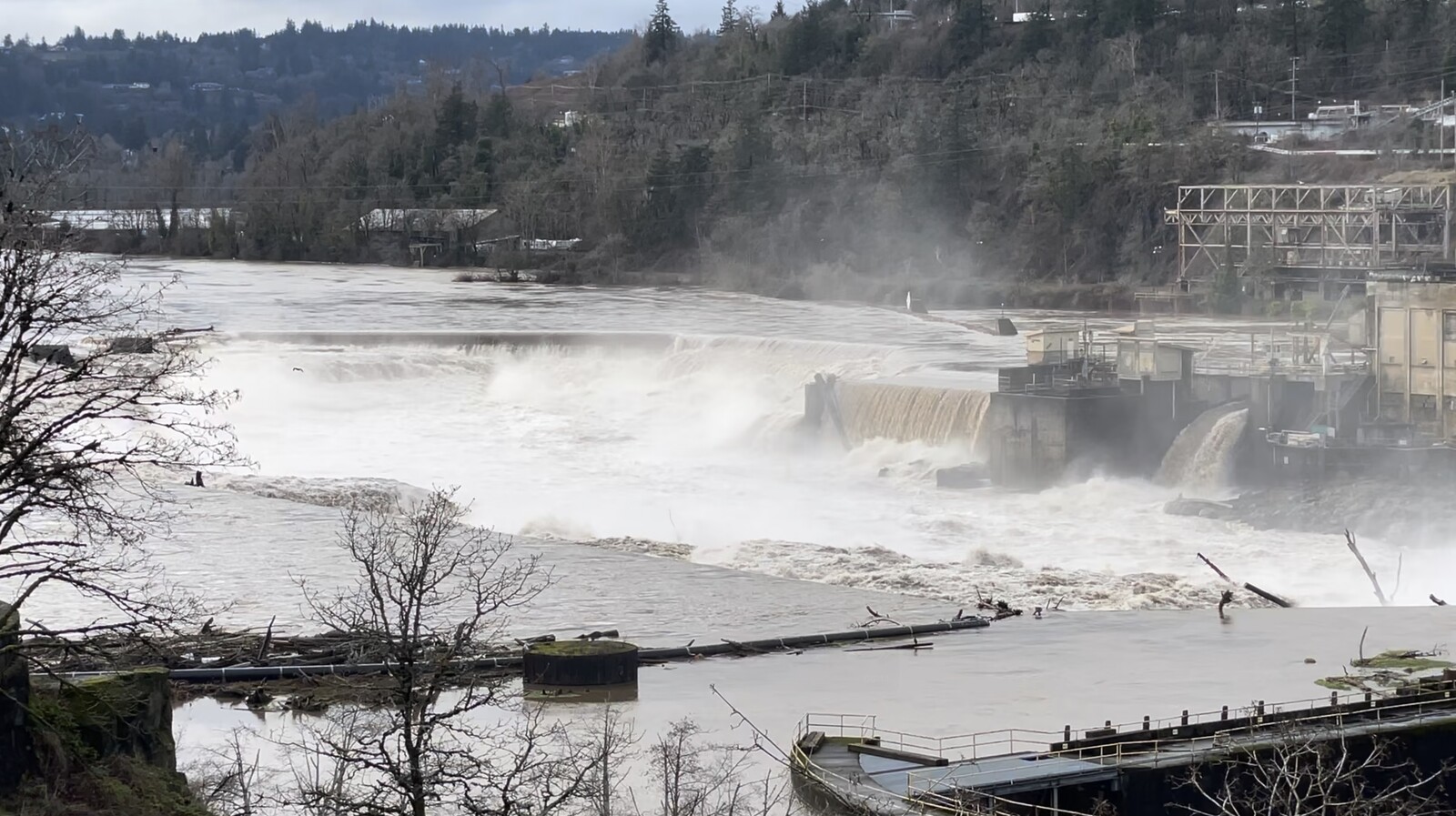
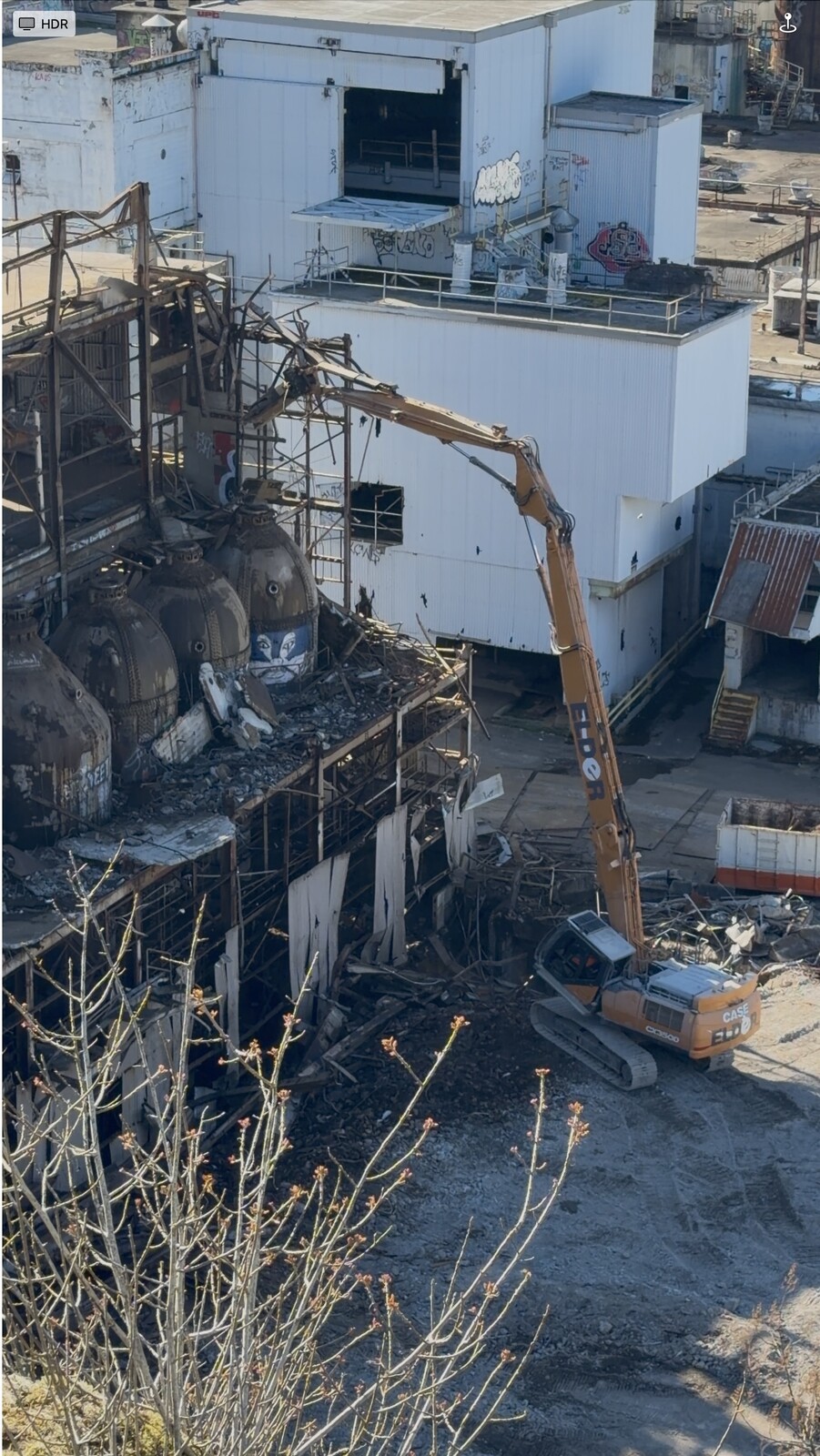
A few days before the newspaper told me, the tents told me. On one of my near-daily walks out to the bluff — four blocks from home to where the land drops away to the river — I saw the canvas structures going up on the old Blue Heron mill site below, and I knew there would be a ceremony soon. The body reads its ground before the record does. Smoke Signals — the Grand Ronde's newspaper — came this morning, and when I read it at lunch it confirmed what the tents had already said: on May 28, tribal council and dignitaries broke ground on tumwata village, the gathering place rising on the site of the demolished paper mill, a short walk down from my door.
I don't, strictly, live in Canemah, but I live within walking distance of the Canoe Place. My home and laboratory sit on the flat historic bench of the McLoughlin bluff, overlooking the falls and the mill site, a little downriver of Canemah proper, where I walk most weeks — out to the bluff nature park and the pioneer cemetery on its rim. Canemah is what the Clackamas called the still water above the falls: kanim, the canoe place, where canoes put in to portage around them. When I named my laboratory Canemah Nature Lab in 2019, I took that older, displaced name on purpose, because a name is what turns a location into a place — and the ground I actually study and steward is itself a chosen thing: in the Macroscope sense, a curated place stitched from the Canemah District and my own reach of Oregon City, held together by attention rather than by any property line.
I have watched the mill come down over years — the slow, methodical un-building, building by building, the buried railway tanker cars and fuel tanks hauled out of ground the Tribe has been cleaning since it bought the site in 2019. I even built a small text world with that mill as its backdrop, one you enter by naming where you want to go, whose first instruction to the visitor is the only instruction a naturalist ever really needs: pay attention. I made an explorable memory of the place before the wrecking started, and did not know, when I made it, that I was rehearsing the argument of this essay.
That same lunch I read a second piece, in Aeon, by the philosopher Sandrine Bergès — a recovery of the home as a subject worthy of philosophy. I did not expect the two to be talking to each other. They were.
Re-founding on poisoned ground
Bergès's argument is a story of reception. Oikonomika — the science of the household — was once a legitimate branch of ancient thought, before "economics" was hollowed out into the getting and spending of money and the home dropped quietly out of the canon. The texts that treated the household as the ground of human flourishing survived poorly or were discredited; Aristotle's Politics, with its household as a mere prerequisite to the real business of the city, became the authoritative transmission. Philosophers, she writes, took from the past what they wanted and helped the rest disappear. What gets transmitted, what gets demolished, who is permitted to lay the foundation again — that is the whole drama.
It is also, precisely, the drama at the mill. The Grand Ronde are re-founding on ground that an industrial century took from its original stewards, reshaped, poisoned, and left. Ryan Webb, who oversees the project, called it not merely a project but a promise — that the land would rise again in a way that reflects the people of this place. Cheryle Kennedy's words at the groundbreaking were plainer still: today, she said, we start rebuilding. Governor Kotek, on the same churned earth, called it less a beginning than a continuity — a fishery and trading center and site of ceremony long before there was an Oregon to host it.
Here the two essays fuse. In the seventeenth century the Venetian philosopher Lucrezia Marinella, reading the recovered domestic texts, inverted Aristotle: if a city is simply an aggregate of households, then the women who keep the households are the ones who keep the city. Kennedy's claim is structurally identical. The falls were the great gathering place — the largest center of commerce west of the Mississippi for Native people, she said, the keepers of the falls welcoming all tribes. The "domestic" scale, properly understood, was never the minor one. It was the engine.
Place is the opposite of a coordinate
I spend my working life building instruments, and instruments produce coordinates. They have to; that is how measurement works. But a coordinate is the opposite of a place. We use coordinates because they are interchangeable, transferable, indifferent to whether anyone ever stood there. The eagles that nest in Waterboard Park and feed from the river below my walk are not living in a coordinate, and neither am I.
What turns a coordinate into a place is naming, returning, attending. The oldest expression of this I know was told at the groundbreaking itself. Greg Archuleta, taking what he called the most dangerous job — telling the people's ikanum outside its proper season — recounted how the falls came to be where they are. Coyote and Meadowlark, the story goes, set out to make a falls and started far up the river. Meadowlark kept asking, how about here?, but he and Coyote spoke different languages and could not understand one another, so the falls kept sliding downstream — past Salem, further and further — until, at Oregon City, Meadowlark finally spoke in chinuk wawa, Coyote understood, and they set the falls down and tied it in place with hazel that turned to stone.
I am not Clackamas, and the story is not mine to interpret. But as a naturalist I hear in it something true about how places are made: a falls cannot be fixed until it is correctly named, in the right tongue, by parties who finally understand one another. That is the whole of topophilia — Yi-Fu Tuan's word for the bond between a people and a particular ground — compressed into a creation story. Our lineage came out of Africa, but the urge to migrate carried us to specific falls and confluences and estuaries, each of which became a place by being learned and named and returned to. Canemah carrying "canoe place" forward into the sign on my laboratory is the same act as the hazel: a name that ties the water down.
The whole instrument
For a scientist who is also a naturalist, the instrument reading and the feeling are not two things. The feeling comes first — formed from the senses, in real time, immediate — and the quantitative arrives afterward as a layer of abstraction laid over it. Alfred North Whitehead named the standing danger here the fallacy of misplaced concreteness: mistaking the abstraction for the concrete reality it was drawn from. The number is parasitic on the felt encounter, never the reverse. An instrument that forgot that would be measuring its own shadow.
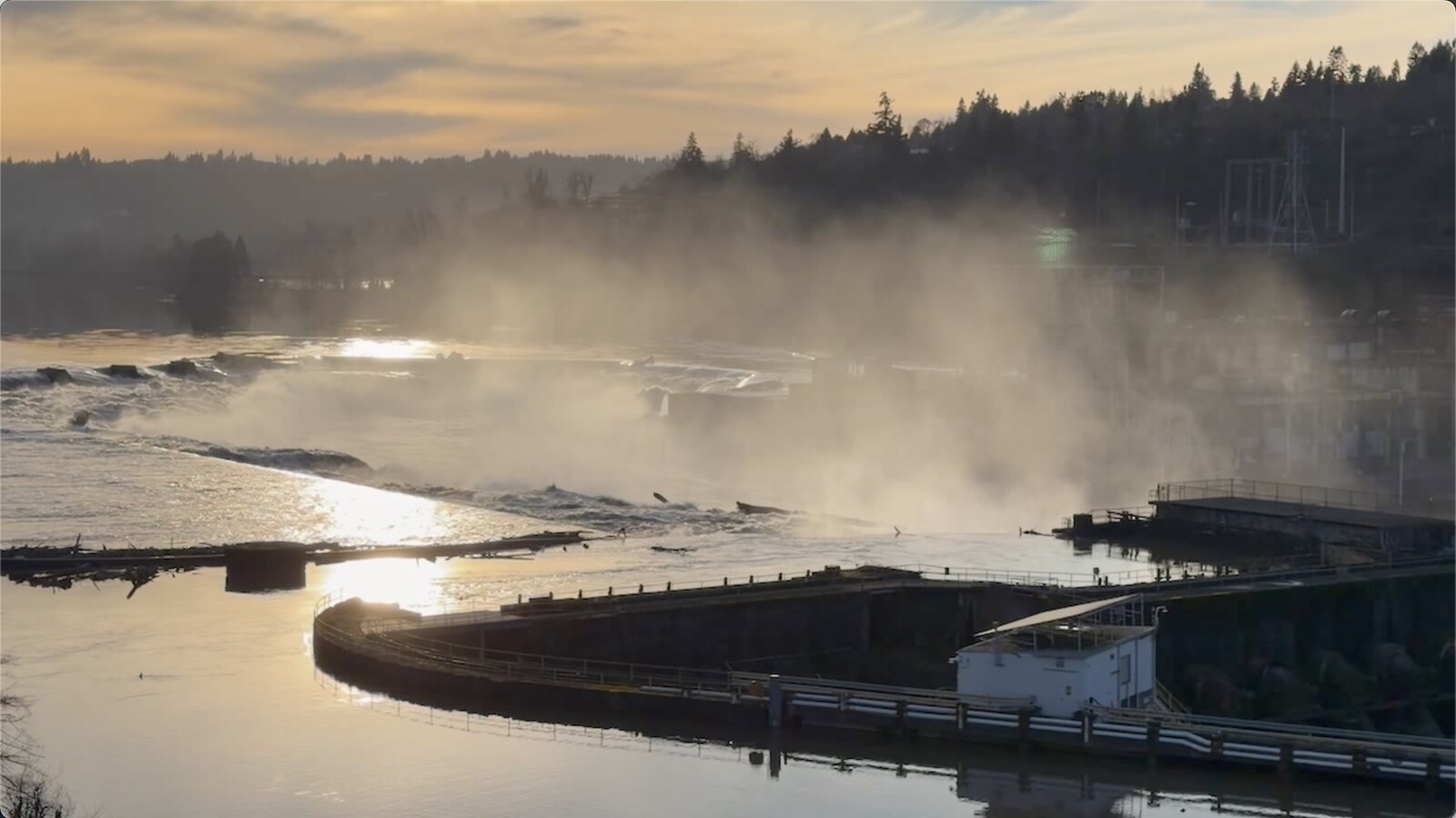
And yet the two together hold more than either alone. When I watch an eagle drop and clear a fish from the river, the wingspan and the angle of the stoop are one channel; the catch in the chest is another. The first is about the world. The second is the older signal underneath it — this matters, in this way, here, again. Run both over the same field, in the same mind, across years, and what you get is neither a measurement nor a mood but a place: this kind of event, mattering this way, at this reach of this river. That is what the instrument exists to serve, and the one layer it cannot itself contain.
So I have come to think the instrument is not, at bottom, a representation of a place or a measurement of it. It is a mnemonic. Its real job is to capture enough of a place to trigger the memory and bring the earlier world back. It does not store the earlier river as data; the earlier river lives in me. It stores only the cues rich and specific enough to bring back the original feeling when I run them through myself again. My little mill-world, with its single command to pay attention, was that all along. The Tribe says the same thing in a truer register: their cultural-resources people, talking about the native-plant nursery in the same issue of the paper, describe how their history is written on the landscape, so that the land holds it "for our own finding." Culture, they add, goes static unless it is practiced on the ground. The land is the mnemonic. The instrument is only a way of paying attention on purpose.
The baseline both then and now
I grieve the losses I have measured. That is the particular weight of the naturalist's grief — not a vague sense that things were once better, but decades of observation that will not let me round up. Glenn Albrecht called it solastalgia: the homesickness you feel without ever leaving home, because it is the home that moved. Everything I have watched shows no sign of the river returning to what I knew in my youth. In the same paper, a council member warns that once the Willamette's salmon are gone they are gone forever, and the Tribe adopts its first climate-adaptation plan against a decade of heat and smoke and storm. The line shows no bend.
The elders speak of the now in the tense of their ancestors. Our ancestors are here watching, Kennedy said. The baseline, in that grammar, is both then and now, and I suspect it helps carry the pain of a hard history. It is not mine to borrow, and I will not pretend it is. But what moves me in it is true on its own terms: holding the earlier river present — as the thing the loss is measured against, mourned against, refused — is not the same claim as the river coming back. The ancestors watching isn't pretending the mill never poisoned the ground. It is refusing to let the poisoned present install itself as the only reality.
Which means my grief is not separate from my work; it is the engine of it. The younger generation doesn't grieve what I grieve because they never held the baseline — the drifted river is simply the river to them. My grief is the earlier world still alive in me. It hurts because it is intact. The day it stopped hurting would be the day the baseline finally shifted in me too.
And so I keep one thing beside the grief, not against it. The eagles over Waterboard Park were nearly gone in my youth; DDT had them. They came back. I set my home and lab on the bluff where I could watch a recovery unfold over a poisoned reach, in the same sightline as a people re-founding their gathering ground on a demolished mill. None of that erases what the decades of watching have shown me. But it is worth noticing what I chose to build my home next to. I did not anchor myself looking only at the loss. The grief and the eagles are both true, and a man who can hold both at once is not confused — he is only looking with the whole instrument, the one tied down, like the falls, with hazel that turned to stone.
References
- - Whitehead, Alfred North (1925). *Science and the Modern World*. Macmillan. ↗
- - Tuan, Yi-Fu (1974). *Topophilia: A Study of Environmental Perception, Attitudes, and Values*. Prentice-Hall. ↗
- - Albrecht, Glenn (2005). "Solastalgia: a new concept in health and identity." *PAN: Philosophy Activism Nature*, 3, 41–55. ↗
- - Montesano, Nicole (2026). "Plants for People showcases Tribe's restoration work." *Smoke Signals* (Confederated Tribes of Grand Ronde), June 15, 2026. https://www.smokesignals.org/articles/2026/06/12/plants-for-people-showcases-tribe-s-restoration-work/ ↗
- - Montesano, Nicole (2026). "Coming home to tumwata" / "'Today we start rebuilding.'" *Smoke Signals* (Confederated Tribes of Grand Ronde), June 15, 2026. https://www.smokesignals.org/articles/2026/06/12/coming-home-to-tumwata/ ↗
- - Bergès, Sandrine (2026). "A philosophy of home." *Aeon*, June 12, 2026. https://aeon.co/essays/what-ancient-philosophy-really-thought-about-domestic-life ↗