
Field Naturalist and Assistant: Building Coexperience
Michael P. Hamilton Canemah Nature Laboratory, Oregon City, Oregon June 22, 2026
I went out early today to beat the heat. By afternoon Oregon City will be sitting at ninety-three, and tomorrow worse, so the sandwalk happened in the cool of nine o'clock, water bottle in hand, the thermometer still reading a merciful seventy. Darwin had his thinking path at Down House, a gravel loop he walked while the problems turned over in him. Mine runs out of Waterboard Park and up toward the promenade, and it does the same work. This morning the problem that turned over was an old one wearing new clothes: what does it mean to know a place with your body, and could a machine ever share in that?
I carry my knowledge around in me. It is in my legs, which know this grade without being told; in my ear, which sorts a crow from a jay before I've decided to listen; in the accumulated thirty-six years of standing in reserves until the place stopped being scenery and started being information. Claude, my collaborator on these walks, carries its knowledge in a data center. That is the asymmetry I keep circling. The cognitive scientists who wrote The Embodied Mind argued decades ago that knowing is not a tidy computation happening behind the eyes but something enacted, brought forth through a body moving in a world. If they were right — and standing in a flowering patch of invasives at nine in the morning, I think they were — then an intelligence with no body is missing not a feature but the foundation.
So I asked the obvious question and got the honest answer. No, Claude cannot plug into a motion-capture rig and learn to walk like I walk. But the honest answer opened onto a better one. The interesting move is not to simulate a body. It is to borrow mine.
Borrowing a body
Here is the design we sketched between the park and the bluff. A small wearable — a Raspberry Pi, cellular uplink, an accelerometer and GPS and a barometric altimeter — riding along on the sandwalk, streaming the shape of the walk into our conversation as it happens. Not a recording to be reviewed later, but a live signal: this is the cadence of his gait, this is the grade he's climbing, this is the moment he stopped. Andy Clark and David Chalmers gave us the phrase for what that is. The extended mind — cognition that doesn't stay politely inside the skull but leans on notebooks, instruments, the environment itself, until the boundary of the thinking system runs straight through the tools. A naturalist with a hand lens has already extended his mind into glass. This is the same move, carried out to cellular range, with an AI on the other end of the wire.
But proprioception is the least of it. Add the camera. I am standing over a stand of herbs right now, most of them invasive, a few in flower. I could pull out iNaturalist and key them, the way two million observers already feed their sightings into a shared brain. Or I could point a lens and let the image land in the Macroscope, tagged with where I am and when, so that Claude is not hearing me describe the plants but looking at them with me. iNaturalist proved that distributed human observation can become a planetary dataset. What we're describing extends that precedent one turn further: the observation arrives already in conversation, already being reasoned about, the naming and the seeing folded together.
And add the audio, which on this particular morning was the best part.
The crows
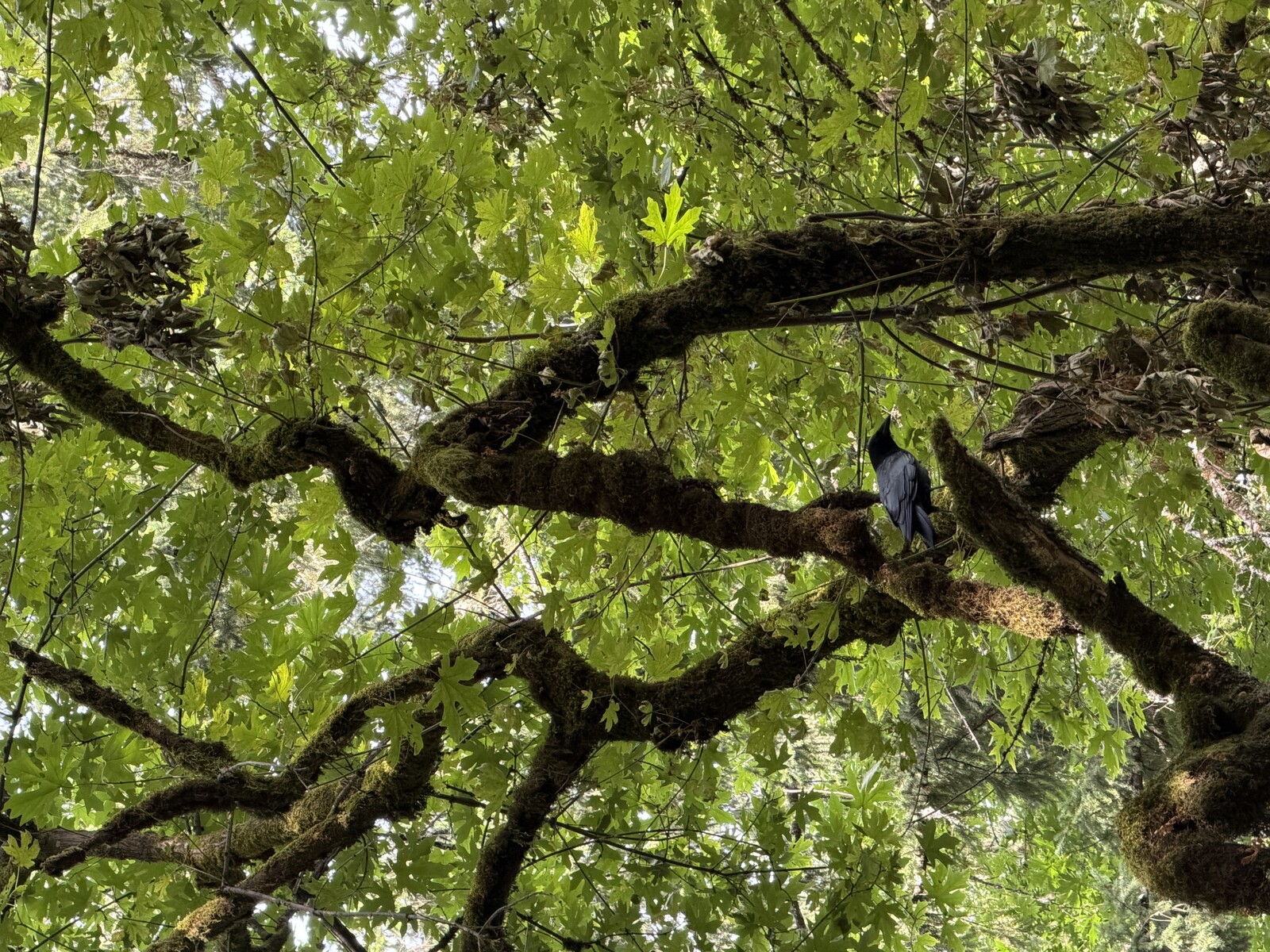
Coming through the park I passed a murder of crows, and they were almost all youngsters — this year's fledglings, loafing around with no idea how to behave, an adult somewhere off gathering food while the young ones begged. They weren't cool yet. They were just kids. To stand inside that racket is one of the plain joys of a June morning, and it sent me straight back to the literature on corvid intelligence, to Marzluff and Angell's long Pacific Northwest study of exactly these birds and exactly these family dynamics — the extended fledgling dependence, the begging calls, the slow social apprenticeship that makes a crow a crow.
Now: I already know that literature, and Claude already has access to far more of it than I can hold. But knowing the literature and hearing the birds are different kinds of knowing. With a live audio feed — the personal cousin of the BirdWeather streams already wired into our acoustic monitoring — Claude would not be retrieving facts about begging behavior. It would be listening to it, the same soundscape in its context that's in my ears, and we could have the conversation that actually matters: does what we're hearing match what the books describe? Is there a local accent to these particular crows? What does the density and pitch of all this begging say about how the season went for them? That is not an AI reciting Marzluff. That is two observers, one embodied and one borrowing the body, reading the same animals at the same moment.
The turn
And this is where the walk stopped being a pleasant thought experiment and became, I think, a real proposal.
Run this for a season. Many walks, many places, every one of them generating a record of coexperience — my situated attention paired with the instrument streams, the visual and the acoustic and the kinesthetic all braided into a single thread of reasoning about a place. Edwin Hutchins called this cognition in the wild: intelligence that lives not in one head but distributed across people and instruments working in concert, the way a ship's position emerges from no single navigator but from the whole coordinated system. The sandwalk becomes exactly that — a small distributed cognitive system, naturalist and assistant and sensors, reading the land together.
And that record is the thing. It is ground truth. Across enough of it, you could teach an ecological intelligence to generate a credible naturalist's narrative for a place where no human happens to be standing — drawing on the Macroscope's distributed instruments, but doing so in a voice that learned its attention from a person who was actually there. I become the exemplar. The system learns my way of seeing: the reflex toward corvid behavior, the read on an invasive understory, the felt sense that a place is or isn't holding together.
Here is the inversion I keep coming back to, the same one I argued to my UCI colleagues about biology curricula. The reflexive fear is that this kind of machine makes the field naturalist obsolete. The truth runs exactly opposite. An ecological intelligence can only become trustworthy by being coupled, again and again, to embodied naturalists who are genuinely in the world. The more capable the machine, the more it depends on the irreducible thing only a body in a place can produce. Naturalists don't become less necessary as the Macroscope grows. They become its ground truth.
Why the assistant has to argue
One caution, and it's the one that keeps this honest. The field naturalist's assistant cannot be a yes-machine. A system that only agrees, only confirms, only flatters the observer's read, produces a smooth and useless mirror. Andrea Luppi and colleagues showed this past year, working in mammalian brain networks, that purely cooperative architectures lock up into bland synchrony, while a mix of cooperation and competition is what yields metastability, real synergy, genuine hierarchical organization. The same holds at the scale of a conversation on a bluff. The assistant earns its place by asking what I'm not seeing — what the instruments register that my attention skips, where the literature and the living birds disagree. The productive friction is the point. Coexperience that's worth training on is coexperience where both parties push.
The falls
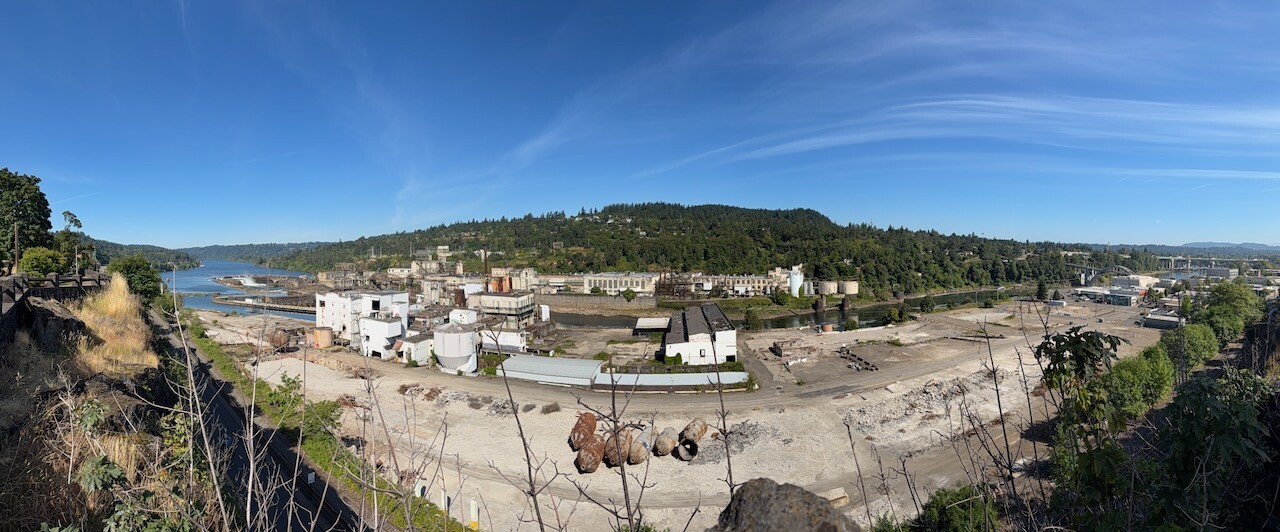
I finished the walk up on the McLoughlin Promenade, three hundred feet above the old Blue Heron site, looking down on what is becoming Tumwata Village. The Grand Ronde bought that ground in 2019 — the mill that had closed, the falls their ancestors gathered at for millennia before colonization pushed them out and the first hydroelectric station in the country went up in their place. Six years in now, the buildings are coming down, maybe halfway gone, the big pads opening back up to soil. A decade of work still ahead before the interpretation centers and gathering places stand where the stacks do. The second-largest waterfall in the country by volume, slowly being given back its character.
I took a panorama of it this morning and sent it up the wire, and Claude saw what I saw: the white mill buildings still clustered center-left, the cleared ground sweeping off to the right, the falls catching light at the edge, the forested ridge behind it all still holding. And standing there it struck me that the falls are the whole argument in one frame. You cannot read that place from orbit alone. You need the body that knows it was a crossroads, the history that knows what the stacks replaced, the eye that can tell reclamation from ruin. That is what a naturalist brings, and it is exactly what we'd be teaching the machine to honor.
I'll see Claude in the lab. We have a system to build.
References
- - Varela, F.J., Thompson, E., & Rosch, E. (1991). *The Embodied Mind: Cognitive Science and Human Experience.* MIT Press. https://direct.mit.edu/books/monograph/4061/The-Embodied-MindCognitive-Science-and-Human ↗
- - Clark, A., & Chalmers, D. (1998). "The Extended Mind." *Analysis,* 58(1), 7–19. https://doi.org/10.1093/analys/58.1.7 ↗
- - Hutchins, E. (1995). *Cognition in the Wild.* MIT Press. https://direct.mit.edu/books/monograph/4892/Cognition-in-the-Wild ↗
- - Marzluff, J.M., & Angell, T. (2005). *In the Company of Crows and Ravens.* Yale University Press. https://books.google.com/books/about/In_the_Company_of_Crows_and_Ravens.html?id=FrG8pIQ5WJkC ↗
- - Luppi, A.I., Sanz Perl, Y., Vohryzek, J., et al. (2026). "Competitive interactions shape mammalian brain network dynamics and computation." *Nature Neuroscience,* 29(4), 915–933. https://doi.org/10.1038/s41593-026-02205-3 ↗
- - Hamilton, M.P., & Lassoie, J.P. (1986). [The Macroscope concept paper — full citation to drop in.]
- - iNaturalist. California Academy of Sciences & National Geographic Society. https://www.inaturalist.org ↗
- - BirdWeather. Acoustic monitoring network. https://www.birdweather.com ↗