
A World Where Nothing Gets Eaten
The birds started before I did this morning. I was still assembling myself around the day's one cup of coffee, watching the light come up over the Willamette, working through Three Quarks Daily the way I do most mornings, when I came to a new essay by Marie Snyder. Her byline is one I look for — she tends to write from a place I already stand — and the subject this time was climate, which promised lighter reading. It was not lighter reading. It was a piece about climate inaction that detoured through infant psychology and a Hindu goddess of brokenness before it was done — and somewhere in the middle of it, groggy and half-caffeinated with the birds going full chorus outside, I felt a bridge swing into place between two halves of my life I had never quite joined. This is my attempt to walk you across it while it is still standing.
Let me start with trees, because that is where the essay started me.
The map where nothing gets eaten
You have probably heard the good news about trees. They cooperate. Beneath the forest floor, threaded through the roots, runs a fungal network — the "wood wide web" — through which trees are said to share sugar with their neighbors, nurse their seedlings, even warn each other of danger. A dying elder pumps its last reserves into the young. It is a beautiful story, and it sells: the book that made it famous sits face-out in airport shops between the thrillers and the diet plans, because it tells us something we ache to hear — that nature, underneath all the competition we were taught to expect, is really a community of mutual care.
I have spent a career in the field, and I want to be careful here, because the story is not false so much as it is convenient. In 2023 three ecologists published a sober review of the actual evidence and found that the popular claims had run miles ahead of anything anyone had measured. The sharing is patchier, the nursing more doubtful, the network less a benevolent internet than a messy tangle in which fungi pursue their own interests and sometimes rob the trees blind. The real forest is cooperation and theft and competition and indifference, all at once, all the time.
So why did the cooperative version travel so far? Here is the thing I keep circling. It is a map on which nothing ever gets eaten. Everyone is sharing; no one is prey. And a picture of the world where nothing gets eaten is enormously comforting, precisely because there is nothing in it that can be proven wrong by dying. It is safe the way a daydream is safe.
The fox
Now let me put the missing thing back.
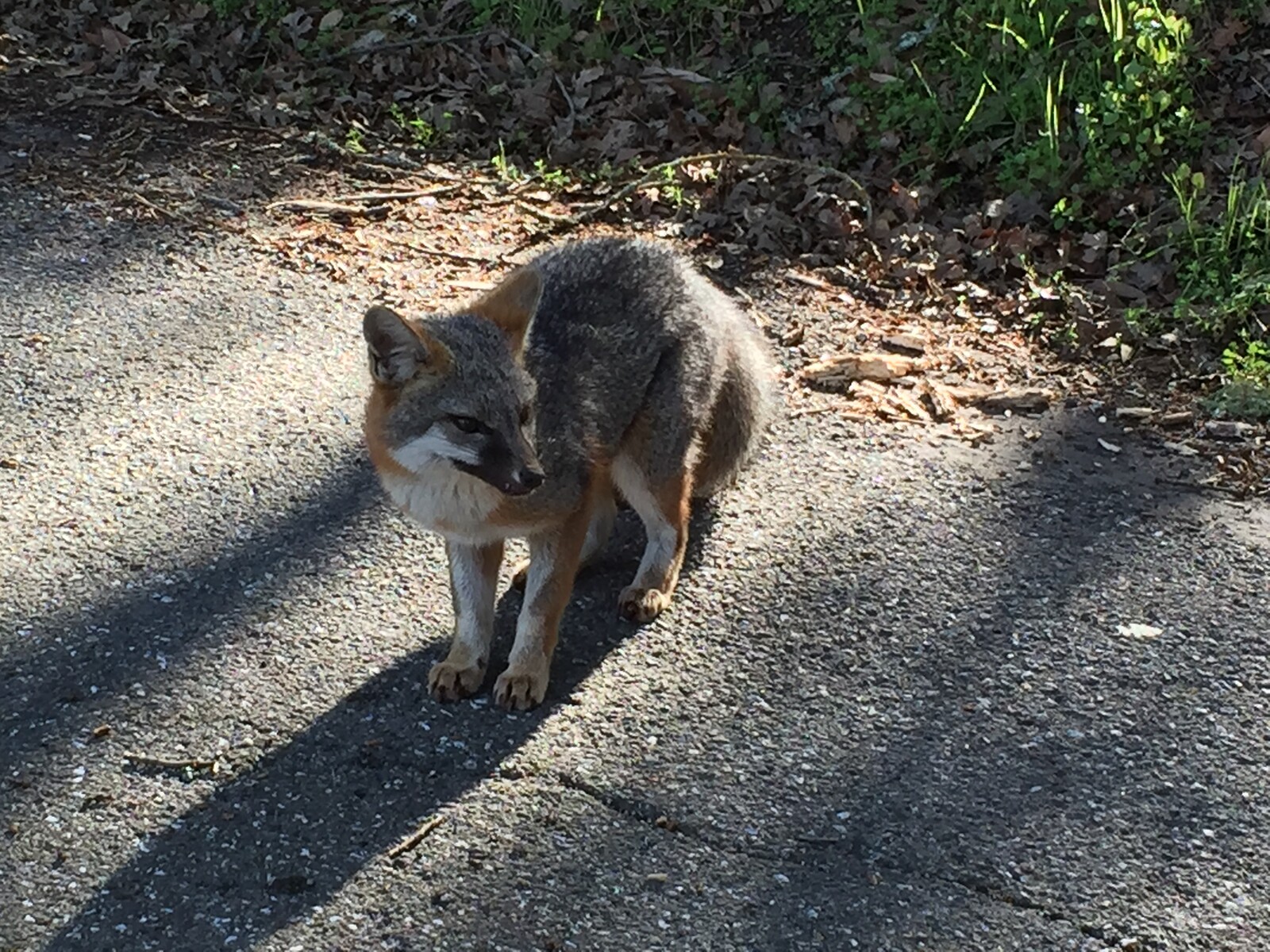
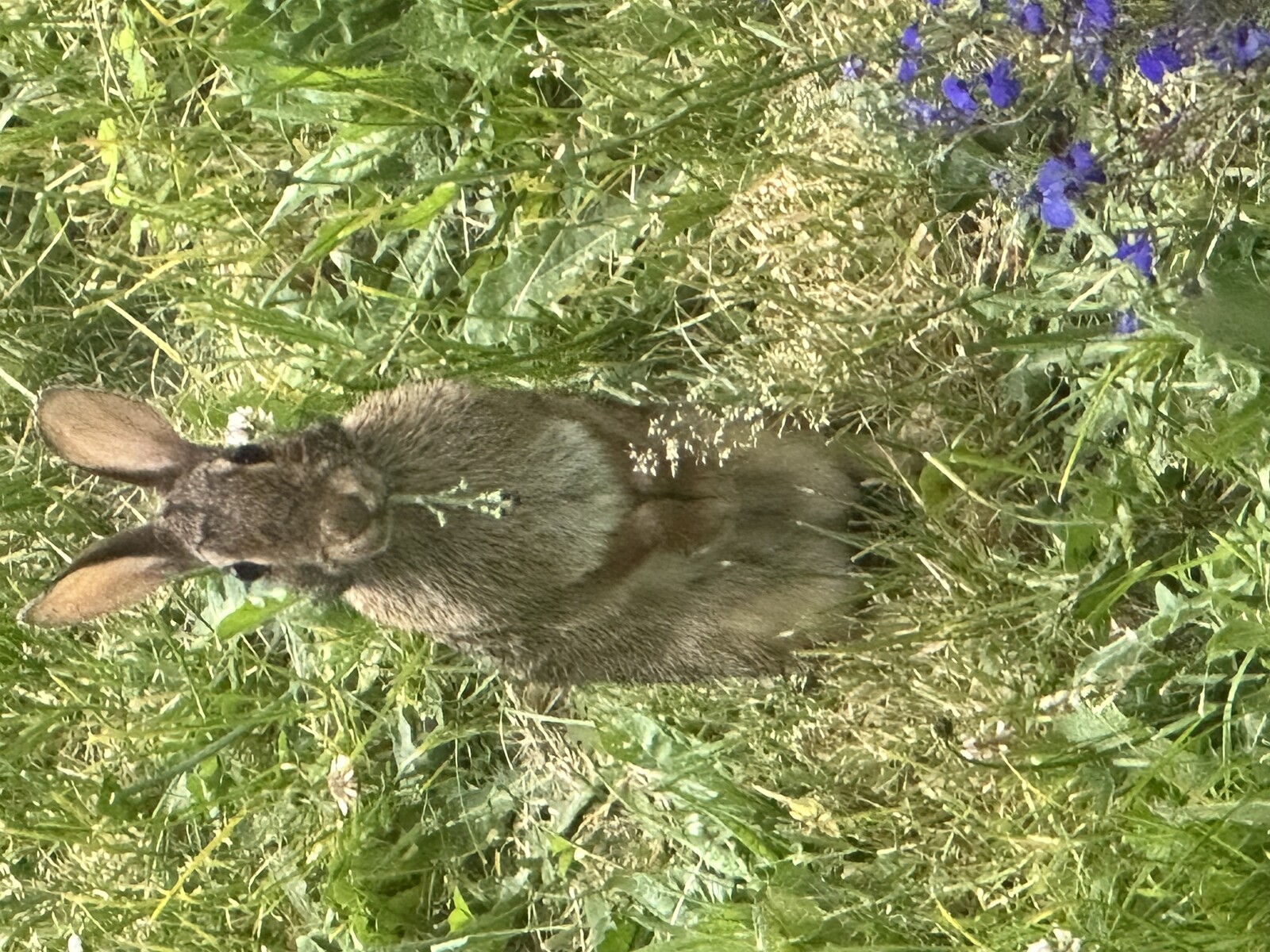
Picture a hare in a meadow. The hare's whole life is a stream of predictions: that patch is safe, that shadow is only a cloud, I can reach the hedge before the thing at the tree line reaches me. Most of the time the predictions hold and the hare goes on being a hare. But there is a fox at the tree line, and the fox is the part of the world that gets to say no. When the hare's prediction is wrong badly enough, the fox corrects it, and the correction is fatal.
That loop — guess, then get corrected by a world that can kill you — is, as far as anyone can tell, the whole engine of living intelligence. A recent piece in Quanta on what makes life different lands on exactly this: the neuroscientist Karl Friston argues that a creature has real agency when it can predict an outcome, compare the prediction against what actually happens, and work to shrink the gap between them. Predict, measure, correct, repeat. No mysticism required. Just a loop with a stake welded to it.
Darwin found the oldest version of that loop a long time ago. Natural selection is nothing but the fox at planetary scale: four billion years of guesses, every bad one eaten before it could breed. Life never once got to hold a belief the world couldn't overrule. The fluency and the correction shipped as a single part, always, enforced by death before lunch.
Which gives us a clean way to tell two kinds of knowing apart. There is the comforting kind, where being right means leaning toward a pleasant direction — more cooperation, more harmony, more hope. And there is the real kind, where being right means surviving a collision. The cooperative forest is the first kind. The fox is the second.
Why we love the foxless map
Snyder's essay offers a lovely diagnosis of why we reach for the comforting kind. Drawing on the psychiatrist Frank Yeomans, she describes the infant mind, which cannot yet hold "the mother who feeds me" and "the mother who is absent" as one person. The world splits into all-good and all-bad, heaven and hell, and the baby lives in whichever half is present. Growing up means integrating the two — accepting that the same person, the same world, is both, and mourning the perfect version that never existed.
Here is the part almost everyone skips. Yeomans is emphatic that the all-good half is just as false as the all-bad half. A mind stuck in idealizing is as detached from reality as a mind stuck in paranoia.
And that, I realized as the cup went down, is exactly what the cooperative forest is. It is the idealized half of nature — the nurturing Mother Tree — with all the aggression sliced off and shipped back to the villains of the old "nature red in tooth and claw." We did not outgrow the split. We just moved to its sunny side and called it wisdom. Growing up, for an ecologist, means welding the halves back together: a forest that shares and steals, cooperates and devours, its boundaries renegotiated every single day. It means putting the fox back in.
The machine that only teases the fox
I should tell you what I do, because this is where it stops being philosophy. In my retirement I have been building what you might call a digital twin of a small piece of the world — a lifetime's worth of sensors reading one place, thousands of measurements a day, an attempt to read the world honestly from a single point. The whole AI industry is now chasing a grander version of the same dream. They call them "world models": systems that do not merely describe the world in words but learn how it behaves and simulate it forward. A recent TIME essay by Celine Herweijer makes the case that these could finally deliver honest forecasts of oceans and carbon and ice.
I hope she is right. But I have watched my own instrument closely enough to see the catch, and it is the same catch. A world model does not contain a fox. It contains a model of the fox. It tests its predictions against its own learned expectations, not against the world — a hare that has studied the predator so thoroughly it believes it need never meet one. Herweijer, to her credit, names the wall herself: a world model cannot forecast a situation the Earth has never entered, because there is no data from the far side to learn from. The map goes blind at precisely the edge where the stakes turn lethal.
My own twin does something sneakier, and it taught me the lesson in miniature. Collect millions of measurements at once, then ask how they relate to something simple — say, how I feel on a given morning — and the machine will always find an answer. Something in that ocean of trendlines lines up with my Tuesday every time, not because it explains anything but because with enough lines, something always does. The twin does not discover the cause of my mood. It teases one. It murmurs: maybe the pollen, maybe the pressure drop, maybe the poor sleep — and it is never once at a loss for a suspect.
And "how I feel" turns out to be no firmer than the sensors, because a feeling is not a reading of the world either. It is the body's own prediction of its own state — one more guess wearing the costume of solid ground. So the real hazard in my whole enterprise is two maps shaking hands and mistaking it for touching the earth.
The one thing with actual teeth is the gap between them: the morning the sensors report clean air, calm weather, a full night's sleep — and I feel like hell anyway. That disagreement is the only fox in the system. And it cuts both ways. Sometimes the gap means there is a measurement I have not learned to take yet. Sometimes it means the feeling is about something no instrument on this river will ever read.
The fox lengthens
That is where the morning's bridge actually swung, and it is the idea I most want to hand you. The correction loop — the fox — gets longer as you climb from the self toward the world.
For me, the fox is tomorrow. Guess wrong about my sleep or my limits and the correction arrives fast, in my own body, on my own clock. For a household it is a season — the winter the heating bill or the failed backup teaches you what you got wrong. For a forest it is years — the seedlings that do not return, the bloom that arrives three weeks early. And for the Earth's climate the fox runs on a clock of decades, with one merciless twist: the correction does not land on whoever made the bad prediction. It lands downstream, on people not yet born.
That, and not any shortage of science, is the true pathology of climate. It is not that there is no fox. It is that the fox is enormous, and lethal, and thirty years late, and aimed at the wrong body to correct anyone in time to matter. Every feedback loop humans have ever failed at — every debt, every slow collapse — has exactly this shape.
So: collision, or course correction?
Which finally lets me answer the question the morning left ringing. Are we and the climate on an inevitable collision course — or can millions of people steer the way a single person cannot?
Notice that the question smuggles in two certainties: doom (it is fated) and hope (we will be saved). Rebecca Solnit, whom Snyder leans on, has the line that dissolves both. A false certainty that everything is going to hell and a false certainty that it will all work out are the same drug, because each one hands you permission to stop acting. Neither is knowledge. Both are foxless maps of a future that has no far side to send back data.
So the honest answer is not a point between doom and hope. It is this: the collision is not fated. Foxlessness is merely the default — what happens when no one builds the loop — and you beat a default the only way defaults are ever beaten, one closed loop at a time.
But you have to build the loop at the right scale, and here the doomers and the hopers both pick the wrong unit. The lone self is too small to hold a climate-fox — your personal footprint is the trendline that always correlates and never bites, which is exactly why the very idea of a "personal carbon footprint" was popularized, famously, by an oil company. It pins the loop at the one scale where it can turn nothing. And "humanity" is too big — a we so vast it commits no one to anything. The unit that can actually hold a climate-fox is the corrigible collective in between: the city, the utility, the watershed, the insurer. Watch where the sharpest correction is biting right now and you find it there — insurers walking out of Florida and California, a prediction meeting a measurement and losing, in dollars, this quarter, on a clock people can feel.
Sensing is not steering
Let me be my own fox for one last moment, because seeing the rocks is not the same as turning the ship. Feedback only steers a vessel if it is wired to a rudder. And that, precisely, is where a culture of hard individualism does its damage — not, as the gentler essays would have it, because "everything is secretly connected," but for a blunter, more mechanical reason: it cuts the wire between the person who can feel the disagreement and any collective strong enough to act on it while there is still time. It leaves us with reach — billions of hands remaking the planet — bolted to no depth, no loop anywhere with the authority to make the remaking lose to a measurement before the bill comes due. The peril was never disconnection as a metaphysics. It is unwired foxes.
Why I believed it before the cup was empty
So here is what swung into place this morning, and why a naturalist's retirement project stopped feeling like a hobby before the cup in my hand was even empty.
Everything I have spent my life building — the sensors, the twin, the stubborn ambition to read the whole world from one small point above a waterfall — is an attempt to do one thing: take that far, slow, downstream, lethal climate-fox and drag it close enough that a living person can feel its breath today. To put the far fox on the near clock. Not to predict the collapse — no map can do that from this side of it — but to instrument the approach so densely that the ground tilting underfoot becomes something you can measure before you fall.
That does not make our course correction inevitable. Nothing makes it inevitable. It only makes it possible — which is, I have decided, the only honest thing anyone can offer against both the doom and the hope.
And the smallest proof of the method was sitting right there in my kitchen. A morning of essays, a flood of half-formed inputs, one groggy human signal, and the gap between them resolving into a direction to walk. One skull, one cup of coffee, the whole loop closed in miniature. If it can work there, it can work on a delta, and a watershed, and — loop by patient loop, collector by collector — maybe on the only home we have.
The birds, for the record, had it figured out long before I did. They just never mistook the map for the meadow.
References
- - Snyder, Marie (2026). "Is Climate Inaction from Peak Individualism?" *3 Quarks Daily*. https://3quarksdaily.com/3quarksdaily/2026/07/is-climate-inaction-from-peak-individualism.html ↗
- - Herweijer, Celine (2026). "World Models Are AI's Next Frontier." *TIME*. https://time.com/article/2026/07/15/world-models-are-ai-s-next-frontier/ ↗
- - Solnit, Rebecca (2025). *No Straight Road Takes You There: Essays for Uneven Terrain*. Haymarket Books.
- - Karst, Justine; Jones, Melanie D.; & Hoeksema, Jason D. (2023). "Positive citation bias and overinterpreted results lead to misinformation on common mycorrhizal networks in forests." *Nature Ecology & Evolution* 7.
- - Ball, Philip (2026). "Is Life Just Different?" *Quanta Magazine*. https://www.quantamagazine.org/is-life-just-different-20260708/ ↗
- - Friston, Karl (2010). "The free-energy principle: a unified brain theory?" *Nature Reviews Neuroscience* 11, 127–138.