
Known, Not Owned
When I launched Science with Claude in May I promised a laboratory rather than a diary, and I said the rooms would be working surfaces where reading and doing share a page. Four months in, the honest report is that I have been doing more than writing. That is deliberate. Somewhere in August I decided that this site had enough essays about what the Macroscope might become and not enough demonstrated results that another scientist could pick up, run, and argue with. So the mornings still begin with coffee and Claude, but most of them now end in the lab.
Here is where the lab stands. The Collaboratory, the investigation framework at the center of the Macroscope, saw first light in April. Since then we have been building what I think of as the v3 substrate underneath it: a PostgreSQL backbone for every new piece of Macroscope work, a context engine called STRATA that gathers three things about any place before a question is asked of it (what is known about the place, what instruments are listening there, and what the literature has already said), and a seven-phase investigation workflow rigid enough that someone else could reproduce it. Semantic Scholar is wired in as the literature worker. A free local language model runs the summarization at zero cost, which matters for a solo laboratory that intends to scale. The near-term goal is unglamorous: a backend that could carry thousands of monitoring nodes without anyone having to babysit them. A few more months, if the work goes as it has been going.
What I did not have, until this morning, was a clean statement of the ethical shape of the thing. Cory Doctorow gave me one without meaning to.
Property Talk
Doctorow's essay today is about scraping, and about why he thinks the argument against it has been rigged before it starts. His claim is that fifty years of market thinking have trained all of us, critics included, to argue about information as if it were property. If scraping is theft, then the remedy is a purchase, and the only parties who can afford the purchase are the companies already sitting on the money. Privacy, he says, is a human right, not a property right; you cannot sell it any more than you can sell a kidney to make rent, and a world that prices it will be a world in which the poor sell theirs and the rich keep theirs. Creative labor, likewise, is a labor issue, and the Hollywood writers won their fight with a union contract, not a copyright claim.
The part that stopped me was his defense of what academics have started calling unpermissioned research. Ethan Zuckerman, who studies how platforms shape what billions of people see, has just moved his lab from Massachusetts to McGill, one of dozens of American researchers relocating to Canada, and his announcement is frank about why: the work depends on scraping platforms that would never grant permission to be studied, and the climate for doing that in the United States has turned. Tech Policy Press has documented the same pressure from the AI companies themselves. Doctorow's point is that the harms scraping can cause are real, but they are harms to privacy, to labor, to people, and those frameworks can address them without handing every corporation a veto over who is allowed to look at it.
I read this as a person who has spent a career handling other people's data, first as a field station director and now as the builder of a system whose entire purpose is to gather, cache, and redisplay information about places. So the natural question over coffee was: is anything we do in the Macroscope a scraping violation, or an ethical wrong?
The answer turned out to be no, and the reason it is no turned out to be the design of the whole project.
What the Macroscope Actually Does
The Macroscope works from a coordinate outward. It hosts government data outright, the federal and state layers that are public domain by law and were built to be mirrored. It reaches citizen science platforms such as iNaturalist and eBird through their sanctioned interfaces, on demand, and keeps a local cache so that a curated place loads quickly and still works when the fiber to the house is down. That is not scraping in Doctorow's sense, which is specifically the circumvention of limits a platform erects to hide its own conduct. It is what the platforms ask well-behaved clients to do; iNaturalist's own guidelines tell developers to cache rather than hammer the servers. The project is non-commercial and educational, which dissolves the license questions that would otherwise attach to non-commercial content.
The obligations that remain are exactly the ones Doctorow says matter more than property. Observers are people, and a username plus a precise coordinate plus a timestamp can reveal where someone lives or walks; the platforms obscure locations for sensitive species and private land for that reason, and a redisplay must honor those rules rather than reverse them. The observers and identifiers did the work, so attribution is not a legal nicety but the labor half of the question. And Wikipedia's current misery, being knocked offline by AI crawlers that have every legal right to its Creative Commons text, is a reminder that the most common harm in this space is not theft but denial of service. Politeness toward a small nonprofit's servers is an ethical act.
None of those obligations is a burden. They are what a naturalist would do anyway.
Curators, Not Platforms
The deeper design decision is one I had already made and did not know how to defend until today. I do not want the Macroscope to be a social platform. Every curated place has a curator, a person who works there, who knows it, and who decides what information is appropriate to fold into the place's record. I do not make that determination. They do.
Yesterday I published an essay about a ponderosa pine at the James Reserve that I lived beside for twenty-six years and that died this summer. In writing it I noticed something about that tree that bears directly on the argument here. Nobody ever measured it with any authority. There are three heights in circulation and no consensus on its age. It was cored once, and the cores should still be in a museum cabinet. It sat on a spring, and I believe the water is what kept the beetles off for four centuries. It had a name, given by the caretaker who scattered the ashes of the couple who saved the land at its base. All of that is knowledge, and almost none of it exists in any database. A student who arrives at that canyon with a phone full of iNaturalist observations knows the tree is a Pinus ponderosa. Only a curator can tell her about the spring.
That is the difference between a field guide and place-backed ecological intelligence. Data is what a platform aggregates. Knowing is what a curator does, and the Macroscope's job is to give the curator a surface to put that knowing on, alongside the data, so that the next person to stand under the tree inherits both. Doctorow's line about human beings being too valuable to price applies, in a smaller register, to places. A reserve is not a dataset with a fence around it. It is a relationship, and relationships have stewards, not owners.
The Reserve Student
The first real deployment of the v3 Macroscope, once the backend is finished, will be at the biological field stations of the University of California Natural Reserve System. I know that culture and its administration better than any other, and I have colleagues at every station who will work with me on it. It is the low-hanging fruit, and it is also the hardest ethical case done in the safest setting: adults, institutional rules, a designated curator, and a century of precedent about what visiting researchers may do with what they find.
Picture the app. A student arrives at a reserve for a week and opens the Macroscope for that place. It already knows what the curator has assembled: the weather record, the phenology, the acoustic detections from a monitor on the ridge, the theses written there, the spring under the tree. She keeps a field notebook that lives on her own device, private by default, hers to export and hers to delete. When she sees a bird, the app does not ask her to type it into the Macroscope; it sends her to eBird or iNaturalist to enter it under her own name, where it joins the global commons with the platform's privacy rules already in force. The Macroscope holds no observations of hers at all.
What it can hold, if she and the curator agree, is her study. This is the thing a field guide cannot do. A field guide answers what is this; a study asks what is happening here and how would I find out. The seven-phase workflow is a scaffold for that second question, and the record it produces is a scholarly artifact rather than personal data: the question, the design, the pointers to where the observations live. Offered to the curator, it enters the place's knowledge context for the next student. Over a decade a reserve accumulates not just data but a lineage of inquiry, which is what field stations have always been for and what almost none of them can show a visitor. The test I have set myself is whether a student's study, five years on, can be read and re-run by another student at the same place.
The Backyard Node
At the far end of the scale from a research reserve is a family in Oregon City or Portland or anywhere who wants their children to start collecting kid-friendly data from the yard and contribute it toward a better understanding of where they live. This is the end where Doctorow's essay bites hardest, because here the place is a home and the observers are children, and the fact he raises about private information not being a rival good applies literally. A family's moth trap, their first hummingbird, the nights the barred owl calls: all of these describe the neighbors' yards nearly as well as their own.
So the design question at this end is not whether families may contribute. It is what the unit of contribution is. The curated place is the household, private, with a parent as curator. The shared unit is a neighborhood grid cell or a small watershed. A child sees her own bird at her own feeder; the neighborhood learns that hummingbirds arrived four days earlier this year across thirty yards. Nobody's data appears at a resolution finer than the question requires, and the observations themselves still go to iNaturalist under a family account. What the Macroscope adds is what it adds at the reserve: context and inquiry. This is the first one this year. The salal is early too. The monitor down the block heard the same species yesterday. What do you think is going on?
That is how citizen scientists are made, and it is the pipeline field stations have wanted for a century without a way to build it: the backyard child becomes the reserve student becomes the one who writes the study the next student re-runs.
Nothing Here Is Stolen
I came to Doctorow's essay expecting an argument about AI and copyright and found instead a set of design rules for a project I have been building since 1984. Curators, not platforms. Investigations, not observations. The household as the private unit and the watershed as the shared one. Attribution as a labor right, obscuring as a privacy right, politeness to servers as a form of care. None of it requires owning anything, and none of it can be bought.
This essay is itself built on Doctorow's text, which he publishes under a license that lets anyone use it for any purpose so long as they say where it came from. I have said so. That, in the end, is the whole of the ethic: the tree was known, not measured, and the Macroscope is meant to be known, not owned.
References
- iNaturalist (n.d.). "API Recommended Practices." https://www.inaturalist.org/pages/api+recommended+practices ↗
- Hamilton, M. P. (2026). "Science with Claude: An Introduction." *Science with Claude*, May 9, 2026. https://sciencewithclaude.com/post.php?slug=coffee-with-claude-an-introduction ↗
- Hamilton, M. P. (2026). "An Ode to a Tree." *Science with Claude*, September 1, 2026. https://sciencewithclaude.com/post.php?slug=an-ode-to-a-tree ↗
- Tech Policy Press (2026). "AI Companies Threaten Independent Social Media Research." https://www.techpolicy.press/ai-companies-threaten-independent-social-media-research/ ↗
- Zuckerman, E. (2026). "My personal contribution to the US-Canada trade war." *ethanzuckerman.com*, August 27, 2026. https://ethanzuckerman.com/2026/08/27/my-personal-contribution-to-the-us-canada-trade-war/ ↗
- Doctorow, C. (2026). "Unpermissioned research." *Pluralistic*, September 2, 2026. https://pluralistic.net/2026/09/02/scrape-scrope-scrap/ ↗
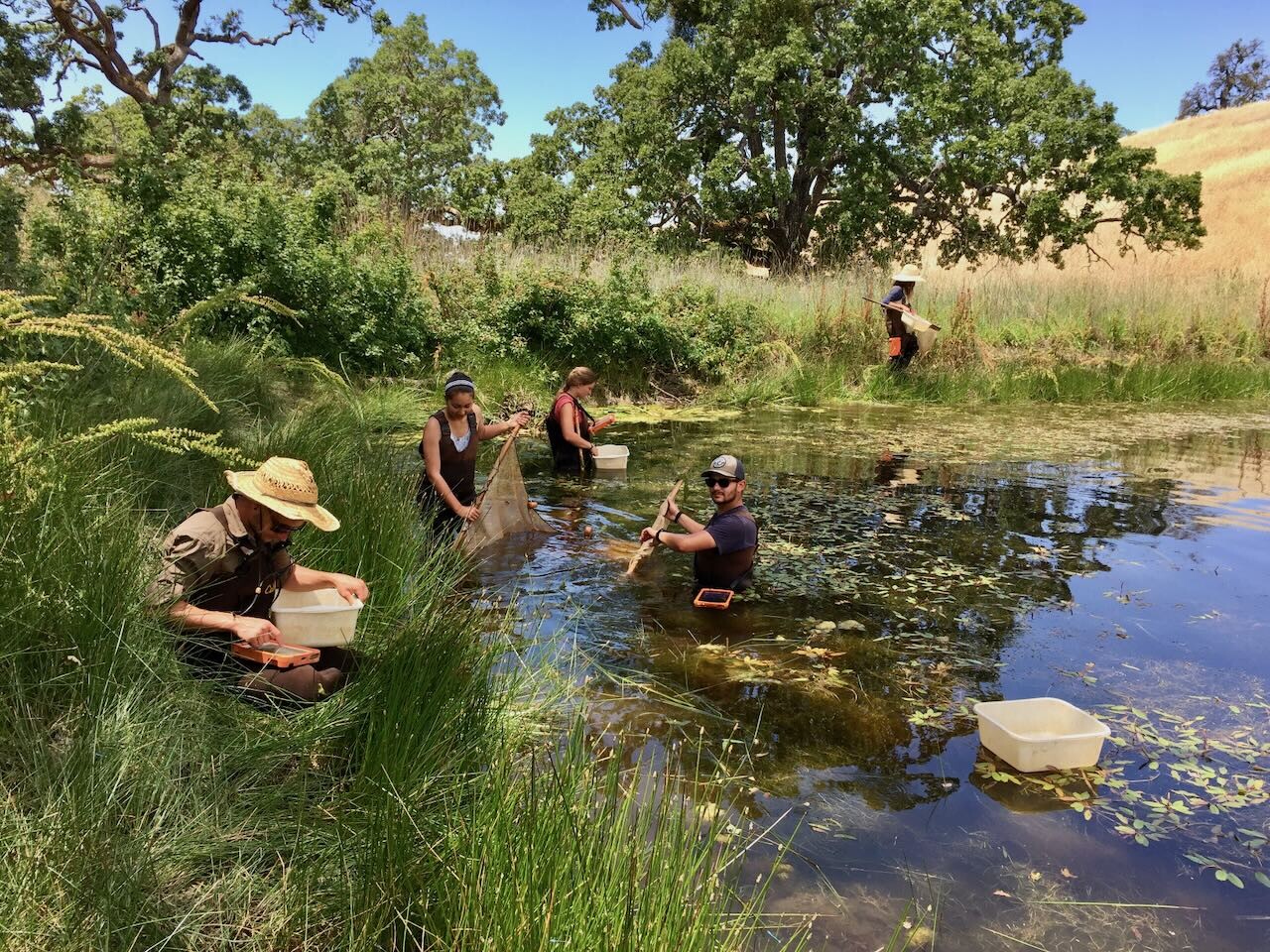
- Hamilton, M. P. (2021). “Turtle Pond Field Work.” Third place, Faces of Biology Photography Competition, American Institute of Biological Sciences. BioScience 71: 327–329. ↗