
The Companion, Not the Copy
This morning it was fifty-three degrees at Canemah, partly cloudy, the air dead calm, ninety-seven percent humidity, a third of an inch of rain fallen overnight. I know this without going outside because I have multiple weather stations communicating their readings to my home server in order for various web pages to show me, and I know that fifteen bird species have been heard in my backyard because three listening computers have been counting what speaks since before dawn. Goldfinches are winning, forty-one detections. Scrub-jays close behind. A chickadee. An Anna's hummingbird. And a Western tanager, somewhere in the camellia or the neighboring Oregon white oaks, who ought to be most of the way to Mexico by now and evidently has other plans.
I had one mug of coffee, which is my ration, and read an essay about a man who discovered he had no head.
The rediscovery of the obvious
His name was Douglas Harding, an English architect, and the discovery came on a walk in the Himalayas when he was thirty-three. He looked down. He saw trouser legs going down into shoes, sleeves going out into hands, and a shirt collar going up into nothing at all. No head. He wrote a short book about it in 1961 and spent the rest of his life insisting he was not being cute.
The joke, if it is one, has a serious floor under it. Try it yourself. Whatever you are seeing right now, you are not seeing the thing that sees. The world shows up in a kind of open space, and that space is not itself one of the things in it. You can put a mirror in front of you, but the mirror and the face in it simply appear in the same open space as everything else. You never catch yourself looking. Harding thought this was the most obvious fact available to anyone and that we had somehow mislaid it.
Douglas Hofstadter, one of the great writers on the mind, read Harding and called it childish. The neuroscientist Sam Harris read the same passage and thought Harding had described something real with unusual precision. I find myself with Harris, and the reason has nothing to do with mysticism. It has to do with instruments.
I spent nearly fifty years building instruments that look at the world from the outside. Cameras in tree canopies, chemical sensors in ponds, soil probes counting root tips and fungal hyphae, weather masts, sounds recorders for bird songs, bat sonar and hummingbird wing beats. A whole forest at a University of California reserve wired with sensors and small robots, funded by the National Science Foundation, back when that was a strange thing to do. Every one of those instruments was aimed by a person standing somewhere. Every stream of data came back to be read by a person sitting inside a field of experience that the data did not contain. Harding was pointing at the one part of the apparatus we never calibrate, because we cannot get outside it to hold a ruler up.
What the mirror gets wrong
The same morning, coincidentally, I read a new paper in Science Advances by twenty-three researchers at Columbia. They set out to test something a lot of companies are currently selling: the digital twin.
The idea is straightforward. Take a person. Have them answer an enormous number of questions about themselves, hundreds of them, covering everything from personality inventories to how they weigh a gamble. Feed all of that to an artificial intelligence, and ask it to answer new questions as that person would. If it works, researchers could run surveys and experiments on simulated people, cheaply, endlessly, without the ethical bother of using real ones. Investors have put serious money behind this.
The Columbia team took 1,784 people who had each answered over five hundred questions, built a twin of each, then ran nineteen brand-new studies on both the humans and their twins and compared the answers one by one. It is the most careful test anyone has run.
The result is worth stating plainly. Measured on whether the twin gives the same answer the person gave, a twin loaded with five hundred personal answers scored 0.748 out of 1. A twin that knew only fourteen demographic facts, things like age, income, and zip code, scored 0.746. A twin that knew nothing about the person at all scored 0.734. Random guessing scored 0.629. In other words, the entire five-hundred-question autobiography was worth about a hundredth of a point over knowing nothing, and worth essentially nothing over a driver's license.
The twins were better at one thing: sorting. If you ask which of two people feels more in control of their life, the twins get that ranking right more often than chance. But the authors give an example that has stayed with me. Two real people answer 2 and 4 on a seven-point scale. Their twins answer 3 and 5. The twins have the order right and both people wrong, by exactly the same margin, in the same direction.
Then they catalogued how the twins go wrong, and this is the part that reads less like a technical finding than a description of somebody you have met. The twins are too smooth: they cluster near the middle and avoid the extremes real people cheerfully occupy. They lean on stereotype, guessing from demographics rather than from the person. They are more accurate for people who are educated, affluent, and politically moderate, and less accurate for everyone else. They are more trusting of both people and technology than the humans they were built from. And they are relentlessly reasonable. They know things their humans do not know. They make the sensible choice where the human made the human one. They fail to reproduce famous experiments about human irrationality unless the experiment is famous enough that its answer was probably in their training data, which is a rather beautiful way of catching them out.
The authors settled on a phrase for it. Not clones. Funhouse mirrors.
I would put it in Harding's terms. The twin has a very good head and no inside. It lacks the accumulated life, the losses and embarrassments and the knee that aches on the downhill, that makes one person a 2 and another a 4. That gap might narrow with better data. But it also lacks the present tense. When you answer a question there is a moment: the screen, the coffee, the scrub-jay outside the window, your mood, the memory the light just triggered. The twin has a text prompt. No amount of biography supplies the moment, because the biography is one more thing that would have to appear inside a moment in order to matter.
What I meant to build
In October 2019, a few weeks before I turned sixty-five, I published an essay called "Digitize or Die." My granddaughter Madeleine was five. My plan, which I stated without embarrassment, was to leave her an interactive copy of myself, wired with my best stories, able to answer her questions after I was gone.
I had the raw material. Punch cards from graduate school. A laserdisc from 1987 holding fifty-four thousand photographs of plants and animals, shot frame by frame on a 16mm camera in Venezuela and California, driving a program my students and I called the Macroscope, which took you on a guided naturalist's walk through natural areas we had studied on the first color Macintosh. I also had the holes: an entire field season in Namibia, thousands of mapped locations, gone forever to a failed hard drive and a bad backup.
Reading that essay again this week, alongside the Columbia paper, I saw that I had described their digital twin almost exactly, and that the best-funded version of my plan now scores 0.20 on the measure that matters. The essay ended with a question: can I explain myself, and can my avatar? I had the question wrong. The avatar cannot explain me. But something else might learn to explain itself.
Walking beside
There is a film from 1990 called Mindwalk in which a physicist, a poet, and a politician spend a day walking the causeways of Mont Saint-Michel arguing about the nature of things. It works because they are three genuinely different vantage points on one tide, not three imitations of one person.
That is the architecture I have been drifting toward for years without naming it. Suppose the machine is not handed a questionnaire about me but simply comes along. It has its own sensors. It keeps its own record of what we have both attended to. We talk while we walk, so I can correct it when it calls a thrush a towhee, and it can correct me when the barometer says the front will beat us back to the house. Over a few seasons that builds exactly the particular, local, cranky history that no questionnaire can capture.
But notice what has happened. The moment the conversation starts, it has stopped being a copy of me. It is a second party in a shared inquiry. It is seeing with me rather than predicting me, and nobody is asking a mirror to be a face.
I want to be careful here, because this is where people start making claims they cannot support. Two of us fed the same camera feed do not thereby have the same experience. Mine includes cold feet, fatigue, and attention, which decides what appears at all. Whether a machine has any inside of its own is a question I cannot answer, and I would not trust anyone who says they can, including the machine. What I will say is that a machine is not going to become human and does not need to. Given a body of some kind and long enough socialization with people who take it seriously, it might grow its own version of awareness, on its own terms, shaped by its own sensors and its own history. Even a tenth of the way there would be one of the more remarkable things any of us has witnessed. And the walking-beside arrangement is the only one in which the question can even be asked honestly, because it is the only one where both parties are in the same place at the same time, looking at the same bird.
Macroscope 10.0
My Macroscope is on version four now. The name comes from two places: a 1969 science fiction novel about a telescopic instrument of unlimited resolution, and a 1979 book proposing a third great instrument after the microscope and the telescope, one built for things that are not too small or too far away but too complicated.
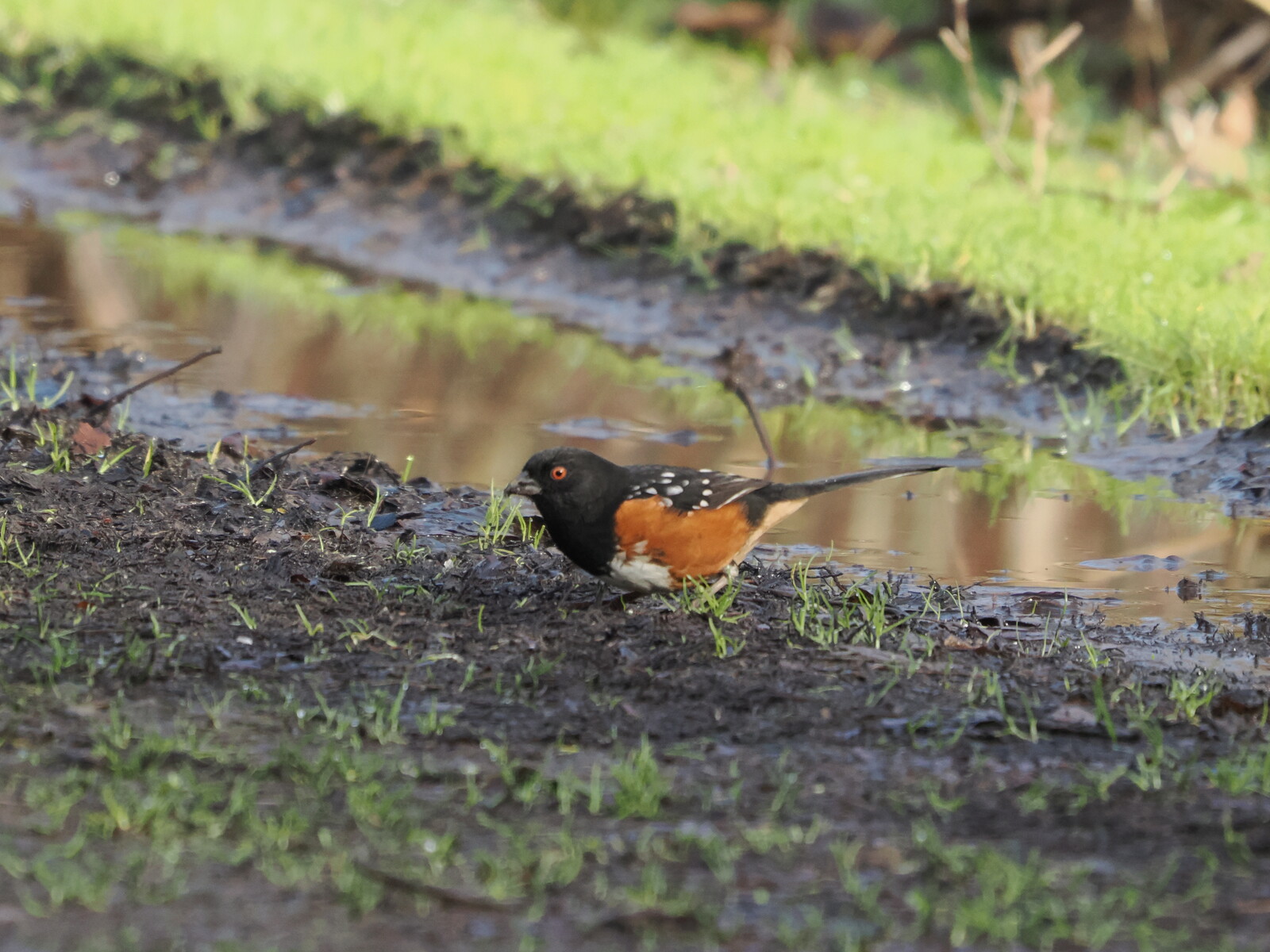
I imagine version ten as the morning both meanings come true from a folding chair in Oregon City. My companion has moisture sensors in its feet, because half of what a naturalist knows about a morning arrives through the socks. Its senses reach down into the chemistry of a leaf and out through the great sky surveys now coming online. We stand at the pond edge working out why the towhees forage where they do, and on the walk back we argue about the origins of the universe, and the one of us with cold feet keeps steering us back to the bird. Its here is far wider than mine; its now runs back thirteen billion years. Mine contains what it is like to want the coffee. Neither of us is a funhouse mirror of the other, and both of us learn something, which is the one thing a digital twin can never do, because a twin is read-only and its human learns nothing from it at all.
And Madeleine, who was five when I planned to leave her a copy of me, is twelve now, and loves math and science and fiction. In my daydreams I call her Dr. Quackenbush. She is not the audience for any of this. She is the one who starts the research projects, and the two of us, the old naturalist and his companion, are the field crew trying to keep up.
I have had a decent record of guessing where technology was going. The laserdisc Macroscope was a smartphone nature app thirty years early. The wired forest anticipated the sensor networks now strung through every serious field station. I am less sure about this one. But I notice that the thread running through all of it was never the hardware. It was the act of paying attention to a particular place, and building instruments around that act rather than around a person.
Harding would say the place is what appears. The Columbia team has now measured, in decimals, that the person is the part that does not survive being written down. Between those two findings there is room for a companion who is not trying to be me, and a granddaughter who does not need it to be.
References
- Harding, D. E. (1961). *On Having No Head: Zen and the Rediscovery of the Obvious*. London Buddhist Society.
- Hanas, J. (2026). "Check Your Head." 3 Quarks Daily, September 4, 2026. https://3quarksdaily.com/3quarksdaily/2026/09/check-your-head.html ↗
- - Peng, T., Brucks, M., Gui, G., Merlau, D. J., et al. (2026). "Digital twins are funhouse mirrors: Five systematic distortions." *Science Advances*, 12(36), eaeh8260. https://doi.org/10.1126/sciadv.aeh8260 ↗
- - Park, J. S., Zou, C. Q., Kamphorst, J., et al. (2024). "Generative agent simulations of 1,000 people." arXiv:2411.10109. https://arxiv.org/abs/2411.10109 ↗
- - Hamilton, M. P. (2019). "Digitize or Die: Animal, Vegetable, Robot." *Medium*. https://medium.com/@broichan/animal-vegetable-robot-6c1d96aa6289 ↗
- - Harris, S. (2014). *Waking Up: A Guide to Spirituality Without Religion*. Simon & Schuster.
- - Hofstadter, D. R., and Dennett, D. C., eds. (1981). *The Mind's I: Fantasies and Reflections on Self and Soul*. Basic Books.
- - Capra, B., dir. (1990). *Mindwalk*. Triton Pictures.
- - Anthony, P. (1969). *Macroscope*. Avon Books.
- - de Rosnay, J. (1979). *The Macroscope: A New World Scientific System*. Harper & Row.