
An Ode to a Tree
A month ago Jen Gee sent me a photograph from her home in Mexico. She had been resident director of the James San Jacinto Mountains Reserve for more than twelve years, and before her Becca Fenwick, whom I hired as an assistant director and who took over when I left in 2008. Jen knows what the place is to me. The photograph had been taken by the Reserve steward, and I understood it before I had finished opening it.
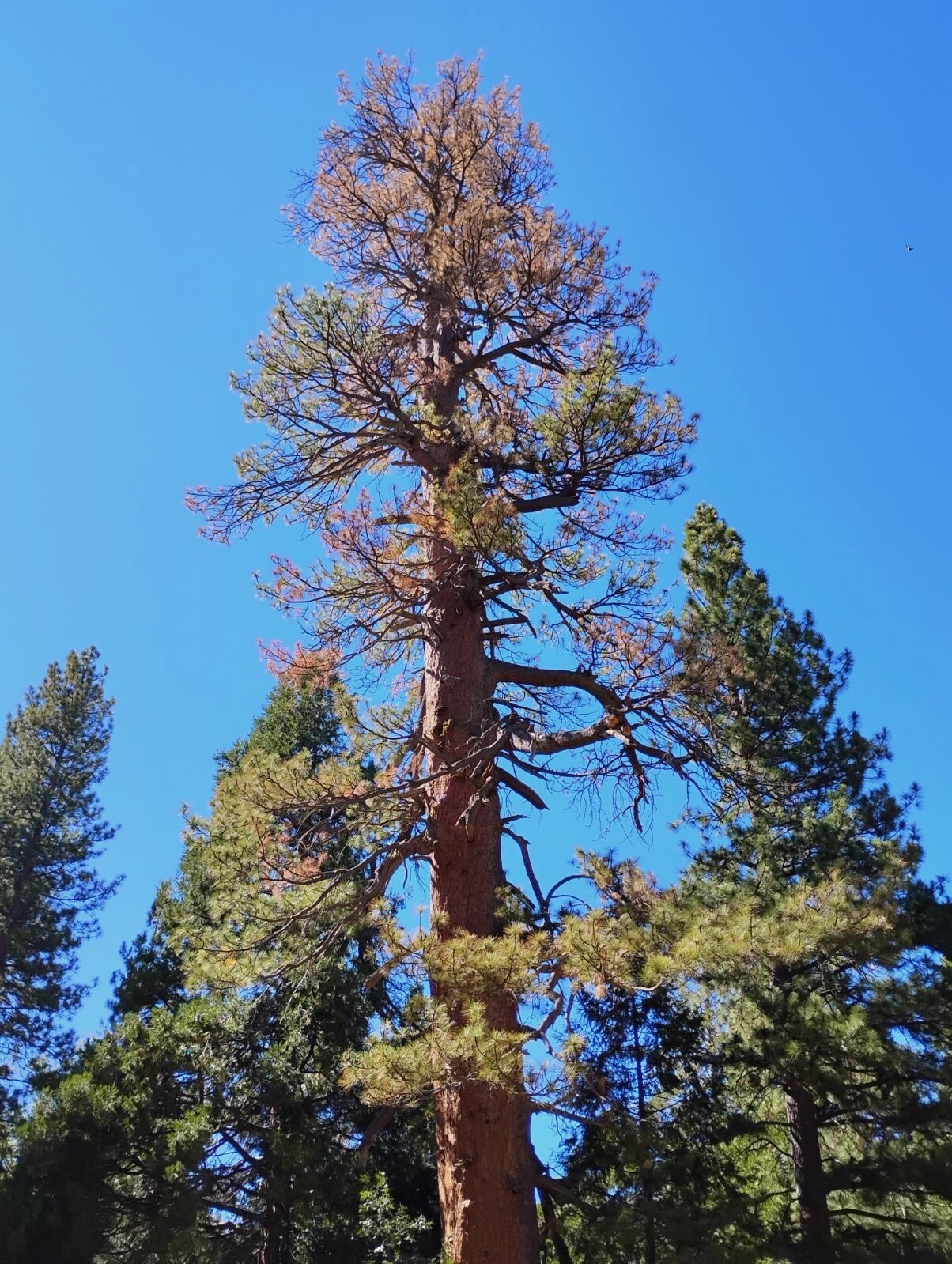
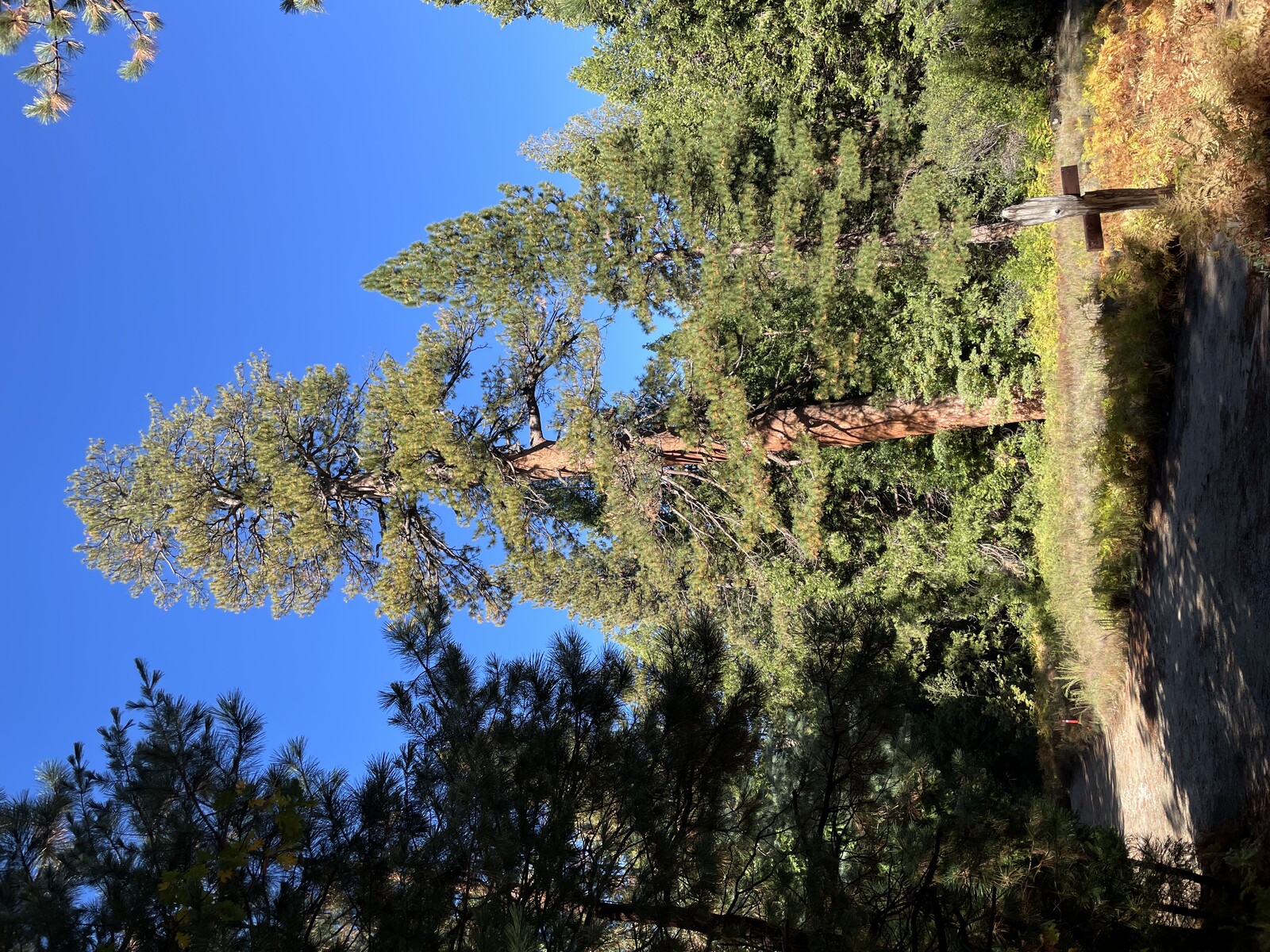
It showed the big ponderosa at the James, the one everybody who ever came through Hall Canyon walked out to see. The upper third of the crown had gone the dull red-brown of needles that died recently enough to still be hanging on. Green persisted lower down, but the change from green to brown is rapid and inexorable once the tree gives up. Top-down flagging in a pine that size, in that ecosystem, in these years, means bark beetles finishing what drought had already started.
The reserve director, Casey Woodall, told a researcher it had gone completely brown in a matter of weeks. By the time the Town Crier wrote it up in August, the tree was past saving. A week later the paper referred to its passing in the past tense.
What It Actually Was
I should say at the outset that nobody really knows how big or how old that tree was, and I find I don't mind.
University literature has been saying, in captions, for decades, that it stood over two hundred feet and was perhaps five hundred years old. Marko Spasojevic of UC Riverside, who has been running a forest dynamics plot in Hall Canyon since 2018, put a tape on it and got 174.5 feet.
Paul Sheppard cored it during his master's work on the fire history of these mountains. He had been my field assistant first, and then followed me to Cornell to study under Jim Lassoie, and the three of us kept working together on tree studies in the San Jacinto wilderness for years afterward. He is a dendrochronologist at Arizona now. The core came out in two short segments, so the total age has to be estimated by regression rather than counted. What he got was something approaching four hundred years, and a height a bit over two hundred feet. Those cores should still be in the museum cabinet at the James.
What you could see in them without any analysis at all was wide rings — rapid growth, year after year. The tree sat nearly on top of a natural spring at the edge of a cleared meadow, and I have always believed that water, more than anything else, is what held the bark beetles off. All the years I was there it had sap running down its side and it stayed green anyway.
Nobody ever submitted dimensions for champion tree designation. In twenty-six years I never did it either. So there are three numbers in circulation and no authority behind any of them, and the honest position is that we won't know until somebody does the analysis.
A tree measured that loosely for that long was never really being measured. It was being known, which is a different operation, and that is the whole of what I want to say here.
The People Who Came First
The canyon was a summer place long before it was anybody's property. Dozens of grinding holes and smoothed working surfaces cover the tops of the big boulders and the bedrock inside the reserve. The soil is still black with the charcoal of countless campfires. The Cahuilla came up from the foothills and the desert springs to harvest acorns at the middle elevations and to hunt higher, and the trails they used are the basis of the trail system that crosses the high country today. When I needed a source for that in my dissertation, I cited Harry James, whose book on the Cahuilla the Malki Museum Press published in 1968. He had been dead five years by the time I filed, and I had no idea then that I would spend twenty-six years living in his house and looking after his land. He was in my bibliography before he was in my life.
Then came the loggers, and they are the reason the tree was there at all.
In 1875 Colonel Milton Sanders Hall, a grading contractor for the Southern Pacific, contracted to supply the railroad with three hundred thousand ties and fuel wood for its locomotives. He organized a wagon road company on money from the Temple and Workman Bank of Los Angeles, drove fourteen miles of hairpins up from Hall City below Cabezon, and set a water-powered mill on Indian Creek in Hall Canyon, right about where Lake Fulmor sits now. An observer at the time called the timber there the best yet seen in California, some of it two hundred and fifty feet tall and going a hundred feet before the first branch. By that December his crews had felled four hundred thousand feet of sugar pine.
Then there was a run on the bank in Los Angeles, Hall was cut off from funds, his men went unpaid, their checks bounced, and by late November the crews had struck and were holding the property against their wages. The bank collapsed outright early in 1876. Robinson and Risher record that he lost a hundred thousand dollars of his own money.
So the tree was not spared. The operation simply died before it got that far. When people ask why the loggers left that one, I think the answer is that a bank in Los Angeles failed, and if you want a lesson in what actually preserves old growth, there it is.
Harry
Harry Clebourne James arrived in Los Angeles from Ottawa in the winter of 1913-14 and went to work at the Griffith studios, where he met a Penobscot actor named Tahamount, known as Dark Cloud. They hiked the Hollywood hills in the evenings. Boys attached themselves to the two of them, and in 1915 they built their first campfires and called themselves the Cahuenga Council. That grew into the Western Rangers and then into The Trailfinders, and over the next fifty years something like forty thousand boys passed through it.
The whole pedagogy was built around fire. Harry wrote that the most memorable thing about a campfire site is the play of flame-light against great tree boles. He meant it literally, and it explains a good deal about where he chose to build his fires. The trunks were the theater.
Amelia Foshay handed Harry and Grace the deed to the San Jacinto property in January 1942. They built Lolomi Lodge with their own funds, felling a hundred and fifty trees on the place to do it, and moved in when they closed the school in June 1950. Lolomi is a Hopi word; they had been using it as the name of the school in Altadena for twenty years before it came up the mountain.
By 1965 the taxes on mountain property had outrun what the James budget could carry. Through friends they had come to know Mildred Mathias, the UCLA botanist, who had been bringing classes up to the dilapidated camp cabins. She explained that the University was assembling a system of natural reserves. In 1966 the property became the James San Jacinto Mountains Reserve, with the arrangement that Harry and Grace would receive a monthly check and stay in Lolomi as long as they were able. The reserve was dedicated in June 1972.
Harry died on the twenty-eighth of May, 1978. Grace died on the twentieth of May, 1980, at eighty-five. Their ashes were scattered over the land they loved. Ken Berg, who was caretaker at the reserve then, told me that most of them went to the base of the big tree.
Afterward, he called the tree Harry.
How I Got There
I met Ken on a trail in the San Jacinto wilderness in 1981, when I was a graduate student at Cornell doing dissertation fieldwork. I was carrying a pack loaded to bear with equipment, a plant press and a copy of Munz's Flora of Southern California strapped to the top. Ken came the other way with a pack, a plant press, and the same Munz strapped to the top of his. We were friends by the end of the conversation. He invited me to set up basecamp at the James for my last year of fieldwork, and when he decided to go back for a master's in botany he told me to apply for his position.
I married Ann in May of 1982. She was finishing a master's in science education at Cornell, and I had a postdoctoral appointment and a teaching job lined up in Ithaca, which was the conventional route toward the faculty position I assumed I was headed for. Then the James directorship was announced and I could not resist it. We talked it through and decided the reserve was the stronger move. We said yes to UC Riverside, moved into Lolomi Lodge that summer, flew back to Ithaca in the fall so I could defend, and walked together at Commencement in the spring of 1983 with a baby bump that became Carl, our first born.
The lodge was rustic in the way that a log house built by hand in 1948 is rustic. A woodstove for heat, a couple of propane heaters, no insulation, and not much else. Ken had left a small set of solar panels for running a couple of lights, and there was an ancient Kohler generator I preferred not to start. My first task as director was to design and install a serious off-grid power supply, and in doing it I learned a skill that carried forward for decades, as I kept expanding the infrastructure at the James until it could support extensive computational facilities.
I started on the first of August, 1982, and I never left. UC Riverside made me an adjunct professor and I taught field courses on and off over the years, including a stint in Venezuela at the university in Caracas. I applied for faculty positions and never got one. I never fledged from the James. Ann wanted a college town and a normal community, and I had an eclectic artists' mountain town and a log house heated by a woodstove; both of those are legitimate things to want and they turned out to be incompatible. Our marriage ended in 1993.
Twenty-Six Years
For all that time, the tree did what it had always done, which was gather people.
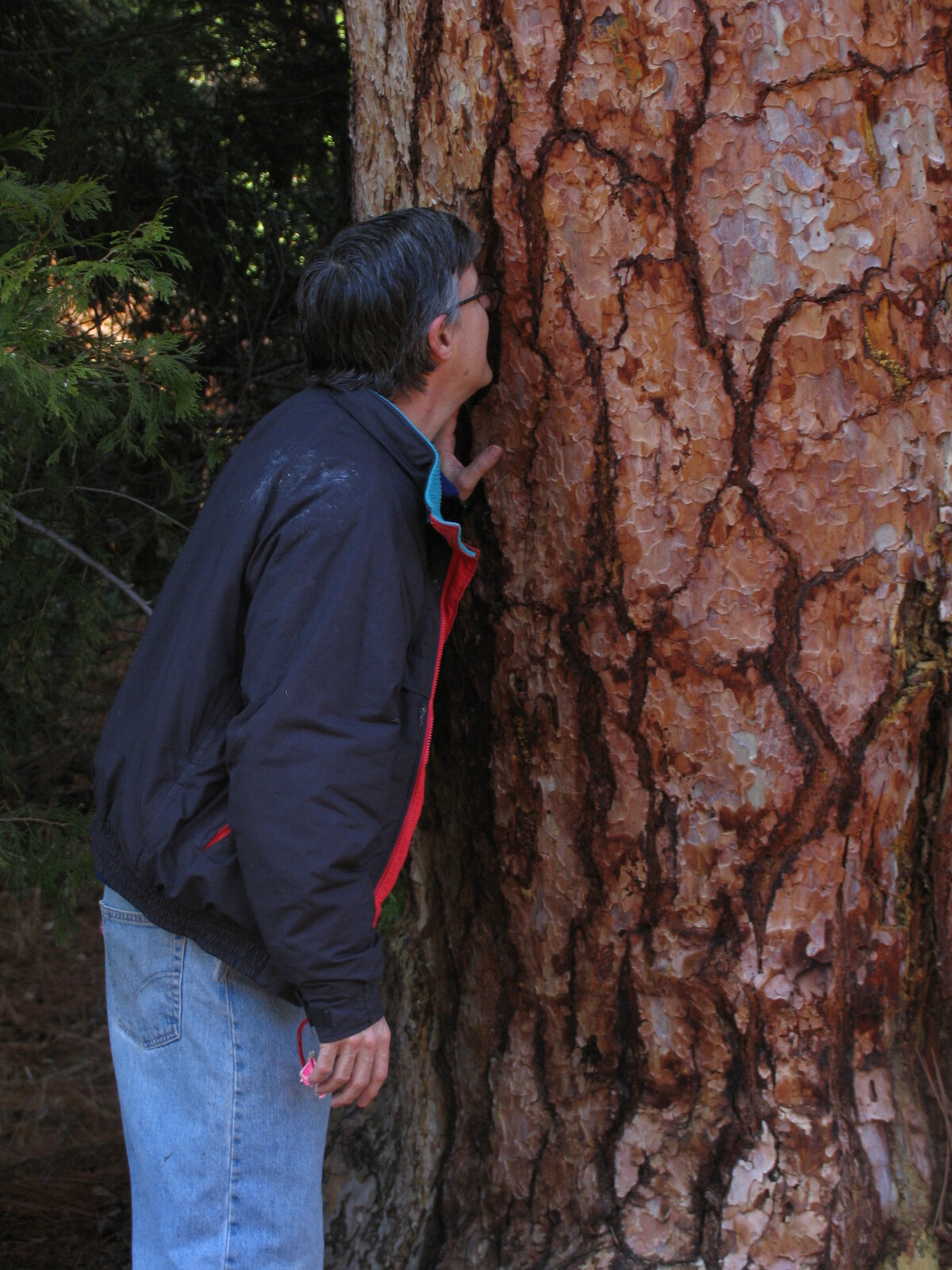
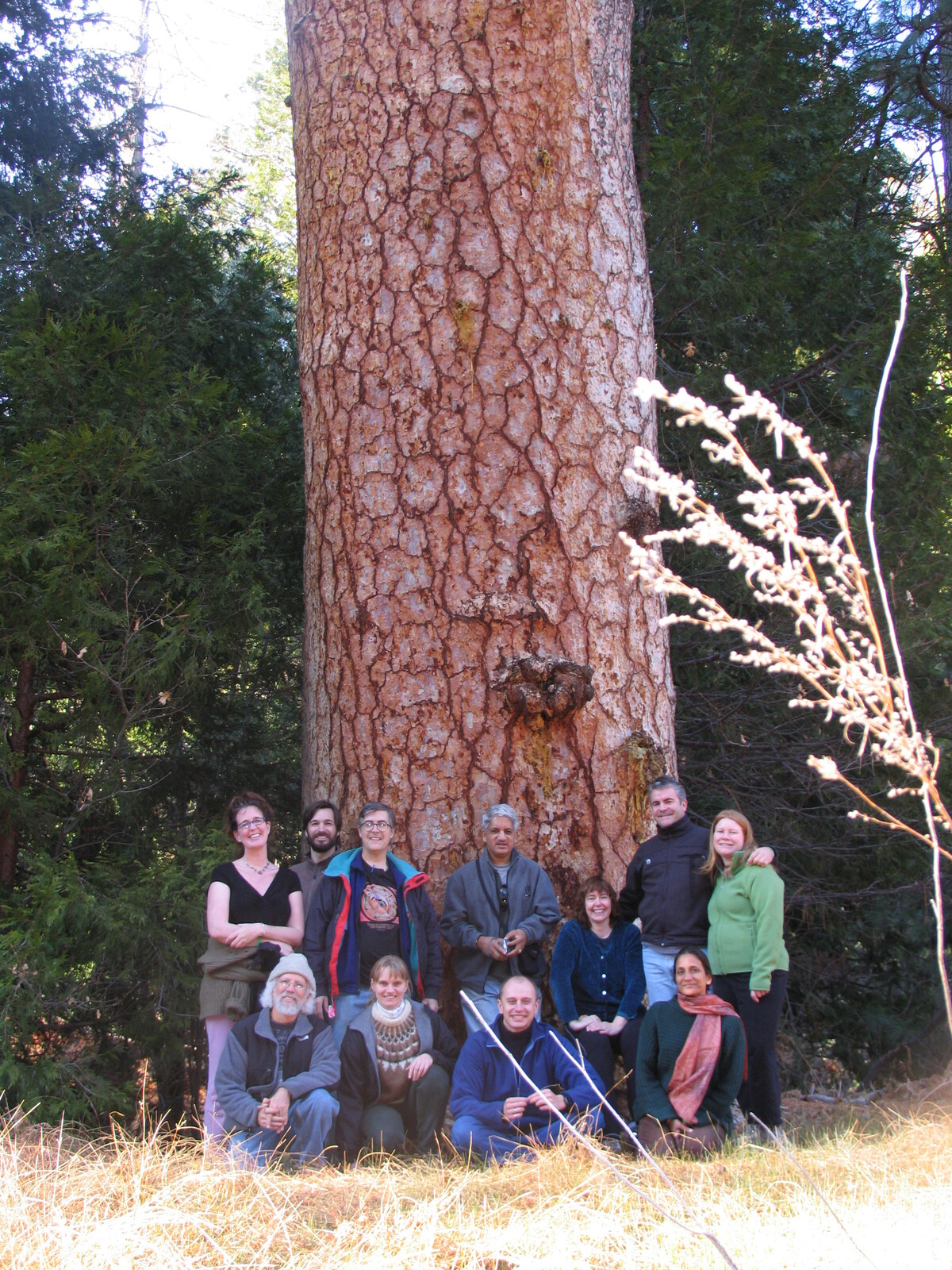
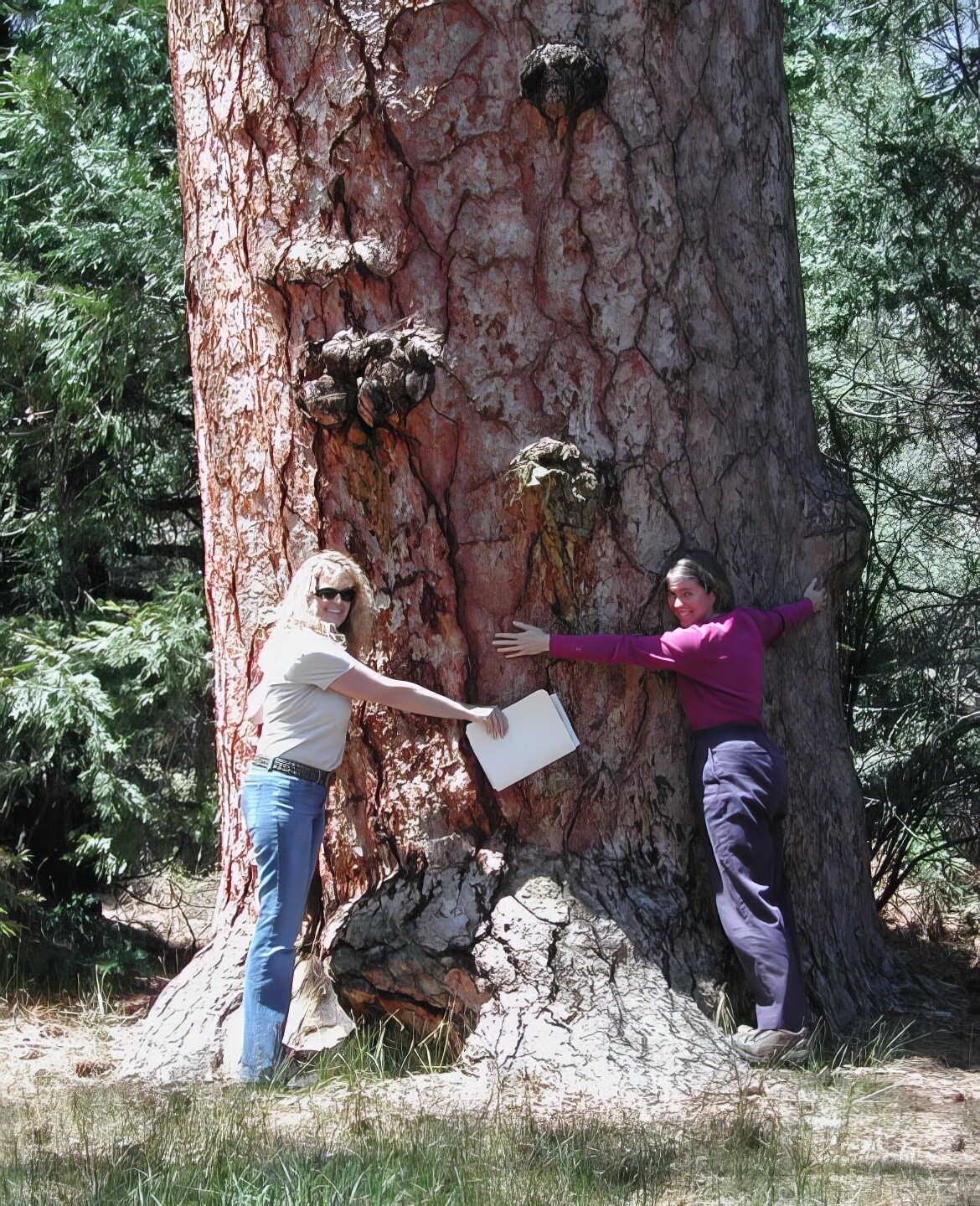
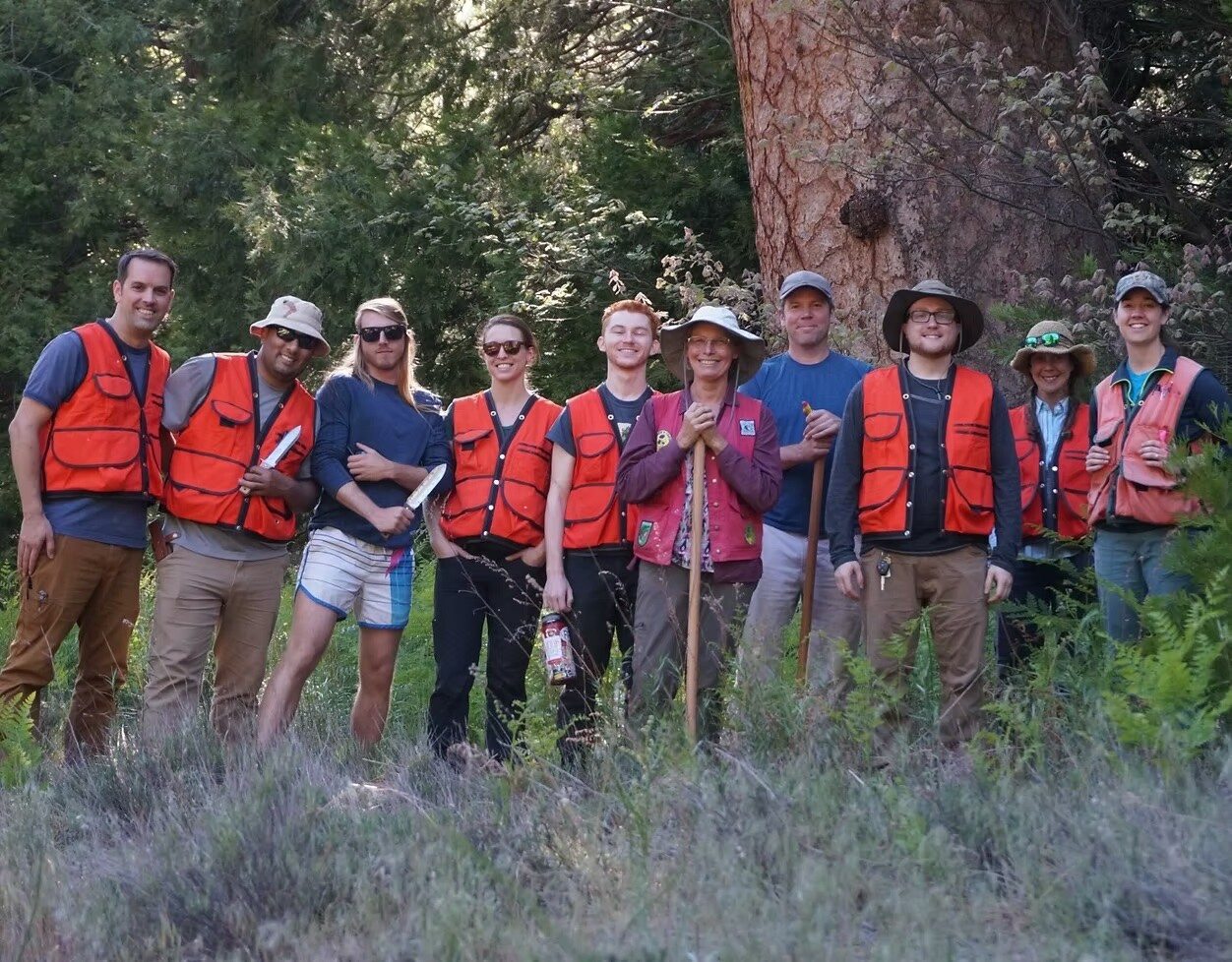
Thousands of them. Undergraduates, graduate students, faculty, school groups, extension classes, visiting scientists, even an astronaut. Almost everyone who came to the reserve walked out to it eventually, and almost everyone did something with their body when they got there. They hugged it. Two people would try to reach around and end up short by a whole person's width, laughing, hands not touching. Groups would encircle it and count themselves. Somebody would put a cheek and a palm flat against the bark and close their eyes. Research groups posed at the base like class portraits, twelve people across, the trunk running out the top of the frame.
I was laughing the day Janice Voss, a NASA scientist and astronaut, pretended to measure the tree using her arms and a friend's.
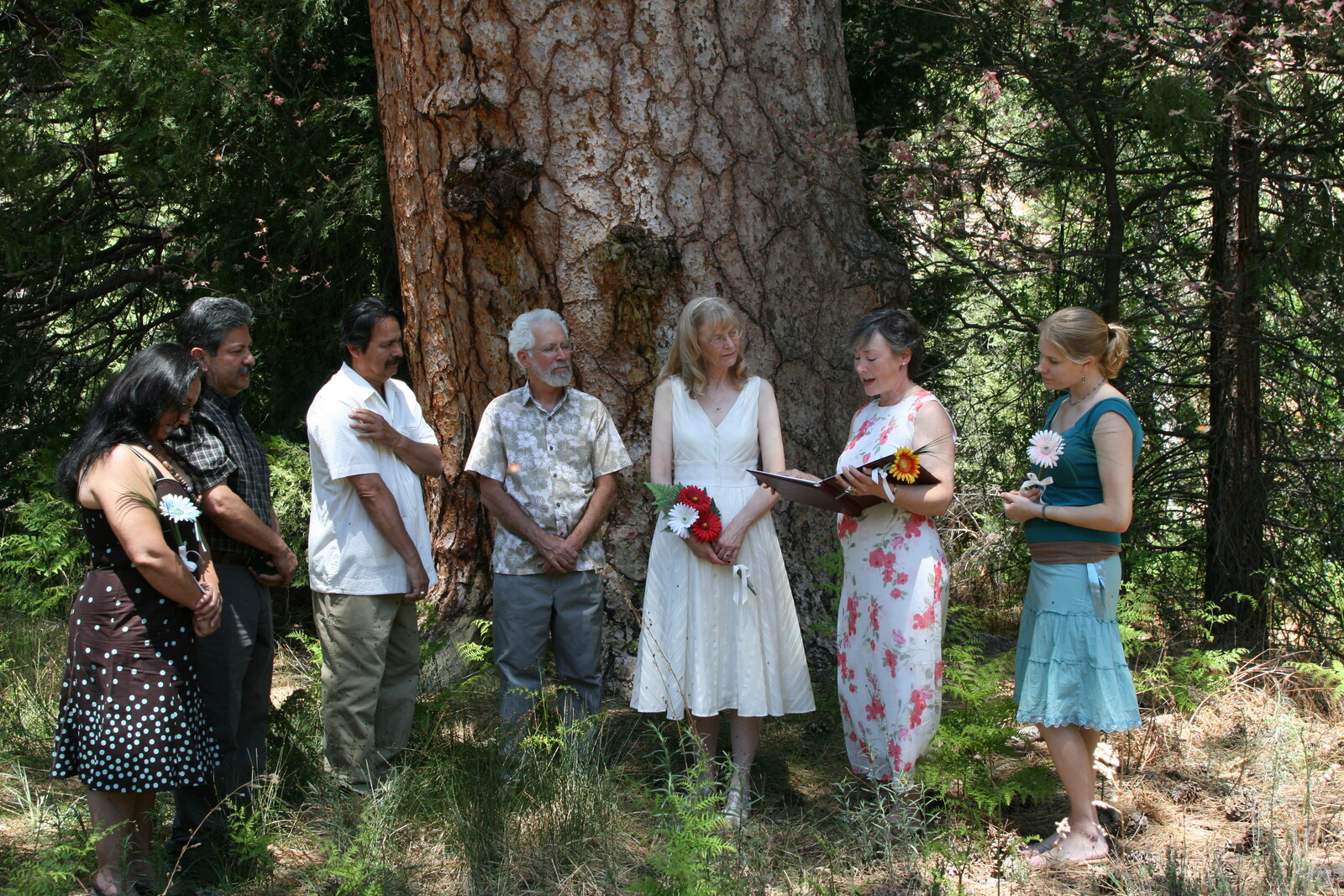
People were married under it.
Ayla came that first September. Word had gone out that we wanted a puppy, and Art and Irene Jaenke out at Trails End had a litter of Queensland heelers whose mother could not suckle them. The pups needed homes fast and the price was right, which was free. We took a spunky tri-colored female with asymmetrical ears, one standing up and one bent down, who ran straight over and started chewing our fingers with her docked tail going about a hundred oscillations a minute. She was two weeks old. I was reading Jean Auel's The Clan of the Cave Bear at the time, and the heroine, an orphan raised by people not her own kind, seemed the right name for a small waif arriving at a house we had just inherited from a dead man.
She lived at the James for fifteen years and died on the thirtieth of September, 1996, and we buried her at the base of the tree. Later my daughter's guinea pig, Corduroy, went into the same ground.
I did not think much about it at the time. It was simply where things were put. It has occurred to me since that this is exactly what the Cahuilla were doing with those boulders, coming back to one place until the rock wore smooth, and what Ken had done with Harry and Grace, and that in doing it we had made ourselves the fourth party in a long habit.
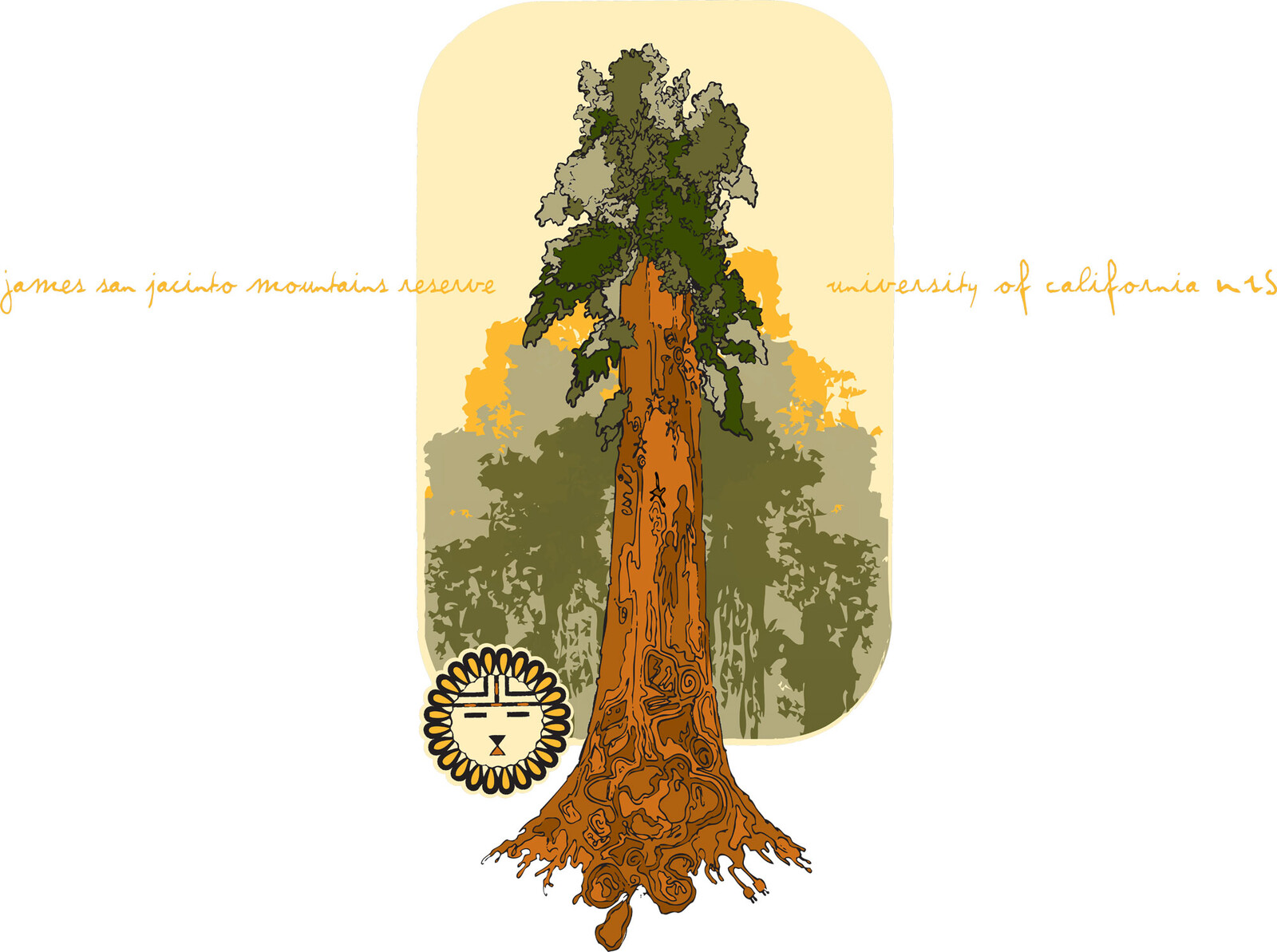
Eventually the tree became the reserve's own face. We needed a T-shirt design, and I had decided it had to carry both the tree and the Hopi Sun Kachina that had been the emblem of the Trailfinders School. Charles Convis, my conservation GIS guru at ESRI, offered his graphics department, and they drew it up: root flare to crown, the Kachina beside it, the University's name in a loose hand across the top. They are still printing those shirts at the Reserve.
The End of It
There were two of them once. Harry mentioned it to me in 1973, when I was a sophomore on a field trip and he was still living in the lodge: a second great tree, and a campfire circle between the two. For years afterward I heard the same thing from Trailfinder alumni. Harry had started a reunion on the first Sunday of June and I kept it going, and the men who came back would tell me about the pair of them, and how one had been undermined by the creek and fell. It is still lying there, stretched out nearly a hundred and eighty-five feet, as long on the ground as the survivor stood in the air.
By the time I arrived the creek had shifted enough to wash away any trace of the fire circle. In all my years there I never heard the tree called the Council Tree and I never wrote that name down, and when the Town Crier used it twice this August without saying where they got it, I assumed the name was recent.
Then this morning, while I was pulling images together for this essay, I took a framed photograph of the tree down off my wall to scan it, and turned it over. On the backing board, in ink: "The Council Pine," photographed by Trailfinder — Jim Farber, June '90.
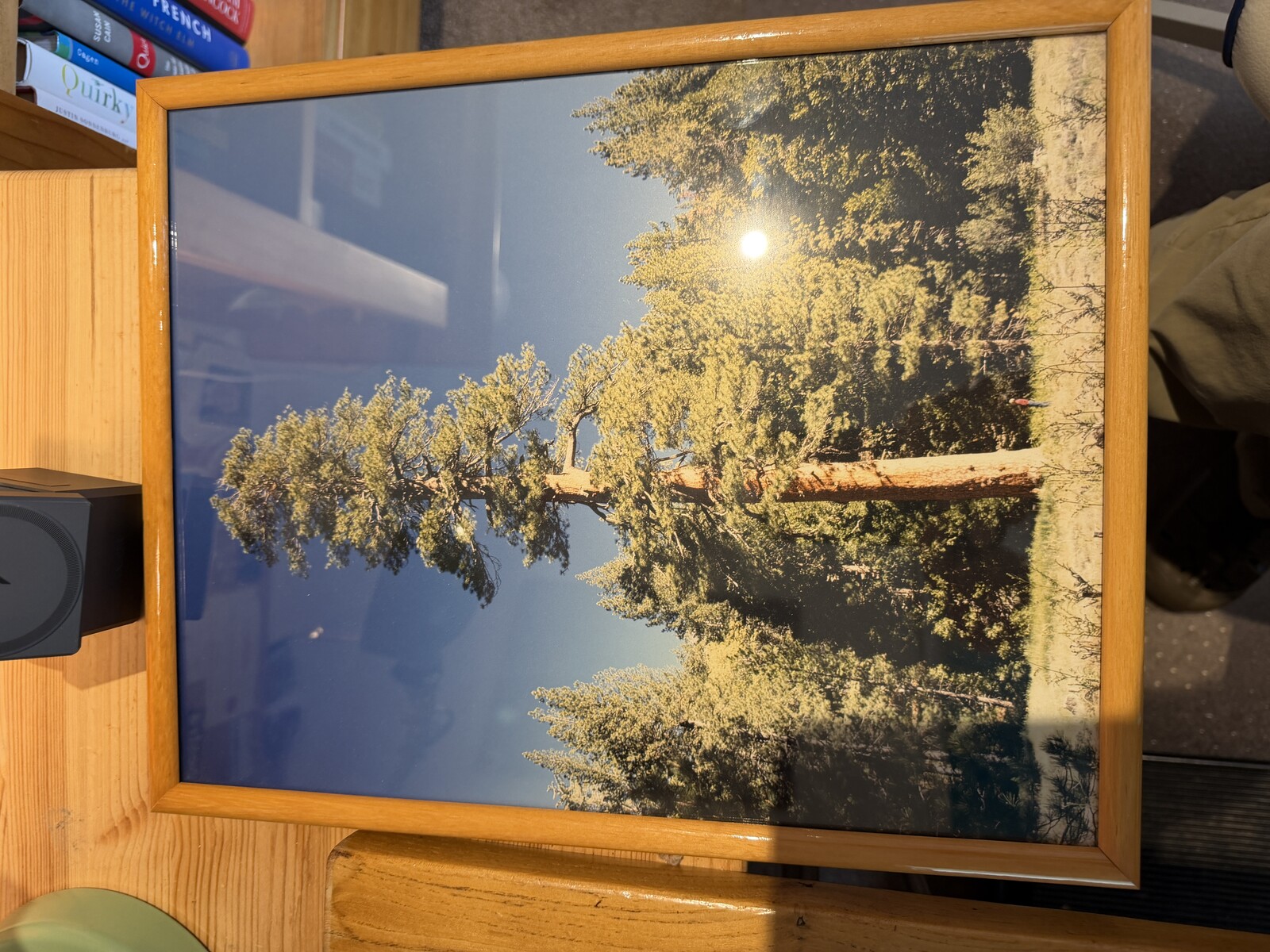
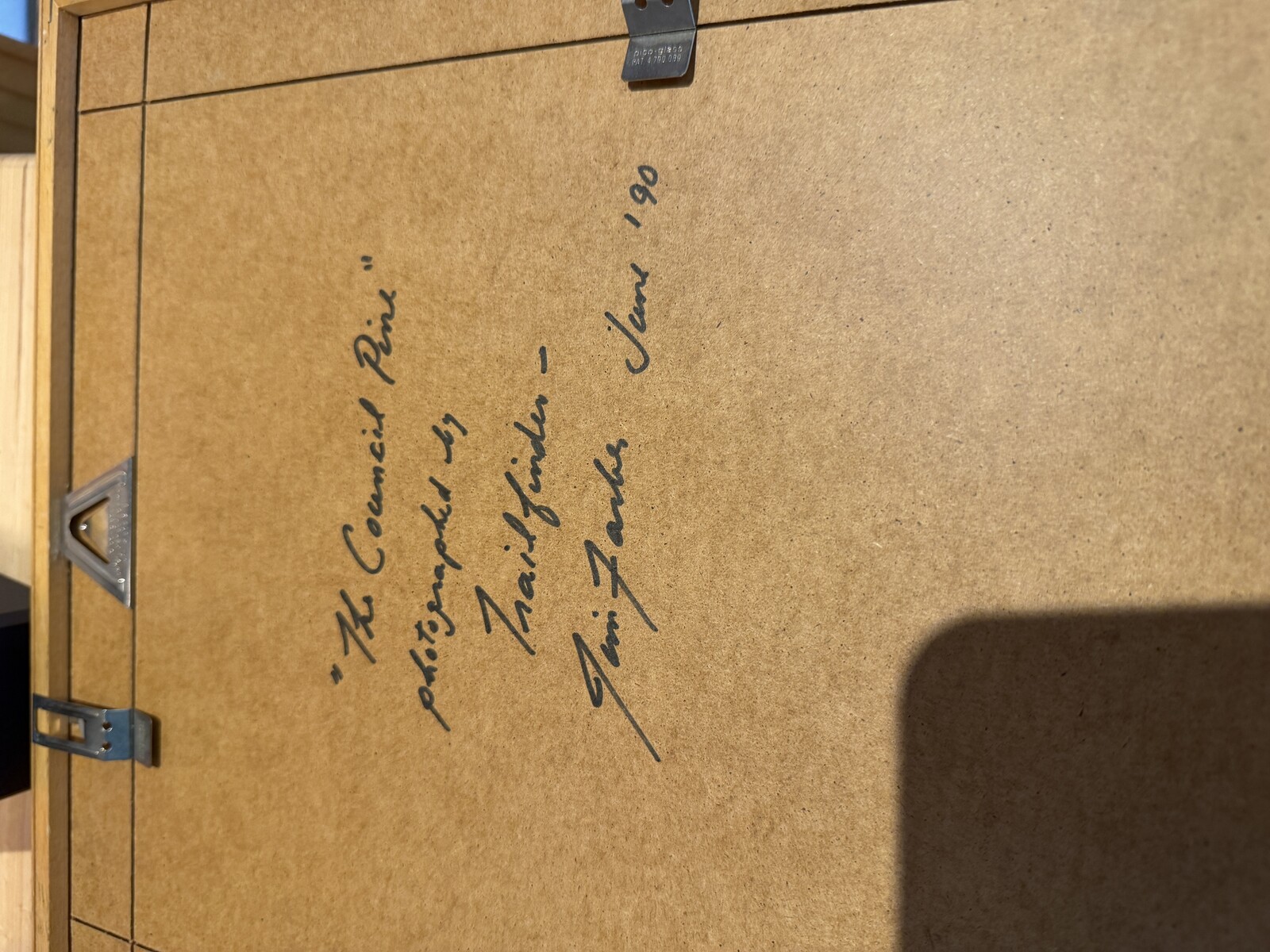
A Trailfinder wrote that at a June reunion in 1990, nine years into my directorship. It has been hanging on my wall ever since and of course I had forgotten about the inscription written on the back of it. So the name is older than the newspaper and older than my skepticism, and it came from exactly where it should have, from one of Harry's boys, at the reunion Harry started and I kept going. Council Pine, not Council Tree, which is probably how the drift began.
Now the second one is gone too, and Spasojevic's plots tell you why it will not be replaced. In two hundred and fifty-six seedling plots his lab finds essentially no ponderosa, Jeffrey, or Coulter pine recruiting. Black oak litter lies eight to twelve inches deep and nothing germinates through it. Tree-ring records show fire returning to these mountains every thirty-two years or so before 1900. The higher elevations of Hall Canyon have not burned in well over a century.
Harry taught forty thousand boys that the one who lit the fire was responsible for its extinction, for seeing that not a single spark remained when the evening ended. He was not wrong about the boys, and he was not wrong about the era. But that canyon needed the fire he taught them to put out, and the tree he sat under was made by a process we have spent a hundred years preventing.
There is a fire story from 1974 that I have never stopped thinking about.
That year Harry was working on a book about Ernest Thompson Seton, whose Woodcraft Indians had almost certainly been the model for his own organization. A fire started in the Soboba hills below the reserve and ran upslope fast enough that Lolomi Lodge was clearly threatened. A short distance from the lodge was a spring box set into a horizontal shaft with a metal door, and Harry judged it the safest place on the property. He carried his manuscripts down and shut them inside.
The fire came close but the reserve was saved. Firefighters set a backfire from the road beside the lodge, and it burned up and over the spring box, and in doing so it went down into the roots. The roots carried it inside, where it took the timbers, and the manuscripts burned. Harry was devastated. He was seventy-eight. He never finished the book, and what survived of the papers has since gone to a museum that specializes in the Seton legacy.
He had spent fifty years teaching boys that the one who lights the fire is responsible for putting it out, and his life's work was destroyed by a fire set deliberately, correctly, by professionals, to save his house.
Since then the James has been evacuated more than once for fires in the neighborhood. The reserve itself has still never burned.
Someone did finally measure it. Three months before the crown turned, a Cal Poly San Luis Obispo field quarter spent eight days in the mountains and put a tape on it. The instructor posted a photograph in May and wrote that based on current records it is likely the world's third largest ponderosa pine, three to five hundred years old. So the estimate had grown again, which is what happens to a tree that is loved rather than catalogued. Two people in the comments asked what the measurements were. Neither got an answer.
There is a bitter joke in there for me. I spent twenty-six years not measuring that tree. A University class from Cal Poly SLO measured it at last, and the numbers went into somebody's phone, and the tree died before anyone published those measurements.
The other thing in that comment thread I cannot stop thinking about. A stranger looked at the photograph in May and said this was a textbook case of shade-tolerant species encroaching from fire exclusion, that the surrounding incense cedars would probably cook that ponderosa, that low-intensity fire should have thinned them long ago, that it would take chainsaws now, and that somebody should propose management to save it if it was really that rare.
Nobody did. Three months later it was brown.
There is one more explanation worth having, and it came in a letter to the Town Crier from Noah Whitney, an arborist who has spent thirty years working in the trees on that mountain. His argument is that drought and beetles are the final chapter but not the author. In its last decade or so, he says, a giant pine stops investing in its own body, in bark and roots and defensive sap, and pours everything remaining into cones and seed. A last push toward posterity. Its defenses are empty when the beetles arrive, and the beetles are the symptom rather than the cause.
I don't know whether he is right. It is a testable claim, and the cores exist. But grant it and the story gets worse rather than better, because it means that tree spent its final years casting seed onto a forest floor buried under a foot of oak litter, in a canyon that has not burned since before Harry was born, where two hundred and fifty-six plots are finding no ponderosa at all. It did the one thing it had left to do, and we had already made sure it would not work.
I keep coming back to the photograph. It is a good photograph. It shows a tree that no one ever officially measured, that nobody could quite get their arms around, that has a person's name.
I don't know what else you would call that but a relationship.
References
- - James, G. C. (1980). "Harry." In *Trailfinders Memories*, ed. W. J. Davis.
- - James, H. C. (1968). *The Cahuilla Indians*. Banning, CA: Malki Museum Press.
- - James, H. C. (1973). *Western Campfires*. Flagstaff, AZ: Northland Press.
- - Robinson, J. W. & Risher, B. (1993). *The San Jacintos*. Big Santa Anita Press.
- - Jerome, D. (2026). "Council Tree, largest ponderosa pine in San Jacintos, nears end of life." *Idyllwild Town Crier*, August 13, 2026.
- - Jerome, D. (2026). "Passing of Council Tree part of changes researchers see in local forest." *Idyllwild Town Crier*, August 20, 2026.
- - Whitney, N. (2026). "Drought, Bark Beetles not the only causes of tree mortality." Letter, *Idyllwild Town Crier*, August 13, 2026.
- - slowplants (2026). Field measurement of the James Reserve ponderosa pine, May 15, 2026. Instagram. https://www.instagram.com/slowplants/ ↗
- - Hamilton, M. P. (1983). *A Floristic Basis for the Management of Rare Plants and Their Communities in the San Jacinto Mountains, California*. Ph.D. dissertation, Cornell University.
- - *The Trailfinder*, Vol. I, No. 1 (1976). University of California Natural Land and Water Reserves System.