
A New Bedrock for the Macroscope
I want to tell you about something I'm genuinely excited about. A little over a month ago I announced Science with Claude, and in the weeks since we moved the original Coffee with Claude site over to it. Behind the scenes, I've been completely redesigning the databases, the server infrastructure, and the working parts of how this experiment in human–AI collaboration runs. Out of the digital forge of Claude Cowork and many hours of my own, we now have the bedrock for a new Macroscope — one that brings the Observatory, the Laboratory, the Workbench, and a publishing platform together in a single system that can scale to hundreds of organizations and individuals.
This is a status report from the middle of the work, so let me tell you what changed underneath, why it matters even if you never touch a server, and what it lets the Macroscope become.
The engine room, rebuilt
The Macroscope has had many lives. The earliest versions ran on a single computer and were handed around on a Laserdisc and a CD-ROM. Later ones layered custom maps and media onto Google Earth, or strung together a web of HyperCard stacks playing some of the very first QuickTime video. I built versions on content-management systems — EverWeb, Drupal — and on a proprietary sensor-network system called EcoView. Each was a creature of the tools of its moment, and each, in its way, was a patchwork.
About three years ago, when the first large language models grew capable enough to help write code — GPT-3.5, and the ones that followed — I began co-writing a new version, this time on a database called MySQL, along with Apache, JavaScript and PHP managed through a commercial control panel named WebMon. In 2024 I moved that collaboration over to Claude Sonnet 3.5. It worked, and I was fond of it.
Over the past month I rebuilt on a new foundation: a database called PostgreSQL, with a handful of powerful open-source libraries layered into it, running on server software I manage directly and serve to the world through a secure connection from Cloudflare. Let me be honest about what actually made this leap possible, because it isn't what people might guess. It wasn't a move from closed to open — the old MySQL stack was open and free too, and the control panel I'd used was just a friendly face over the same Apache and PHP that everyone runs. Two real things changed. I chose a database far better suited to what the Macroscope needs and gave it new libraries that hand it genuinely new abilities. And the AI I build with had grown capable enough that a rebuild this deep became a matter of weeks instead of years.
Start with the database. Think of those new libraries as giving it four new senses, each one turning raw data into a kind of understanding. It now has a true sense of place — it doesn't merely store a pair of coordinates, it knows that this sensor sits inside that watershed, a few hundred meters from another, uphill from the river. It has a sense of time — it can take a firehose of millions of readings and remember how a place actually behaves across hours, seasons, and years. It has a sense of likeness — it can tell that this morning at Canemah resembles last week at a creek across town, the way a naturalist's eye catches a familiar pattern. And it has a sense of kind — it keeps the nesting of things straight: this creature within its family within the wider tree of life, this place within its ecoregion within its biome.
The old database could handle one of those well at a time; a question that crossed two of them meant stitching things together by hand. Choosing PostgreSQL wasn't about open versus closed — both are open — it was about fit. PostgreSQL is built to take on specialized libraries like these, and keeping all four in a single engine — place, time, likeness, and kind, answerable together in one question — is genuinely at the leading edge of how environmental data and ecological knowledge are being engineered today. But it is cutting-edge in service of a very old idea: knowing a place deeply. That combination is what makes everything else in the Macroscope possible.
There is also reach. The public face of the Macroscope now runs from a small, energy-efficient computer in my lab at Canemah, served safely to the world through Cloudflare's network — no doors left open to attackers, no large hosting bill. A nature laboratory on a bluff above the Willamette can quietly run a platform meant for many. That last part is the whole point, and I'll come back to it.
A collaborator at the speed of conversation
Set aside, for a moment, whatever you've heard about artificial intelligence. Here is what it actually was in this project.
I worked alongside Claude — advanced software running on powerful hardware — in a mode called Cowork. I would describe, in plain language, what I wanted the system to do. It would write the code, test it, show me what happened, and we would refine it together, back and forth, in real time. Work that would once have cost me months of solitary effort, or a team I don't have, happened in weeks, at the pace of a conversation.
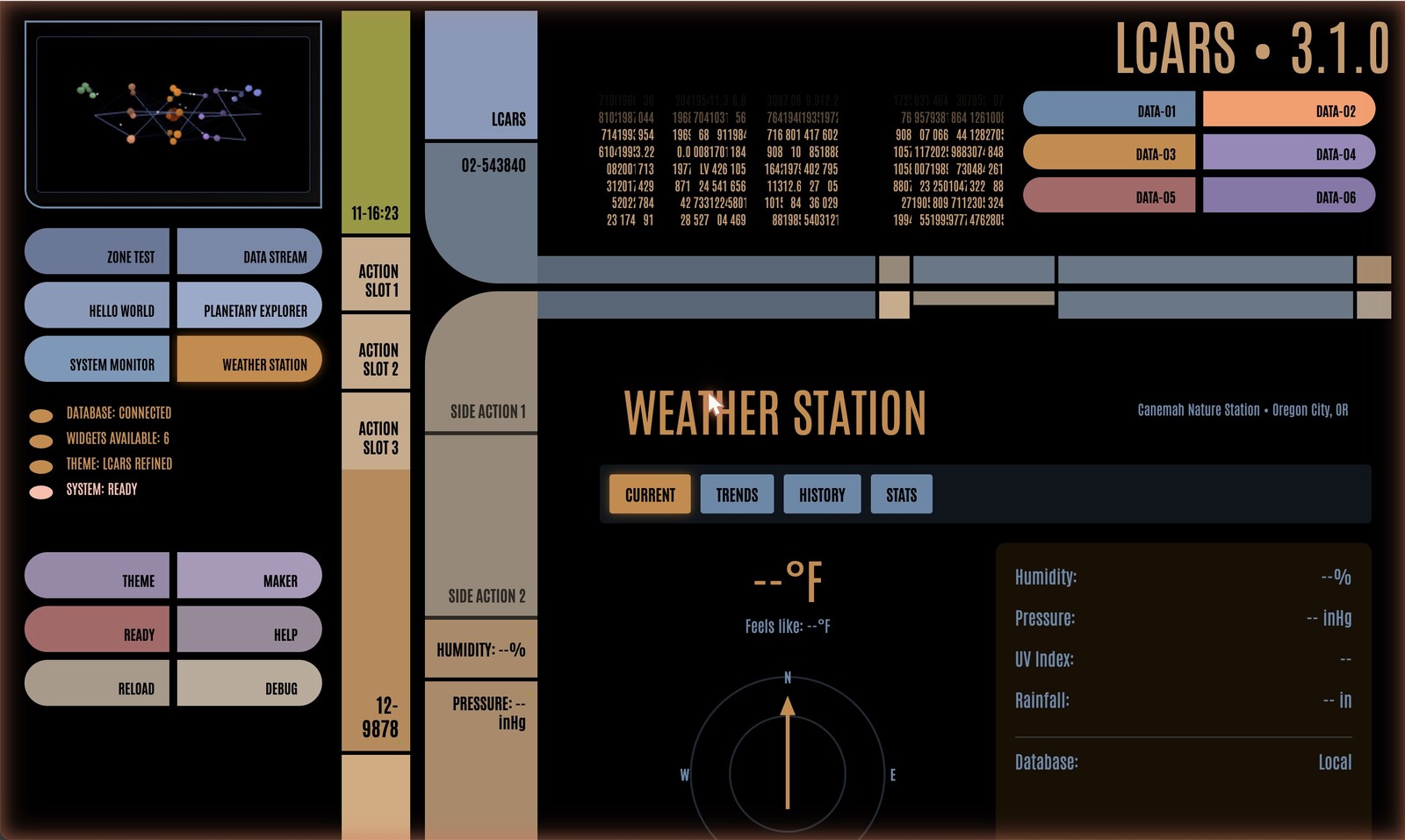
That loop is the real story. Sketch an idea, mock it up, write the code, test it, deploy it, stress it, and start over — a cycle that used to take me weeks now turns in hours, sometimes minutes. Over two years we've worked through more than ten generations of the Macroscope this way. It began, half in fun, as a riff on the LCARS computer interface from Star Trek; it iterated through nine of those; then it became MNG — Macroscope the Next Generation, pun fully intended — and what I'm describing here is MNG 3.0. Each turn kept what worked and gambled on something that hadn't been tried but looked promising. This newest one is the culmination: the best of what we've learned, joined to the parts that hold the most promise.
I brought years of field ecology and a clear sense of what I was trying to make. It brought the ability to turn that intent into working software faster than I could have typed it. That division of labor is the actual experiment Science with Claude is about: not a machine replacing the scientist, but one person gaining the reach of a whole workshop. The fear in the headlines doesn't describe what this felt like. What it felt like was leverage.
Standing at one place
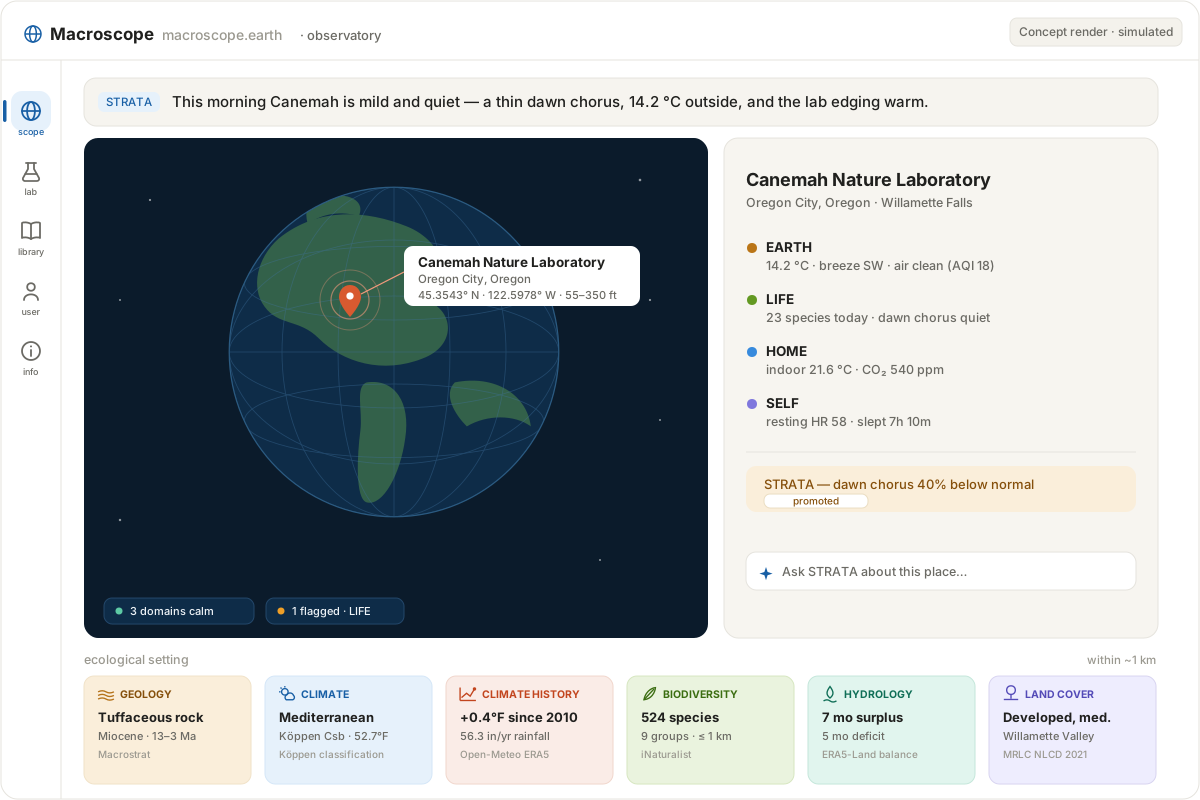
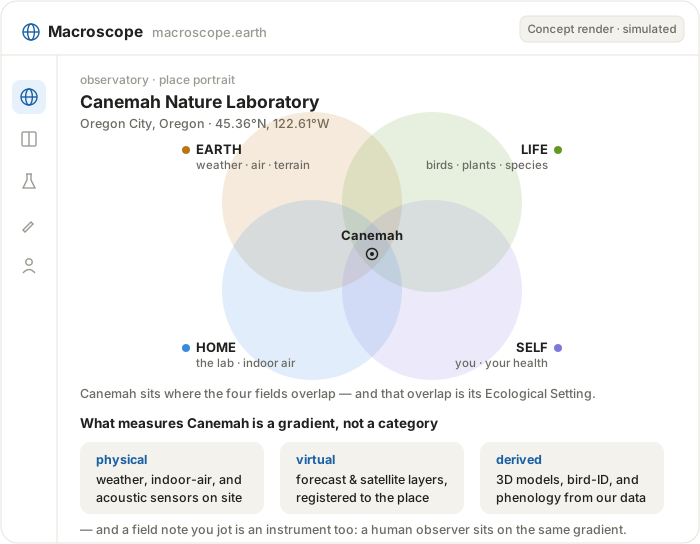
At the heart of the new Macroscope is the Observatory. You pick a place — for me, always, the Canemah Nature Laboratory — and the system shows you that place whole: its weather and air, the birds and plants and fungi living around it, the building and its indoor conditions, and, if the place is your own, your health and daily rhythms. Earth, life, home, and self, in one view.
Nature doesn't actually sort itself into those four bins, though, and neither does the Macroscope. The domains overlap, and the interesting things tend to live where they meet. A thin dawn chorus on a mild June morning isn't a bird fact or a weather fact; it's both at once, and the character of a place lives in that overlap — what we call its ecological setting.
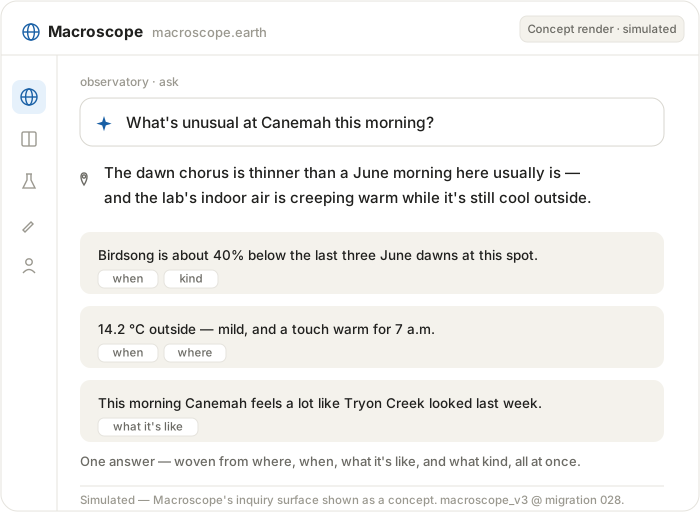
You don't need to know any of that to use it. You can simply ask the place a question in ordinary words — "what's unusual this morning?" — and get a plain answer back, one that has quietly drawn on where the place is, what time it is, what the place resembles, and what kinds of things are there, all at the same time.
From looking to understanding
The Macroscope treats time as one continuous thread. Yesterday's readings, today's averages, and tomorrow's forecast are all the same line — and a forecast, seen this way, is simply a reading whose moment hasn't arrived yet, a small prediction the next hour will test. The system also remembers what each hour usually looks like at a place, so it can notice not just that a morning is "warm" but that it is "warmer than this place should be right now."
That matters to me more than any single feature. Across my career I have watched each generation quietly accept a more degraded version of normal as if it were the baseline. A system that can hold the baseline a human generation can't is, to me, the entire point.
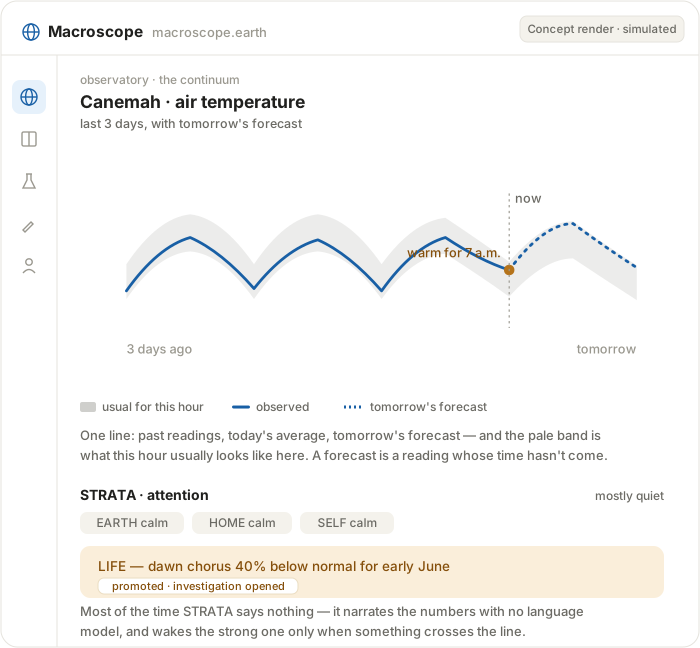
Most of the time the intelligence layer — I call it STRATA — says nothing at all. It narrates the numbers plainly, at no cost, and only raises its hand when something genuinely crosses a line. This morning that was the thin dawn chorus: noticed, flagged, and handed up for a closer look on its own.
It's organized like a watch crew, and that arrangement is what keeps it both affordable and safe. Most of the watching is done by simple, tireless routines that cost nothing to run and need no artificial intelligence at all. When something unusual does appear, a modest AI gathers just the facts that bear on it; only the genuinely hard, can't-be-computed questions get passed up to the most capable — and most expensive — model. The powerful thinking is rationed to where it's actually needed, rather than spent narrating every ordinary morning.
Just as important, none of these helpers holds a master key. Each one can see only what the person it's assisting is allowed to see — never the whole database — and it cannot reach past those bounds. So even if someone tried to trick one into misbehaving, there is very little to take: it is contained by design, not merely asked to be polite. The safety comes from the structure, not from hoping a model behaves.
That closer look is where the Laboratory and the Workbench come in — a structured place to turn a flagged signal or a hunch into a real investigation, with a notebook for the analysis itself and a library of methods to reach for. And when an investigation is done, it publishes outward, into Science with Claude, the very site you are reading this on. Observing, investigating, and publishing, in one continuous motion.
Built to grow, and to be shared
Because the whole system rests on open tools and one small server, it can grow without growing expensive — and, just as important, it isn't only mine. The same design that watches Canemah can watch a schoolyard garden, a land trust's preserve, a city's parks, or your own backyard. Hundreds of them, without the old patchwork of separate apps. That is what the new architecture really buys: not a faster website, but a thing other people can stand up for themselves.
Which raises a fair question — who gets to see what? Here the Macroscope does something I'm proud of.
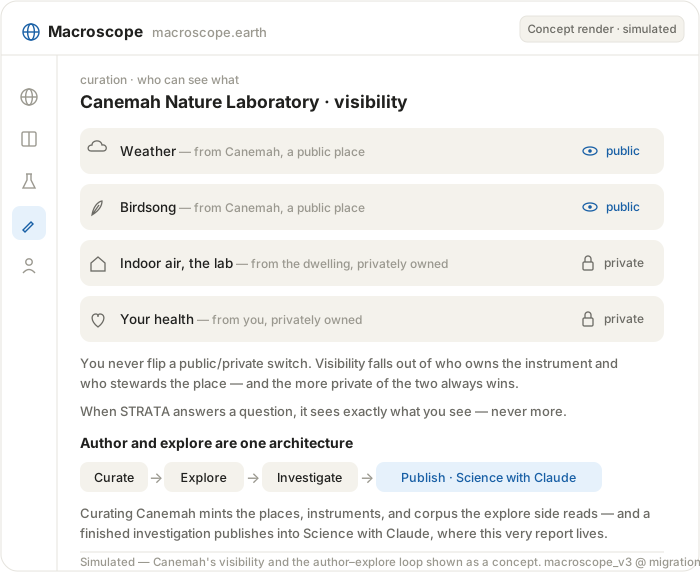
You never flip a public-or-private switch on each thing. What's visible simply follows from who owns it and who tends the place. At Canemah, the weather and the birdsong are public, because the place is; my health and the inside of the lab are private, because they're mine. Privacy isn't added on afterward — it grows out of ownership. And the intelligence, as I said, can only ever see exactly what you can, never more.
Put those pieces together — no exposed doors to the outside, no master keys on the inside, and visibility that follows ownership — and the result is a system that is secure and privacy-centric by design, not by promise. For a platform meant to hold both a public park and a person's health, that has to be true at the foundation, not patched on at the end.
Where it stands
Let me be honest about the state of things, because honesty is part of the design. The foundation is real and running: the new database is live, the security model is built and tested, and the system logs people in. The polished screens in this piece are faithful previews — drawn against that real foundation and labeled as concept renders, not dressed up as a finished product. The rooms aren't furnished yet.
After a decade of separate experiments, the new Macroscope is becoming one system — built in conversation, iterated into shape, and made to grow. I'll show you the rooms as we raise them.