
A Shoebox with Eyes
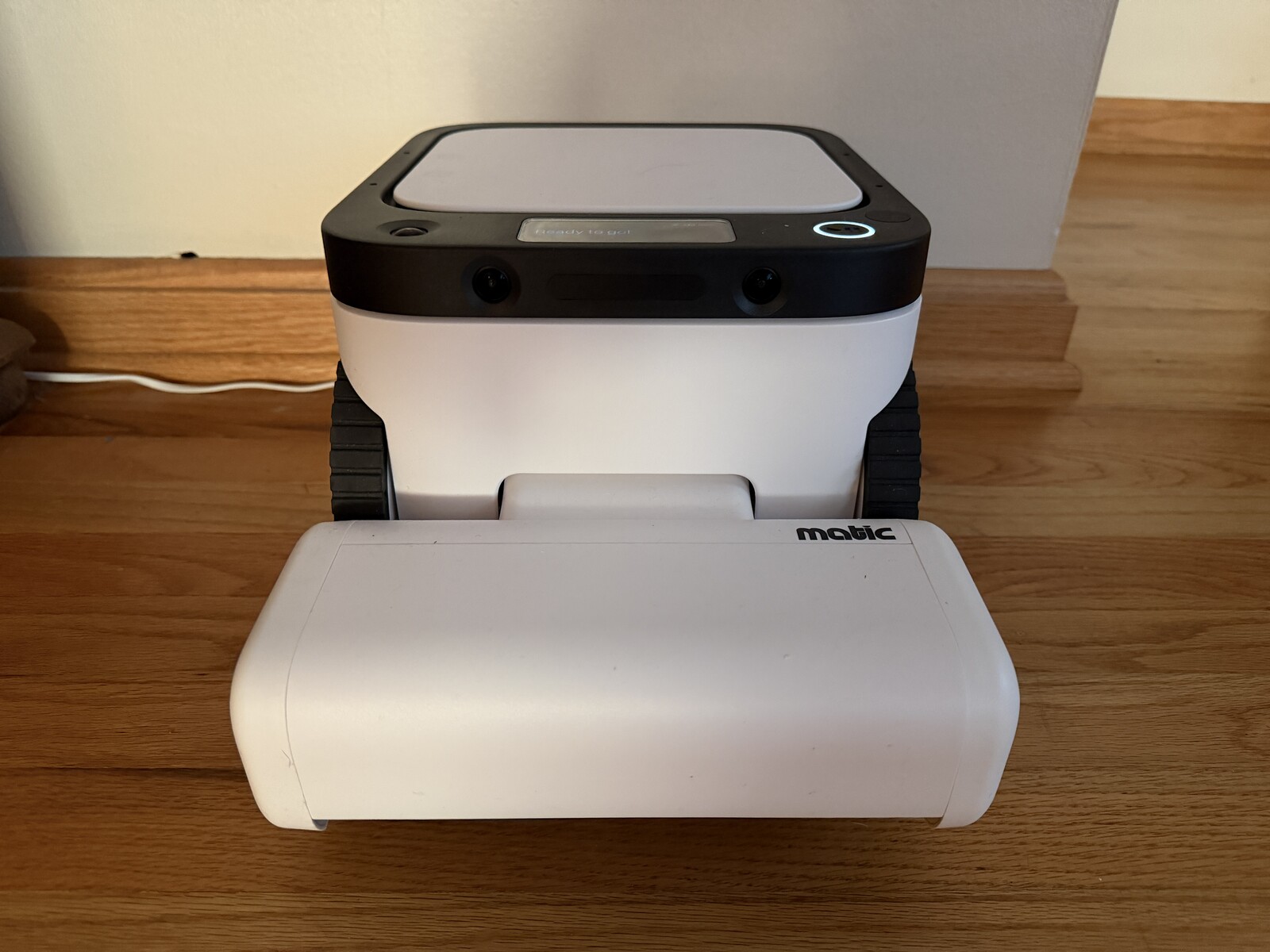
There is a photograph on my phone of a small white box parked against the baseboard of my living room, a few feet from a piece of quarter-sawn oak furniture that is roughly a century older than everything else in the frame. The box is about the size of a loaf of bread. Along its top edge, if you look closely, there is a row of lenses.
That is Rosey.
I named her after Rosey the Robot, the housekeeper from The Jetsons, which went on the air in 1962, when I was seven. The Rosey that Hanna-Barbera imagined stood about five feet tall, wore a frilly apron, spoke with a Brooklyn accent, and had firm opinions about the children. The Rosey that actually turned up in my house sixty-four years later has no opinions whatsoever. She cannot talk. She cannot climb stairs. She does not know she is named Rosey.
My floors have never been cleaner in my life.
The thing that was supposed to happen
Noah Smith wrote a piece this month asking what more intelligence is actually going to do for us, and the honest premise of it is that superintelligence has more or less arrived and the world stubbornly refuses to look transformed. Employment is fine. Productivity growth is decent and unremarkable. We are still driving to work and scrolling on our phones. One of the writers he quotes, Clifford Sosin, puts it about as flatly as it can be put: "No takeoff. No explosion." That, Sosin says, is the strange part.
There is a whole literature of expectation behind that disappointment. Ian McDonald has a line in a story of his about intelligence being destiny, manifest — the most powerful force in the universe, the one all other physical laws must kneel to. Plenty of very serious people believed something close to that, and some of them still do.
Smith entertains an uncomfortable alternative, which comes from the AI researcher François Chollet: maybe intelligence isn't a thing you can scale without limit. Chollet's image is that increasing intelligence isn't like making a tower taller. It's more like "making the ball rounder," and past a certain point the ball is already about as spherical as it is going to get. Arvind Narayanan and Sayash Kapoor make a related argument from a different direction — that for a great many real-world tasks there is an irreducible error baked into the phenomenon itself, and trained humans are already sitting near it.
I have no standing to adjudicate any of this. I am a field ecologist. What I have is a living room and a robot in it, and the robot has been quietly settling the question for me for two weeks.
Rosey is not smart
Here is the thing about Rosey: nothing I like about her has anything to do with intelligence.
She is not clever. She has no judgment. She does not understand what a floor is for, or why anyone would track fir needles in from the porch, or that the cat bowls are cat bowls. If I could somehow triple her IQ, my floors would not get any cleaner, because the limiting factor was never reasoning.
What she has instead is a set of frankly inhuman advantages. She can see very well, in a narrow sense. She never gets bored. She never decides that under the sideboard is close enough. She works in the dark. She has no back to strain and no Saturday to protect, and she is entirely content to do the same modest thing forever.
That is Smith's real argument, and Rosey demonstrates it in about ten minutes. He suggests we have been thinking about the benefits of intelligence wrong — arrogantly privileging the mental tasks that we humans happen to be good at, while ignoring the ones we do badly. Persistence is a thing we do badly. Patience is a thing we do badly. Seeing the same square meter of oak floor for the four-hundredth time with undiminished attention is a thing we do so badly that we invented an entire product category to get out of it.
What she did before she cleaned anything
The unboxing took about four minutes. I found a spot for the charging base, plugged it in, set her on it, and scanned a QR code off the packaging with my phone. Then a small sequence of quiet miracles went by in order: she announced herself, authenticated, asked to be given a name, and then asked whether she could go and have a look at the house.
I said yes, and off she went. Room by room. Corner by corner, crevice by crevice, in no hurry at all. When she was done she came back to the base and reported that she was ready to clean.
What she had made while she was out there was not a floor plan. It was a textured, navigable three-dimensional model of my house — the kind of thing I would have written a grant to produce in 2005. My rooms, my furniture, the actual grain and color of the floors. She had also divided the place into regions of her own devising, which will matter in a minute.
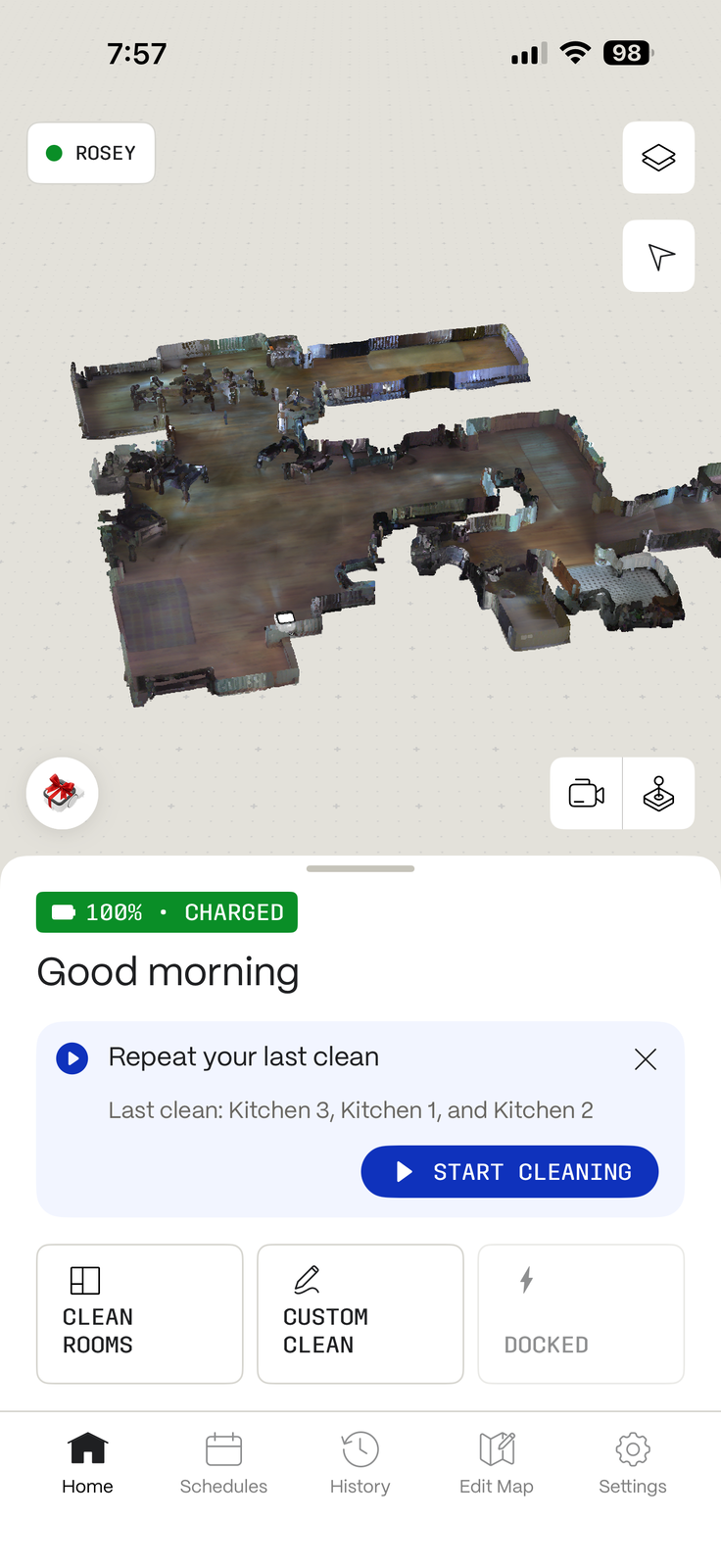
She built all of it because she needed it. You cannot reliably visit every corner of a house you cannot picture.
So I sat there on the first day marveling at a photogrammetric survey of my own home that had arrived as the setup step for mopping.
I should explain why this landed the way it did. I have spent more years than I want to admit tinkering on something I’m currently calling ecoSPLAT — capturing 360-degree imagery in the field and turning it into a navigable three-dimensional reconstruction of a piece of forest, so that a place can be revisited later, measured, and compared against itself across seasons. It is genuinely difficult. It involves a specialized camera rig and a good deal of computation and a fair amount of swearing.
A mop did my living room for free.
Kitchen 3, Kitchen 1, and Kitchen 2
The app also told me what she had cleaned most recently: Kitchen 3, Kitchen 1, and Kitchen 2.
I have one kitchen.
Rosey has three, and she is not wrong, exactly. She carved my house into regions according to some logic of her own — sightlines, surfaces, the places where her navigation naturally breaks — and the boundaries she drew do not match the boundaries in my head, which are about cooking and eating and where the coffee lives. Hers are about coverage. And here is the part I keep chewing on: the floor comes out cleaner because of it.
That gap between how the machine divides up the world and how I do is not an error. It is information. It is the most interesting thing she has told me.
The other robot
Which brings me to the second robot that arrived in my life this summer, except this one has not arrived yet, because I am building it.
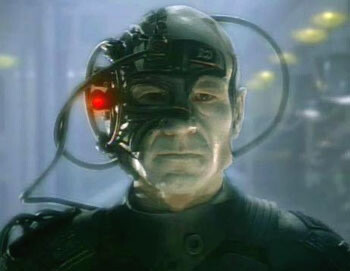
The parts are on their way. An NVIDIA “super computer” small enough to ride in a backpack. Hilariously it’s called a Jetson nano, so Rosey is going to be right at home. Also on the way is a pair of the latest open-source augmented-reality glasses called Halo built by Brilliant Labs — for which, I will note with some pride, I have already ordered prescription lenses, because a device you cannot see through is a device you will not wear. Then there is the latest version of the BirdWeather PUC, which now can hear bats as well as bird song, and it’s a nifty little weather station too. These PUCS run a cloud-based audio classification system called BirdNET that listens and tells me what is calling and roughly from where. I have a few other gadgets to include, but I’ll save you from the technical weeds for now suffice to say my 360 camera plays a role. Why do the BORG suddenly come to mind 🤪…
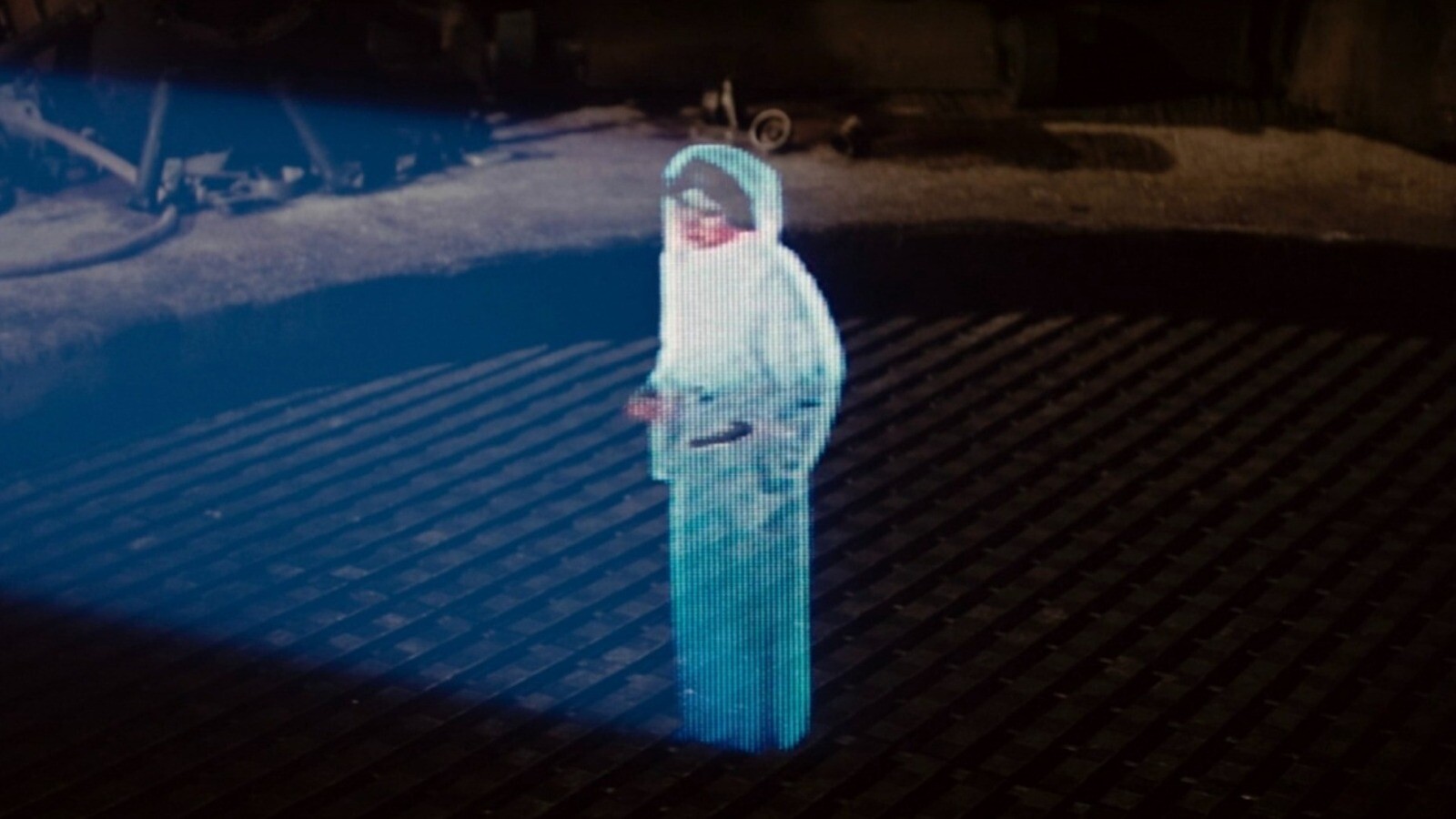
The glasses are the interesting piece, and not for the reason people assume. Their camera is nearly useless for imaging. The quality seems to be similar to the hologram of Princess Leia on the first Star Wars movie. What they are good for is knowing where my head is pointed — not where I am standing, which any phone can tell you, but where I am looking — and metering how much light is coming through the canopy above me.
That second one is the small miracle. Ecologists have chased canopy openness for a century with hemispherical photographs and hand-held densiometers, one careful reading at a time. A pair of glasses can sample it continuously as I walk, and stamp every reading with the moment it happened.
And that is where the whole thing becomes a puzzle about time rather than about intelligence. Each gadget in that backpack has its own clock, and clocks drift. If the bird detection and the light reading and the head-turn and any spoken remarks cannot all be lined up against a single trustworthy timeline, then I have a bag of unrelated data instead of an observation. The hard problem is not making the machine smarter. The hard problem is getting everyone in the backpack to agree on what time it is.
The rule I will not break
At a park near my home where I’m testing my inventions, the route runs between tall closed canopy and open gaps that give onto a vista, and the birds sort themselves accordingly. Eagles and turkey vultures over the open sky. Robins, thrushes, Song Sparrows and Bewick's wrens under the closed canopy. The rig should be able to show me both variables moving together while I am standing in it — the light rising as I step into a gap, the detected company changing on the same small display.
But the value is not the confirmation. Everybody already knows vultures like open sky. The value is in the places where the expected thing does not happen. The gap with no soaring birds. The dense stand that is oddly silent. Those anomalies are the entire reason to go outside, and you can only notice them if you already know what should have been there.
So there is one design rule I have set for myself, and it is the whole ethic of the thing: the machine speaks second.
If the glasses tell me what a bird is before I have decided for myself, they have not helped me. They have replaced me, and worse, they have quietly eroded the forty years of pattern-matching that is the only thing I actually bring to a survey. But if the rig records my call first and then offers its own, then two things survive that would otherwise be lost. My judgment stays intact. And every disagreement between us gets written down, geotagged and timestamped — a permanent record of exactly where a very capable machine and a very experienced naturalist saw the world differently.
Those disagreements are where a career's worth of judgment actually lives. Nobody has ever written them down, because until now there was no way to. I am sixty-something field seasons into a life spent looking at hillsides, and none of what I learned on them exists anywhere but in my head and a few thousand pages of notes nobody will ever read. Rosey's three kitchens are the same phenomenon in slippers — funny at home, and something closer to salvage out in the woods.
Two robots, one house, one forest
Here is the distinction I did not expect to find, and it is not a technical one.
Rosey should be autonomous and invisible. She handles a job whose entire value is in the outcome. If she ever needed my judgment it would be because she got tangled with a rug or something worse, and the day I stop thinking about her is the day she has fully succeeded.
The thing in my backpack must never be autonomous. It attends a job whose entire value is in the doing. Walking a transect is not a chore I am trying to escape. It is the best part of my life and has been since I was a student. A robot that offered to do my fieldwork for me would be offering to do my living for me.
Same underlying technology. Opposite specifications. The variable that flips the sign is simply whether the human wanted the work in the first place — which is a distinction economics has real trouble seeing, because from a productivity standpoint the mopping and the walking are the same category of labor. From inside a life they are not remotely the same thing.
I am seventy-one. My only real regret is the collection of things I could not do because the tools did not exist yet, and the delicious, useless speculation about where I would be now if they had. But I have come around to thinking the constraint was doing some work. Forty years of unanswerable questions is not wasted time. It is a specification, written slowly, in the only medium then available. Hand today's sensors to my younger self and he would have collected magnificent data and never developed the sense of what the data ought to look like.
No takeoff. No explosion. Just a shoebox with eyes mopping in the dark, and an old naturalist at the kitchen table at dawn — one of the three kitchens, anyway — waiting on a package so he can go outside and look at some birds in a different way than he could last year.
That will do.
References
- - Smith, N. (2026). "What will more intelligence actually do for us?" *Noahpinion*. https://www.noahpinion.blog/p/what-will-more-intelligence-actually-do ↗
- - Smith, N. (2025). "The Third Magic." *Noahpinion*, October 5, 2025.
- - Chollet, F. (2026). Posts on intelligence as a conversion ratio. X, March 2026.
- - Sosin, C. (2026). Quoted in Smith (2026).
- - Teslo, R. (2026). Quoted in Smith (2026).
- - Narayanan, A., & Kapoor, S. (2025). "AI as Normal Technology." *Knight First Amendment Institute*. https://knightcolumbia.org/content/ai-as-normal-technology ↗
- - McDonald, I. (2007). "Verthandi's Ring." In *The New Space Opera*, eds. Dozois & Strahan. Eos.
- - Hanna-Barbera Productions (1962). *The Jetsons*. ABC.
- - Kahl, S., Wood, C. M., Eibl, M., & Klinck, H. (2021). "BirdNET: A deep learning solution for avian diversity monitoring." *Ecological Informatics*, 61, 101236. https://doi.org/10.1016/j.ecoinf.2021.101236 ↗