
Small Enough to Tell the Truth
Most mornings begin with a question I can't answer by looking. There's a bird calling from the oaks just down the street from the house, and the question is simply: is it supposed to be here yet?
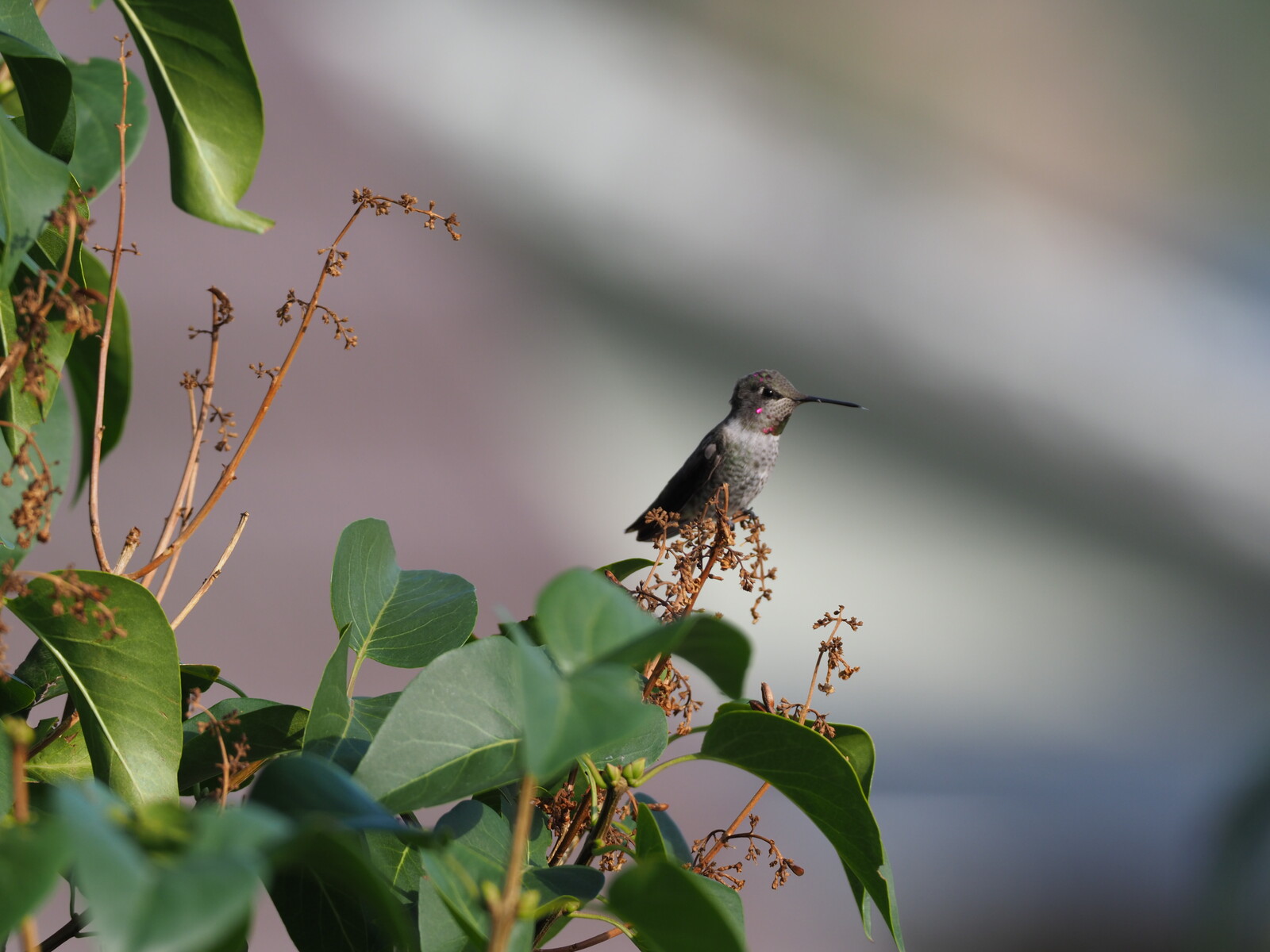
I have a small box that helps. It sits outside and listens, and when something calls it tells me the name — a Pacific wren, a purple finch, an Anna's hummingbird working the summer blooms. On some days I carry another of these boxes clipped to my backpack, so the walk itself keeps a record. Between them and the plants I photograph and the little weather stations in the yard, my corner of Oregon City is watched in as much detail as — and more reliably than — either of the two field stations I directed in my thirty-six-year career.
But the watching isn't the point. The point is the almanac — the accumulating sense of what should be arriving, calling, and blooming here on this day of this year. Once you have that, the intelligence isn't in the data at all. It lives in the gap between what the almanac expects and what the morning actually delivers. A bird three days early is not a data point. It is a small surprise, and surprise is where all the meaning hides. That gap is what I've spent my retirement trying to teach a computer to notice.
Which raises a fair question, one my family asks in gentler words: why does a retired field biologist have artificial intelligence in his home laboratory?
The flood past the fence
Here is the honest answer. On a couple of Mac Minis and a gaming PC I call Sauron, I run a collection of free, open-source models built by AI labs on three continents: Google's Gemma 4 in the US, France's Mistral, and China's GLM-5.2, from the firm Z.ai. The smaller versions I run on my own machines — which keeps my notes and photographs inside the house, no small thing to an old naturalist who distrusts the cloud — and I compare them against the full-size versions Ollama hosts in its private cloud, GLM-5.2 among them, for a fraction of what the big labs charge. And on the standardized tests the industry uses to rank these systems, GLM-5.2 — the current front-runner among the free models — lands about four points behind the very best model any company on Earth will sell you. Its makers describe it, with a certain glint, as offering "technical access without borders."
Sit with that. Four points behind the global frontier, free, private, and — this is the part that matters — impossible to recall. Once a model like that has been copied onto tens of thousands of machines around the world, no government anywhere can call it back. It is out. It is mine. It is everyone's.
Now set it beside what happened this past June. The U.S. Commerce Department ordered Anthropic to switch off its two most powerful models, Mythos 5 and Fable 5 — worldwide, for every customer, overnight — over a single reported flaw. The lid slammed shut in an afternoon. So we arrive at the strange shape of this moment: the models a government can control are the ones locked inside a few large companies, and the models nobody can control are already loose in the world. The second kind is sitting, right now, in my home laboratory, helping me think about hummingbirds.
What the law professor gets right, and the harder question
Into exactly this situation, a law professor named Matthew Tokson has written a careful and sobering essay, "Artificial Intelligence and the Lessons of History." His target is complacency. People wave away worry about AI by pointing backward — we feared the printing press and the automobile, and those turned out fine. Tokson's reply is that history offers no such comfort. Sometimes the skeptics were catastrophically wrong: the great physicists who swore, right up until the moment it happened, that splitting the atom for energy was a fantasy. Sometimes the optimists were wrong instead: everyone who promised the early internet would topple dictators, when mostly it taught them how to watch their citizens. His hardest pages are about the Cold War race for the hydrogen bomb, which the United States "won" only to see the Soviets match it within a year — buying no lasting advantage and several brushes with the end of the world. His warning to anyone insisting we must race China to ever more powerful AI is blunt: the prize is slight and temporary, the downside is unbounded.
I think he is right. He asks only that we refuse complacency, act under uncertainty, and never trust a single authority — because, as he puts it, even Albert Einstein got the future wrong.
And yet, standing in my own woods, I think he is answering the easier of two questions. There is a difference between whether we should act and whether the tools we reach for can still reach. Tokson wants to regulate. But the levers a government actually has — control the specialized chips, control the companies, fence the technology at the border — close mostly on the law-abiding. The flood is already past the fence. The model in my home laboratory is the proof of it.
The swarm
It runs deeper than leaked models, and this is the part that genuinely unsettles me. The one thing that was supposed to stay safely out of reach — the sheer expense of building these systems, the billion-dollar buildings full of specialized machines — is itself starting to come apart. Researchers have begun training AI not inside one company's data center but across thousands of ordinary computers scattered around the planet, strangers volunteering their spare machines the way people once donated idle computer time to search for signals from space. One group, Prime Intellect, trained a genuinely capable reasoning model this way. Another effort this spring let anyone with the right hardware join a single enormous training run — seventy-odd strangers on different continents, no permission required.
Today these swarms are still small. By one careful accounting from the research group Epoch AI, the largest is roughly three hundred times weaker than a corporate data center. But it has been growing about twentyfold every year — several times faster than the giants are growing. If that pace holds, the last moat is quietly filling in from the bottom. You cannot embargo a swarm.
So the honest picture is darker than complacency, and darker even than Tokson's careful worry. The genie will not go back into the bottle, and neither, it turns out, will the bottle.
Aria flies to the wrong Canemah
This is where my hobby stops being a hobby.
Because what I actually do, most days, at the kitchen-table scale of a few square blocks, is build the trustworthy version of the very thing everyone is right to fear.
Let me introduce you to Aria. I built a small assistant to sit on top of all my iNaturalist, eBird, BirdWeather, and Tempest records — the birds the boxes hear, the plants and animals I photograph, the weather my stations log — so that I could ask questions in plain English and get plain answers. I gave it a name, the way you would a research assistant. One evening I asked Aria to take me home, to the laboratory where I work, and she confidently swept the map to a public park a mile down the road and described it, warmly and in detail, as though it were my own backyard. Another time she told me a place held about seventy-eight thousand records — and in the same breath that it held eighty-nine thousand sightings of a single hummingbird. A whole smaller than one of its parts.
These are funny little failures. They are also, precisely, the failure a superpower arms race is made of: fluent, confident, and wrong. An AI's dangerous mode is never silence. It is certainty from the wrong source.
And the fix, it turns out, is not cleverness. It is discipline about where knowledge comes from. In my little system, every fact now has to declare its origin — is this from my own records, from the field guide, or from the wider web — and it is never allowed to dress one up as another. My own counts are mine and exact; a claim about a bird's range that the machine looked up must arrive with its source attached, not as a confident guess wearing the costume of a measurement. Aria learns which place is genuinely my home, stops confusing it with the park, and remembers the correction so she never makes it twice.
That sounds modest. It is the entire game. The thing that separates a trustworthy collaborator from a confident fool — for my backyard and for a missile-warning computer alike — is that it knows what it actually knows, and says so plainly.
A truth no one can capture
There is a second discipline, and it is the one that turns a private hobby into something like an answer.
My records belong to me. My neighbor's belong to my neighbor. The plants and birds anyone can see in a public wood belong to everyone. And the shared backbone underneath — the tree of life, the map of place-names, the agreed methods — is common ground that no one owns and anyone may build on. So a classroom, a field station, or a family need not copy my system or surrender their data to me. They stand up their own small corner against that shared backbone, keep private what is theirs, and contribute only what they choose.
This is not a fantasy of mine. It is, almost exactly, the architecture the national laboratories are now using to train scientific AI across separate institutions without ever pooling their sensitive data — Argonne among them — except that theirs runs on supercomputers and mine runs on three small computers in Oregon City. Same idea. Ownership decides what you are allowed to see; a commons holds the shared truth; and no single power can seize the whole of it.
Here is what a month of this work taught me. You cannot govern the flood from a capital. But you can build, for one location, a small working model of a technology that governs itself — through ownership, through honesty about sources, through a commons anyone may join and no power can capture — and then you can teach people to build their own by handing them the keys. A visitor comes and learns. A participant sets up instruments and begins to contribute. Either way, they are learning the oldest naturalist's discipline — look carefully, claim only what you can support, mark plainly what you are unsure of — in the newest imaginable medium.
That, I have come to think, is what advocacy for the Earth now asks of us. Not that we care harder; we have caring to spare. It asks that we build the honest version of the ungovernable thing, at a scale small enough to keep it truthful, and then give it away.
Small enough to tell the truth
I want to be clear about how unfinished this is. My system stores and serves; it does not yet truly notice or reason. But I'm getting closer. The part that would spot the early warbler on its own, the part that would puzzle out why — those are still design goals on paper, not switches I have thrown. And Aria still gets my own backyard wrong often enough to keep me humble. But these are just engineering gotchas to be sorted out, not insurmountable challenges. In September I will be sharing my new prototype of the Macroscope with colleagues at the annual meeting of the Organization of Biological Field Stations. I'm confident that what I will show them should be less a demonstration than an invitation. Field stations are the natural first citizens of this idea — dozens of them, each already watching its own patch of ground for decades, each holding records no one else has. What I want to show my colleagues is not a finished instrument to admire but a seed to plant: a way for every one of them to stand up their own corner against the shared backbone, keep their own data their own, and add their patch to a picture none of us could assemble alone. Not "look what I built," but "look what we could build together, and no one could take from us."
That is the whole wager, and it is smaller and older than it sounds. A network of people who each watch one place closely, tell the truth about what they see, mark plainly what they're unsure of, and share what they can — that is just natural history, the discipline I was trained in forty years ago, wearing new clothes. The technology that frightens the capitals is the same technology that, at this scale and under this discipline, lets a retired biologist and a classroom and a field station in Maine each hold a true piece of the living world and hand it to one another.
So most mornings I go back out to the woods with a box that listens and a question I can't answer by looking, and I try to build something honest enough to help me answer it. It is a small thing to do about a very large one. But small enough to tell the truth may be exactly where the answer starts.
References
- Lidin, J., Sarfi, A., Miahi, E., Anthony, Q., Chauhan, S., Pappas, E., Thérien, B., Belilovsky, E., & Dare, S. (2026). "Covenant-72B: Pre-Training a 72B LLM with Trustless Peers Over-the-Internet." arXiv:2603.08163. ↗
- - Prime Intellect (2025). "INTELLECT-2: A Reasoning Model Trained Through Globally Decentralized Reinforcement Learning." arXiv:2505.07291. ↗
- - Google DeepMind (2026). "Gemma 4." Ollama Model Library. https://ollama.com/library/gemma4 ↗
- - Mistral AI (2026). "Mistral." Ollama Model Library. https://ollama.com/library/mistral ↗
- - Tokson, M. (2026). "Artificial Intelligence and the Lessons of History." SSRN Working Paper No. 6875838.
- - Z.ai (2026). "GLM-5.2." Ollama Model Library. https://ollama.com/library/glm-5.2 ↗
- - Epoch AI (2025). "How far can decentralized training over the internet scale?" https://epoch.ai/gradient-updates/how-far-can-decentralized-training-over-the-internet-scale ↗
- - International Association of Privacy Professionals (2026). "US government order forces commercial suspension of two frontier AI models." https://iapp.org/news/a/thought-for-the-week-us-government-order-forces-commercial-suspension-of-two-fronteir-ai-models ↗
- - Argonne National Laboratory (2025). "Privacy-Preserving Federated Learning for Scientific Research." https://www.anl.gov/cels/privacypreserving-federated-learning-for-scientific-research ↗