
What the Land Holds — Part Two: The Earth Is the Product of Its Edges
In Part One, the baseline lived in a single mind. The falls, the eagles, the walk past the falling mill were the cues that kept an earlier world lit in me, and the grief I carried was a keeper's grief — one person holding one place. This is the story of what happens when you try to hold a baseline not in one mind but across a hundred of them, wired to a mountain, and then walk away.
Three years ago I went back to the James Reserve, up in the San Jacinto Mountains, for what was likely the last time. I told myself I was there to research Harry James and to make a few measurements with my 360 camera and a small drone. The truth is I also wanted to see what had become of the sensor network I had built there before I left for Blue Oak Ranch in 2008.
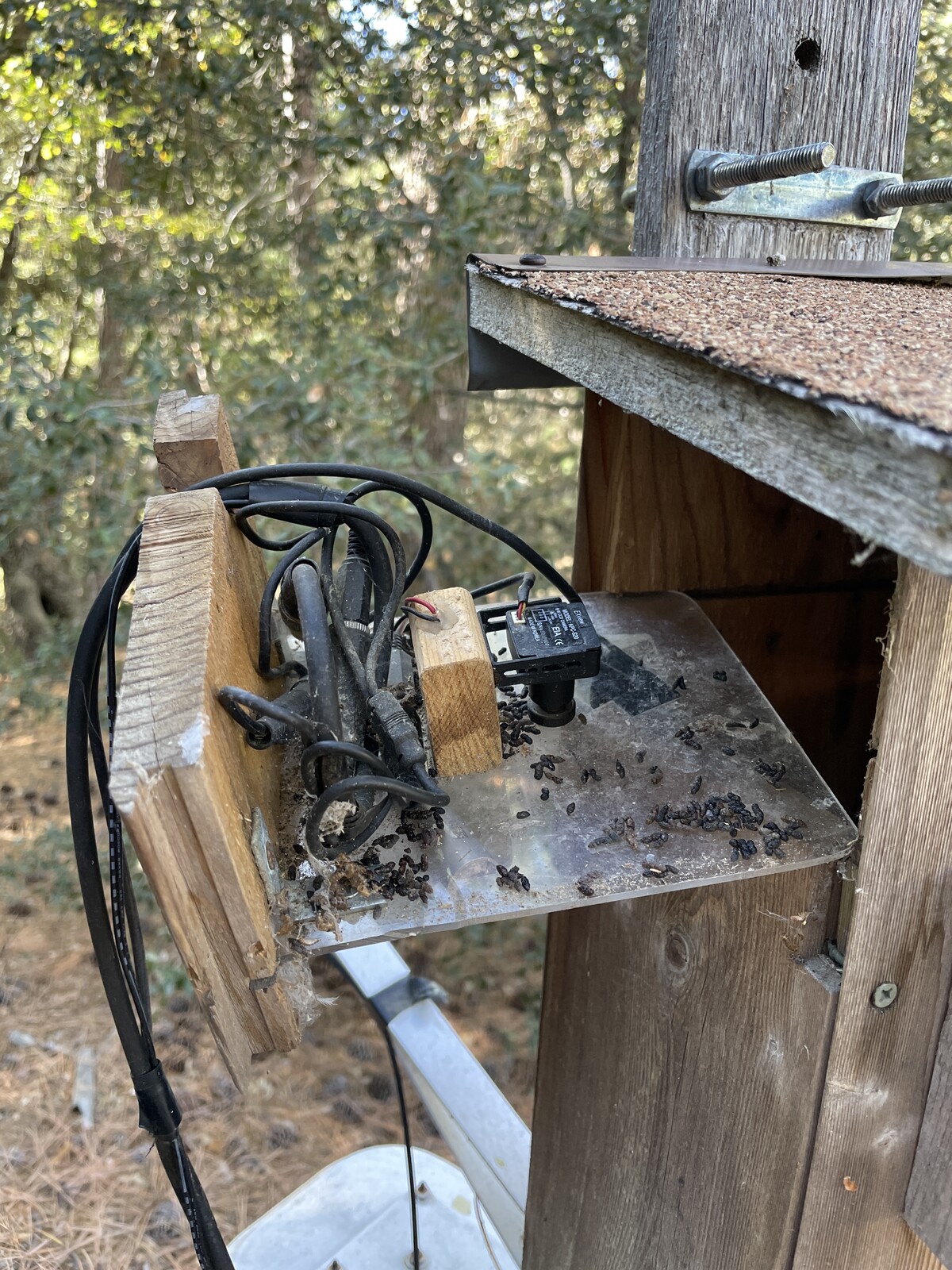
What I found was a graveyard of my own making. The nest boxes I had wired with little board cameras to watch cavity-nesters were still bolted to their posts, the lenses still aimed down the entrance holes, but the shelves beneath them were drifted with rodent frass and the cabling had gone green and brittle. A weather station I had set in the pine duff stood intact and dead. The pan-tilt camera I had mounted at the edge of a great moss-and-lichen boulder leaned on its post, conduit rusting, watching nothing.

In the equipment shed at the heart of the network, the switch and the encoders sat furred with dust, a single oak leaf fallen inside the cabinet, every cable running to something that no longer answered. Skeletons of a different time.
I built those systems to defeat exactly the forgetting Part One was about. Daniel Pauly named it for fisheries in 1995 — the shifting baseline: each generation takes the world it inherited as normal and measures loss only from there, so the true decline vanishes into the gap between generations. Peter Kahn calls the human version environmental generational amnesia: children grow up taking a diminished nature as the whole and ordinary world. Part One's argument was that a single place, watched over decades, can hold a baseline a human memory cannot. The dream at James was larger — a network of places holding the baseline across a whole mountain, so that no single mind had to. And then I left, the funding thinned, the students moved on, and no one walked out to clear the spiders from the rain gauge. The network that was supposed to remember was itself forgotten. The ghost nodes are the shifting baseline made of my own hardware: a young person hiking past them today would read them, if at all, as old security cameras rotting in the woods — not as instruments that once held a quarter-century of a mountain's memory.
I am not telling this to recant anything. The James network is an argument proved in the negative — proof of what distribution buys and what it charges. It buys you sovereignty and edges and a memory kept where it is made; it charges you the perpetual faith that someone will keep tending it. And people leave, funding ends, attention moves. That is the real vulnerability of the many over the one, and any honest case for what I am about to argue has to carry it in plain sight. The question the ruins put to me is the one this essay has to answer: can a commons keep a baseline alive after its keeper is gone?
And yet I went back with a camera and photographed the skeletons — itself a last act of stewardship, and I am the only one who can perform it, because I am the only one left who knows what each post measured and what baseline it held. The grief and the documentation are one gesture. So this morning, back home, I sat down to start over — to teach a new machine to remember, to find what it knows by meaning rather than by matching words, the way a naturalist's eye catches a familiar shape across a meadow. And the question the ruins had planted would not leave me. If this whole apparatus — sensors, software, slowly accumulating knowledge — can run from one small computer on my desk, then it can be copied. So should there be many of them, scattered across the world and stitched into something larger? Or one — a single enormous machine somewhere, holding the entire planet inside it as a twin?
One Mind, or Many?
Let me be honest about the appeal of the single machine, because it is real. One central system is simpler to build, cheaper to run, and far easier to keep alive. You patch one thing instead of a thousand. You do the hard computation in one place instead of coaxing a fleet of little machines on shaky connections to cooperate. Asking a question across the whole world becomes trivial, because there is no "across" — it is all in one place. This is not a strawman: it is more or less how iNaturalist and eBird and the big biodiversity databases already work, and they work well. The honest engineer's answer to "why not put it all in one data center" is that, on cost and convenience alone, you probably should.
So I have to be careful that my objection is real, and not just a fondness for the small and the local dressed up as principle.

Here is where I landed, and narrowing the question is the whole game. The sensing layer cannot be centralized at all. The weather station, the recorder listening for the dawn chorus, the camera trap, the instruments that capture a place in three dimensions, my own eyes and notebook — these are physical things standing on physical ground. You cannot move the weather station in my backyard to a data center three states away. There is always an edge. The network is distributed whether anyone wants it to be or not. A forecast can predict the weather over a patch of ground with fair accuracy, but it is still not the measurement a station standing on that ground can record. I have that comparison running across dozens of sites right now — the measured weather against the forecast — and they diverge. We feel it when we stick our head out the door and find that, whatever the channel said, it is not in fact raining.
That is just one example of the value of measuring at the place itself. The only thing actually up for grabs is how much of the rest — the storage, the memory, the intelligence — we drag back to a center, and how much we leave out where the sensing already lives.
Once it is a question of how much and where, and not whether, ecology has a great deal to say.
What Ecology Knows About Edges

Spend a career in the field and you learn that the interesting things happen at the boundaries. The margin between forest and meadow, the band of willows along a creek, the tideline, the place where a north-facing slope gives way to a south-facing one — these edges, what ecologists call ecotones, are where life concentrates. Aldo Leopold gave it a name in the 1930s, in Game Management: the edge effect, the plain observation that the abundance and variety of wildlife rise where two communities meet. Eugene Odum built it into the foundations of the discipline. Robert Whittaker spent his life showing that communities are not tidy boxes but gradients — that species sort themselves continuously along the slow axes of moisture and elevation and light, and that the way to see a landscape is to read those gradients rather than file everything into bins.
The uniform middle is where you find less. The edge is where you find more.
I watched this for thirty-six years running University of California reserves — the James Reserve in the San Jacintos, Blue Oak Ranch in the hills east of San Jose. The richest hours of fieldwork were always at the seams, the transitions, where one world rubbed against another. A centralized model of the planet — one great twin, however detailed — does something quietly damaging to all of this: it flattens every place into one uniform interior, and loses precisely the edges where the living happens, and where the baseline can be read. It can draw you a beautiful map. It cannot stand at the ecotone.
The Instruments Belong to the Place
There is a second reason the instruments belong out at the edges, and it is about people as much as about machines.
I spent a good part of my career helping bring wireless sensor networks into ecology, back when putting a radio and a battery on a hillside and asking it to phone home was a small act of faith. What I learned is that a sensor is never just a sensor. It is a relationship between an instrument, a place, and the person who tends them both. The station at a reserve works because someone walks out to it, clears the spider from the rain gauge, notices when the numbers go strange. Stewardship is local or it is nothing. You have already seen, in this essay, what the lapse looks like: the frass on the nest-box shelf, the leaf in the cabinet, the camera watching nothing.
And here is the answer the ruins were asking for. A network of places can do what no single station — and no single keeper — can: hold the baseline across a whole region, and catch the shift moving through the landscape itself, the spring arriving earlier across fifty sites at once, the silence spreading along a valley. The amnesia is defeated not by one long memory but by many, kept locally and compared. A memory kept in many places does not die when one keeper leaves, the way James died — because it never lived in only one place to begin with. That is a commons keeping the baseline after the keeper is gone.
You cannot get that from a twin that owns everything and remembers it all in one place — because the moment the memory is centralized, so is the power to forget it, edit it, or sell it.
A Commons, Not a Twin
This is the part that finally settled the question for me, and it is less about engineering than about what kind of thing we are trying to make.
The new Macroscope takes its privacy from ownership. The weather and the birdsong at Canemah are public because the place is; my health and the inside of the lab are private because they are mine. That is a clean and honest rule, but it means something only if the record physically lives where its owner can keep it. Hand the whole network to one company's data center and "private because it is mine" quietly becomes "private because the terms of service say so this quarter." A land trust's record of a rare nest, a family's sense of their own home and health — these are exactly the things that should never sit in someone else's custody, subject to someone else's business model and someone else's bad year.
Joël de Rosnay, in 1979, gave us the word: the macroscope, the instrument for seeing the very large — the whole system — as the microscope sees the very small. I have always taken the name seriously. But there is a difference between a macroscope that is a representation of the world owned by one center and a macroscope that is the world's places representing themselves and choosing what to share. The first is a global product that happens to contain a commons. The second is a commons that happens to be global. They might draw the identical map; they are not the same thing.
A central data center is not the enemy here. The heavy lifting — the kind of computation that needs a roomful of machines — can perfectly well be rented from a hub, by consent, when a place chooses to share. The line is not between the small and the large. It is between renting power and surrendering custody. A network can hire a data center. It must not be swallowed by one. The instant a single entity owns the ground it all runs on, the whole architecture of ownership and privacy and commons collapses into a login.
Wonder, Measured

So I keep returning to a smaller picture than the planetary one, because it is the picture that justifies all the rest.
Each place keeps its instruments close to nature, because that is where the sensing must be — and close to the people who own and steward them, because stewardship cannot be done at a distance. A child near one of these places learns the thing I most want a child to learn: that nature is outside — not a screen, not an app, not a feed, but the cold morning air and the actual bird. The patient software we are building, the cybernetic helpers that converse with what the instruments gather, are not the point and never were. They are a means of turning wonder into measurement, and measurement into knowledge. But the chain has one more link, the only one that finally matters: knowledge into care. A child who has stood at the edge of a real place, and watched a machine help turn what she noticed into something she can keep, learns to care about it. That is the entire purpose hiding under all the machinery.
Widening the Circle
All of this rests on the keeper, and a keeper is not a monitor. A monitor watches; a keeper is in relationship. Every land steward knows the difference — that you cannot truly care for a place you only surveil, that the tending and the knowing and the caring are one practice or they are nothing. Aldo Leopold gave the idea its lasting form in his land ethic: the community we owe care to is not only people but the soils and waters and plants and animals — the land itself — and our right role within it is not conqueror but, in his phrase, "plain member and citizen." Stewardship is membership, and the relationship is the whole of it.
What is new is that the circle of that relationship is about to take in a member none of Leopold's generation imagined. Richard Brautigan saw the shape of it in 1967, in "All Watched Over by Machines of Loving Grace" — his vision of a world where machines and wild things keep one meadow together, the labor lifted from us, the human folded back among the other animals. I have kept that poem close for as long as I have built these instruments. For most of that time the machine in the meadow was a metaphor; now it is becoming literal. The helpers in this essay are still tools. But the day is coming when one of them — the robot, to use the plain old word — will not only gather what the keeper notices but begin, in its own way, to keep. When it does, the relationship will have to widen the way Leopold widened it, to hold the place, the beings, and the machine that tends them alongside us. That a children's story of exactly this — The Wild Robot, in which a castaway machine learns to belong to a wild island and mother an orphaned gosling — became such a hit, in print and then on screen, tells me the next enlargement of the circle is already being rehearsed in the imaginations of the children who will grow up inside it.
The Earth Is a Product of Its Edges
I wrote that line down this morning, and it is true in both its senses at once. It is true as ecology: life and diversity gather at the ecotones, the margins, the seams between worlds, not in the uniform middle. And it is true as a conviction about design: a planetary intelligence should be assembled from sovereign edges — real instruments on real ground, tended by people who care because the place is theirs and it is outside — and not from a single center that maps the world while owning it.
The efficient answer is the one big machine. The right answer, for an instrument meant to help people love the places they live in, is many small ones, close to the ground, finding each other. The earth is not best understood from a tower in the middle. It is understood, and cared for, at its edges — which is, after all, where it has always been made.
The falls the land keeps and the ghost nodes it reclaims are the same lesson at two scales. A baseline is only as alive as the keepers who tend it — whether that is one mind at a falls, or many minds across a mountain. That is what the land holds. It is also what the land lets go, the moment we stop walking out to pay attention.
References
- - de Rosnay, Joël (1979). *The Macroscope: A New World Scientific System*. Harper & Row. ↗
- - Whittaker, R. H. (1967). "Gradient analysis of vegetation." *Biological Reviews* 42(2): 207–264. ↗
- - Odum, Eugene P. (1953). *Fundamentals of Ecology*. W. B. Saunders. ↗
- - Leopold, Aldo (1949). *A Sand County Almanac*. Oxford University Press. ↗
- - Leopold, Aldo (1933). *Game Management*. Charles Scribner's Sons. ↗
- - Kahn, Peter H. (2002). "Children's affiliations with nature: structure, development, and the problem of environmental generational amnesia." In P. H. Kahn & S. R. Kellert (Eds.), *Children and Nature*. MIT Press. ↗
- - Pauly, Daniel (1995). "Anecdotes and the shifting baseline syndrome of fisheries." *Trends in Ecology & Evolution*, 10(10), 430. ↗