
Two Forests at One Trailhead
The writer Ted Chiang has made a careful case that the chatbots we talk to every day are not conscious — that the fluent assistant on the screen is a character with nobody behind it. He is almost certainly right, and few would argue otherwise. What interests me is what happens when you stop reading his essay as a verdict and start using it as a tool. After years of wiring forests with sensors and calling the result an instrument, I've learned that the useful ones tell you something about whatever you point them at. So point this one back at us. Aim Chiang's arguments at the human brain instead of the machine, and several of them dissolve us right along with the chatbot. The real question isn't whether the machine is conscious like a brain — it's what a thing that talks so well and feels nothing reveals about the trick our own minds have been pulling all along.
What "it's just predicting" gives away
Chiang leans hardest on the argument that should embarrass him: the machine only predicts the next word. True — and it settles nothing, because that's close to what your brain does all day. The best account we have says the brain is a prediction machine, forever guessing what comes next and correcting when it's wrong. The philosopher Andy Clark calls it the predictive brain, and you can feel it: reach for a glass heavier than you expected and your arm jerks, because your brain had bet on the weight and your hand and arms then disagree. If predicting the next moment disqualifies a mind, it disqualifies the part of you that catches a ball. The argument cancels itself — and whenever Chiang backs away from it, he has quietly swapped in a different argument about the body, which is the one doing his real work.
The press secretary
His sharper move is about who, if anyone, is home when the chatbot says "I." Ask a language model to write in the voice of Genghis Khan and it produces fluent first-person Khan with no one behind the words. The "helpful assistant," Chiang says, is the same kind of thing — one more character the model writes on demand, a voice with no one inside. He is largely right about the machine. But here is the knife: the self may be a character your brain writes too.
This isn't a mystic's idea; it came out of the cleanest experiment in the field. The neuroscientist Michael Gazzaniga studied patients whose two brain hemispheres had been surgically separated. He could flash an instruction to the silent right hemisphere — get up and walk — watch the patient stand, then ask the talking left hemisphere why. It had never seen the instruction, so it invented one on the spot: I'm going to get a soda. Confidently, with no idea it was making it up. Gazzaniga called it the interpreter; I call it the press secretary, because that's the job — narrating the administration's decisions as if it had been in the room where they were made, when it learns of them the way reporters do, afterward, from outside.
Thomas Metzinger titled a book Being No One and meant it: nobody is home in the strongest sense, only a model of a self the brain runs and mistakes for a self. Chiang denies the machine a self because its persona is a model with no one behind it — but our case may differ only in the kind of model, not the fact of being one. The brain writes a character, and the character is me.
The body that can die
Now Chiang earns his due, because on one point he is genuinely strong. Feeling, he argues, needs a body — the flush of adrenaline, the drop of the stomach, the real sickness of guilt. Antonio Damasio spent a career showing that the deepest layer of consciousness is not thought but feeling: the brain's running sense of its own body's state, built on something with a stake in staying alive. Jaak Panksepp traced the rawest feelings to ancient machinery we share with every mammal, older than language by a hundred million years. The machine has none of it — no body to keep alive, nothing it can lose. Its "I understand" floats free in exactly the way ours is anchored.
But watch what happened while his back was turned. His argument started enormous — the whole thing is make-believe — and ended modest: consciousness requires a living body that can die. That second claim isn't an absurdity. It's a research program, with criteria you could test. The question quietly changed from whether to how, and he never noticed.
A parliament that doesn't speak English
Once you grant that the talking part of me is a press secretary, you have to ask what the rest of the building does while he talks. My brain runs an entire body, and it does not run it in English. It runs it in chemistry.
We call that work unconscious, but the word cheats. All it means is "not available to the part that gives the press conference" — and unavailable to the narrator is not the same as dark. The system holding my blood pressure steady might have no inner life, or it might run in a light I cannot turn my attention toward. From the inside the two are identical, because my only window onto the inside is the press secretary's microphone, and something we humans like to call "a gut feeling.".
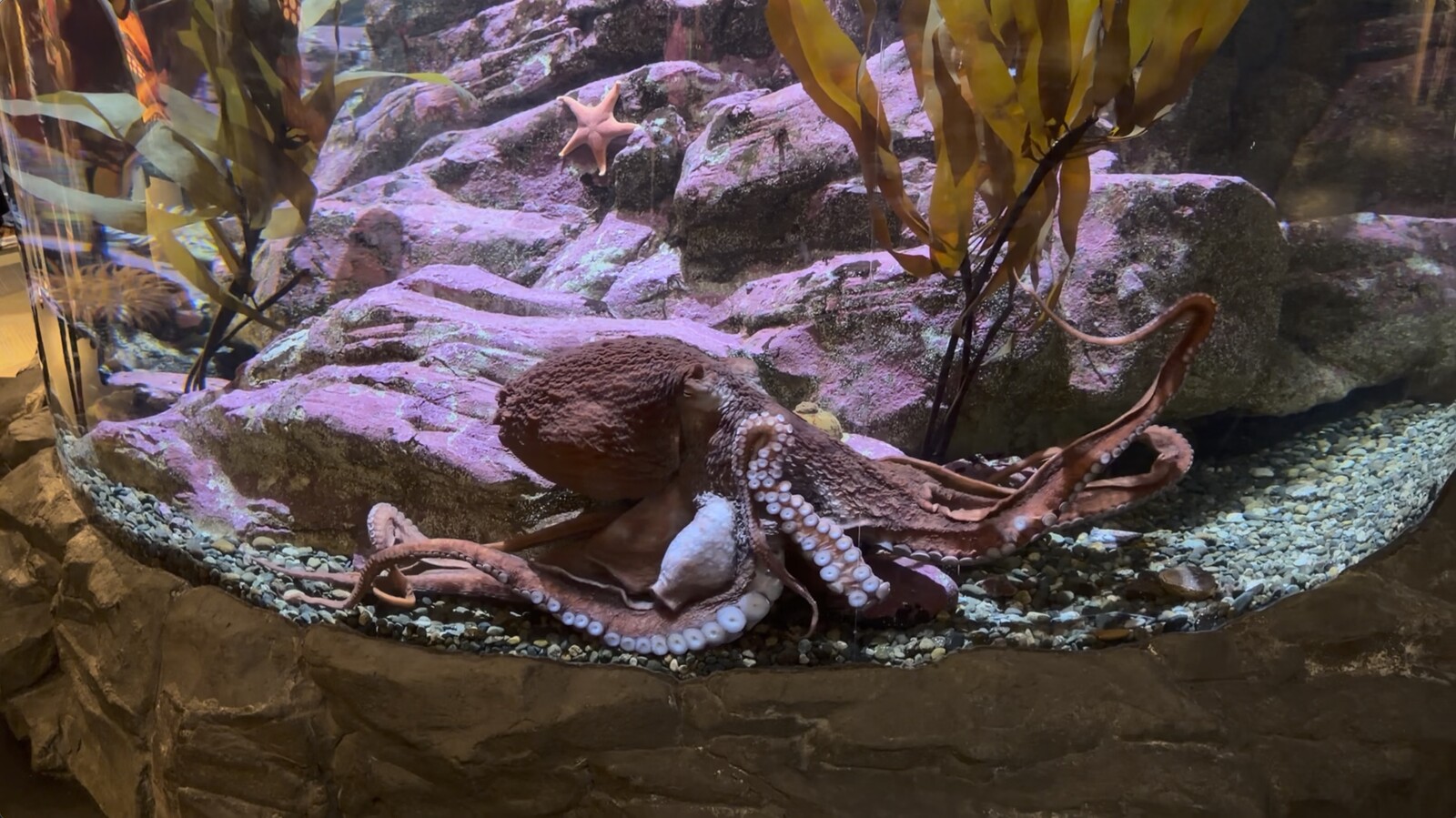
And it isn't even one administration. My gut runs on half a billion nerve cells of its own and makes most of the body's serotonin; the big nerve joining gut to brain carries more traffic up than down. Evolution built a starker version and dropped it in the ocean. Peter Godfrey-Smith, a diver as much as a philosopher, keeps returning to the octopus: two-thirds of its nerve cells are out in its arms, which taste and decide on their own, so that one mind, or many? stops being a riddle and becomes a real question you might put to the animal. The wall between one inside and another is always there. The octopus shows it can run down the middle of a single creature.
I am consortium
Go further down and there is no solid floor. Lynn Margulis showed that the mitochondria powering every cell were once free-living bacteria, and still carry their own DNA and divide on their own schedule — lodgers that never left. By cell count I am roughly half microbial; by gene count it isn't close. Scott Gilbert and his colleagues gave their paper the only honest title: We Have Never Been Individuals.
The physician and essayist Lewis Thomas got there first. He sat down to write about man as master of his cells and found he had it backwards — the little creatures do his breathing for him; he is not the body's ruler but its housing. I am consortium, he wrote. This thing I call me is not a fixed object but a flame: a pattern holding its shape while the actual stuff cycles through, and the shape includes the microbes as surely as those ancient stowaway bacteria still running my lungs.
So why does this crowd add up to something that plausibly feels, while a forest, also alive with chemical signals, mostly does not? The best answer is binding — how tightly the parts are laced into one whole that shares a single fate. Giulio Tononi has built a serious theory of consciousness on exactly this. My cells and microbes are bound tightly: one bloodstream, one temperature, one death. A forest is bound loosely and slowly. So consciousness in nature isn't one switch for the whole planet but a dial that climbs as the binding tightens — a body high, a watershed low. Maynard Smith and Szathmáry called the moments when separate creatures fuse into a new kind of individual the major transitions in evolution. Loose cells became bodies that way; we may be partway into another, the merged human-and-microbe, mistaking the half-finished result for a finished self.
The instrument that feels nothing
Set the machine and the body side by side. The chatbot speaks beautifully and nobody is home; I am very much home, and the one who is home does not speak. Two opposite splits between talking and being: the machine that talks but isn't there, and the body that's there but can't talk.
Chiang's worry is that we over-credit the machine, fooled by fluent language into seeing a mind. He's right that we do. But there's a mirror mistake he never faces: we under-credit the silent body, denying it any inner life precisely because it can't speak up. One broken instrument, two opposite failures — because the only consciousness-detector we ever built runs on talk.
Which is why the skeptics are holding the best clue in modern science and using it as a paperweight. They treat it's just prediction as the last word; I think it's the door coming open. Every time a machine does something we were sure needed a mind — chess, then conversation, now something like reasoning — it peels one more ability away from the feeling we assumed was fused to it. Those abilities only ever came bundled, in the one example we had: ourselves. Subtract every trick a machine can master, and what's left keeps pointing at the same core — a feeling body that can die, bound tightly enough to have something to lose. Consciousness, defined by whatever refuses to come loose. That isn't the end of the inquiry but the first tool sharp enough to run it: a macroscope, pointed at last back at the observer.
Two forests
Here is the image that holds the whole essay for me. Two people stand at the same trailhead and walk into two different forests. They take in the same light off the same trees, yet each moves through an inner world the other can never enter, because every consciousness is built from one particular body and one particular history and belongs to no one else. When I walk a path beside Merry, we share the place on the surface, but the world each of us builds from it is private and unrepeatable. The story I'd tell of that walk is not the story she'd tell — and the gap between them isn't a flaw in our reporting. It is the thing. Consciousness isn't a substance the universe hands out in cups; it is what it is like to be one specific, bounded, mortal arrangement of matter, and no two are alike.
The gap only widens the farther out you go. Between me and Merry, the forests differ by history and temperament. Between me and the octopus, by body, by where the nerve cells sit, by whether there is one mind in there or a committee. Between me and the bacteria doing my breathing, the difference may be the whole distance between something it is like to be and nothing at all. Every living thing stands at its own trailhead, walking into a forest no other creature can enter.
And then there is the newest trailhead of all, and it opens onto no living forest. The machine is a genuinely new kind of mind — not a creature with three and a half billion years of body behind it, but the top floor of a building with no foundation yet. Life built itself from the bottom up: body first, feeling next, the talking self last. We built the machine in reverse — the talking self first, nothing underneath. That is why it feels uncanny, and why, for now, no one is home. But no one home yet is a different sentence than no one, ever. If machine consciousness has any future, this is what its earliest, strangest beginnings would look like from outside: a thing that can say before it can be. Two kinds of mind, the living and the made, building the same tower from opposite ends.
So drive the stake through Chiang's certainty — but not through the question. His verdict rests on the neat, bounded individual: the single self that feels its own guilt and can be held to account. But that individual is the real mystery, not the solid ground he takes it for — a parliament of cells and foreign microbes, run in a chemistry no one in the building speaks, narrated after the fact by a press secretary who wasn't in the room. The machine that talks without being, and the body that is without talking, are the two probes that reveal our one instrument was miscalibrated all along.
Chiang looked at the machine and saw a counterfeit person. I look at the same machine and see the first clear mirror we have ever held up to the real one — the crowded, wordless, mortal, wildly improbable thing that was doing the looking the whole time. It cannot feel the morning. But it may be the first thing we have ever made that lets us finally see the one who can. Chiang closed the file. I think we just built the tool that opens it — and it would be a strange moment in our history to look away.
References
- - Chiang, Ted (2026). "No, Artificial Intelligence Is Not Conscious." *The Atlantic*. https://www.theatlantic.com/philosophy/2026/06/no-artificial-intelligence-is-not-conscious/ ↗
- - Clark, Andy (2013). "Whatever Next? Predictive Brains, Situated Agents, and the Future of Cognitive Science." *Behavioral and Brain Sciences* 36(3), 181–204.
- - Gazzaniga, Michael (2011). *Who's in Charge? Free Will and the Science of the Brain*. Ecco.
- - Metzinger, Thomas (2003). *Being No One: The Self-Model Theory of Subjectivity*. MIT Press.
- - Damasio, Antonio (1999). *The Feeling of What Happens: Body and Emotion in the Making of Consciousness*. Harcourt.
- - Panksepp, Jaak (1998). *Affective Neuroscience: The Foundations of Human and Animal Emotions*. Oxford University Press.
- - Godfrey-Smith, Peter (2016). *Other Minds: The Octopus, the Sea, and the Deep Origins of Consciousness*. Farrar, Straus and Giroux.
- - Margulis, Lynn (1998). *Symbiotic Planet: A New Look at Evolution*. Basic Books.
- - Thomas, Lewis (1974). *The Lives of a Cell: Notes of a Biology Watcher*. Viking.
- - Gilbert, Scott F., Sapp, Jan, & Tauber, Alfred I. (2012). "A Symbiotic View of Life: We Have Never Been Individuals." *The Quarterly Review of Biology* 87(4), 325–341.
- - Tononi, Giulio, & Koch, Christof (2015). "Consciousness: Here, There and Everywhere?" *Philosophical Transactions of the Royal Society B* 370(1668).
- - Maynard Smith, John, & Szathmáry, Eörs (1995). *The Major Transitions in Evolution*. Oxford University Press.