
The Instrument Hiding in the Panorama
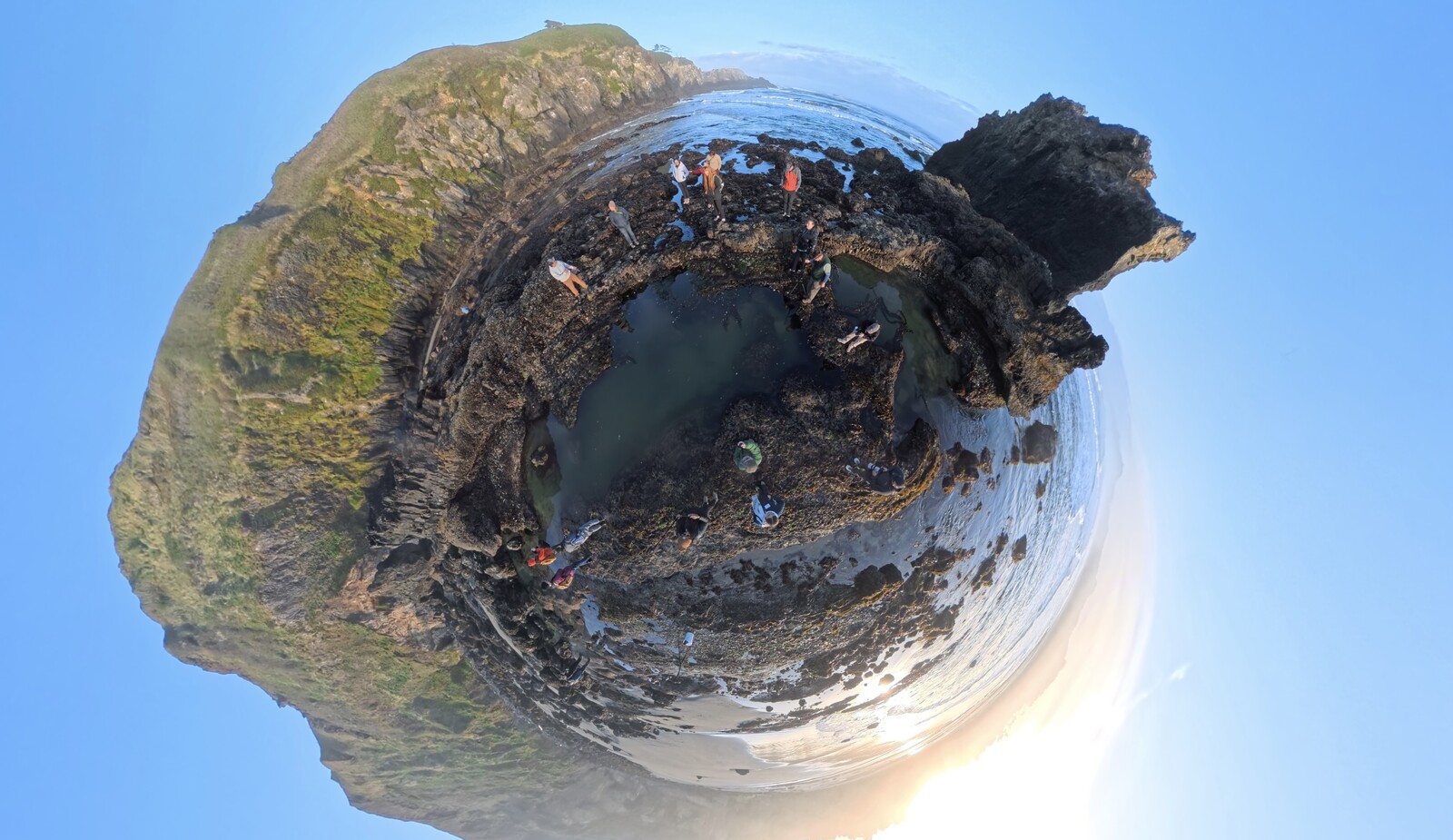
We gathered at a quarter to six and went down the cliff while it was still half dark, a line of field station managers and teachers clambering toward a minus 1 foot tide. The intertidal at a tide that low is a country that surfaces only a few mornings a year, and it does not stay long. We came down into it as the sun cleared the headland — a brisk, bright dawn, the rock streaming, and all around us the exposed plethora that a great low tide gives up: anemones folded in on themselves, sea stars, the whole crowded vertical economy of a Pacific shore laid briefly bare.
Several of us were filming. An Insta360 X5 on a selfie stick, turning slowly to swallow the whole sphere of the morning; a GoPro Hero or two; a scatter of phones. We were, without quite saying so, bridging the old space between natural history and digital documentary — the same impulse that has always sent people to the tide line, now carrying glass and sensors. Professor Itchung Cheung moved among us naming organisms, because he knows that shore the way I once knew my own, and a few of us were simultaneously photographing with our iPhones and feeding the images straight into iNaturalist, watching the identifications come back while the animals were still in front of us. It was a perfect merger of wonder and tech. Before anyone in that group said the word research, the science was already happening, on wet rock, in the cold.
I had come to that coast for a workshop of The Virtual Field — the NSF-supported network that brings field stations and marine labs to students who cannot travel to them — to show these people something, and the spheres we were shooting at dawn were, though none of us paused to think it, already the thing I had come to talk about.
A picture you can stand inside, and what else it might be
For the better part of my career, and more recently the past few years, I have been building what I call the Macroscope, an attempt to hold EARTH, LIFE, HOME, and SELF in a single observational frame. Much of it is plumbing. But one piece had been changing under my hands, and it was that piece I carried into the workshop room later that weekend: the eco-splat.
A 360° panorama, to the eye, is a picture you can turn around inside. To the new generation of splatting algorithms it is something else entirely — a dense field of evidence about the geometry of a place. Feed the sphere through a 360°-native reconstruction and you no longer have a photograph; you have a measurable, registered model of three-dimensional space. The canopy gap is not a bright patch in an image. It is a volume you can put a number on. The downed log is not a brown smear in the lower third of the frame. It is an object with length and orientation and a position you can return to next year to ask: is it still there, and has it moved? And it sees what orbit cannot. A satellite land-cover map will collapse a whole shoreline, or a whole reserve, into a single category; a ground-level transect of these spheres resolves that same ground into the several distinct habitat structures a walking ecologist would name — the fine heterogeneity that gives a place its research value and that a thirty-meter pixel simply cannot hold.
The demonstration came later, indoors. We had worked the rocks until the morning's schedule pulled us back up the cliff; by the time we filed into the classroom we had traded wet boots and damp field layers for a warm room and dry coffee, the cold still on us. This — not the tidepool itself, but what I was about to do with a picture of it — was what I had driven down the coast to show them. The room was made for guiding a group through something: my demo tracked live across mirrored wall-mounted displays, so every face could follow the same frame at the same moment. I set it up slowly, because the moment lands harder when people arrive at it themselves. I took one of their own panoramas — not a demo scene, theirs, a place one of them had stood — and let it resolve into a splat in front of the room. I watched the rooted half of that room lean forward.
What changed in that minute was not the panorama. The panorama had not changed at all. What changed was what they understood it to have been all along.
Exaptation, at the water's edge
There is a word for this, and it comes from the part of biology I love most. In 1982, Gould and Vrba gave us exaptation — a missing term, they argued, in the science of form. The textbook case is the feather, which evolved for thermoregulation and was only later co-opted for flight. The feather was not designed for the sky. It was already lying around, doing a different job, when a new function found it. The trait comes first; the use comes after; and much of the genius of evolution is the genius of finding second lives for things that already exist.
The panoramas were feathers. They had been collected, lovingly and at real expense, to keep students warm — to give a child in a landlocked classroom the felt experience of standing where the science happens. That was a complete and honorable function. But the spheres had been quietly accumulating a second capacity the whole time, a latent geometry nobody had reason to read, because the tool to read it did not yet exist in any practical form. The teaching archive was a research instrument that had not been recognized as one. The workshop was the moment the function found the trait.
I want to be careful here, the way a naturalist learns to be careful, because exaptation is a seductive idea and we should distrust seduction. Not every old thing has a hidden new use, and the history of science is littered with people who mistook their own enthusiasm for signal. But this case is unusually clean. The panoramas are georeferenced, timestamped, collected on a cadence, season after season, by people who already know their ground. The annotations these teachers add — this is the invasive, this is where the channel migrated, this is the snag the osprey uses — are not decoration. In the splat, those annotations attach to coordinates. The teaching gloss becomes a labeled observation. The exaptation is not a metaphor I am laying over the situation. It is a description of what the data already are.
From donors to participants
The deeper shift in that room was not technical, and it is the part I keep turning over. For years the implicit bargain of distributed environmental data has been extractive. Stations and volunteers contribute observations upward — into a database, into someone else's analysis, into a paper they will never be asked to co-author. People become donors. The instruments stay in the hands of the few who can afford and operate them.
What the eco-splat proposes is something else. If the panorama a teacher already collects is the instrument, then the teacher is already holding it. The student who annotated a tidepool sphere for a class assignment is not feeding a distant machine — she is doing primary observation that can stand inside a research record without translation. We had watched it happen at dawn without naming it: a phone held over an anemone, an identification returning from iNaturalist, a sphere turning to catch the whole exposed shore. The act these people were already performing, for their own reasons, turns out to be the act the science needs. No one has to be reduced to a data point in someone else's study. The participation is real because the work was already real; we simply failed, until now, to see it as participation.
I watched that recognition move around the room — not excitement exactly, something quieter, the particular recalculation a working scientist makes when an idea reorganizes their sense of what they have been doing. I felt it on my own face too. I had come to demonstrate a tool and found myself revising what the tool was for.
When the stations become one body
And then the scale opens, which is where I have to be honest about the difference between what I can see and what I can prove.
Imagine it forward. Not one station's archive but all of them — the salt marsh in Oregon, the Sonoran desert in California, the boreal edge in Alaska, the tropical plantation in the Peruvian Amazon — each contributing georeferenced, annotated, seasonally repeated spheres into a common frame. Maynard Smith and Szathmáry, in their account of the major transitions in evolution, described the deepest changes in life as moments when entities that once replicated independently lose that autonomy and can persist only as parts of a larger whole, with information transmitted in a new way. Free-living cells become organelles. Cells become bodies. The hallmark of a major transition is a change in individuality and in how information is stored.
A network of field stations, each guarding its own archive, is a colony of independent organisms. But a network whose spheres register into one observational substrate, whose annotations share a vocabulary, whose seasons line up into a common temporal grid — that is something closer to a single distributed body. The individual station does not disappear, any more than your liver resents being part of you. It differentiates. It becomes a tissue with a specialized view, contributing to an organism that can perceive at a scale no single station ever could: the same disturbance, the same phenological drift, the same invasion front, observed in registered three dimensions across a continent.
I did not say all of this in the room, because I do not yet get to. This is a shape I can see, not a result I can hand anyone. The reconstruction pipeline is young, the shared vocabulary does not exist, and the unglamorous work of registration and standards and sustained collection has barely begun — which is exactly where most beautiful ideas in ecology die, in the gap between the glimpse and the grind. Whether the eco-splat becomes a genuine research innovation will not be settled by how good it felt in that room. It will be settled downstream, in whether stations adopt it, whether the measurements hold, whether the thing survives a decade of real fieldwork. Fitness, not eloquence, decides.
What the morning cost, and who paid it
I have not yet told you how the morning on the rocks ended.
I was filming with the X5 on its selfie stick when my phone slipped from my hand and landed, of all the soft places it might have found, on a floating kelp frond. I bent to lay the camera down — and in the half-second that took, a gentle surge of the incoming tide shook the frond, and my iPhone slid off it into a surge channel two meters deep and was gone. The water was perhaps forty degrees. I am seventy-one. The arithmetic of getting into that channel myself produced a sum I would not, could not entertain. So I did the only useful thing left to me, which was to call out for help.
A group gathered fast. We probed the channel with our extensible selfie sticks, the same tools that minutes before had been instruments of wonder, now reduced to blind sticks poking cold water, and we came up with nothing and no ideas. Then Itchung arrived, took perhaps two minutes to assess it, and decided to dive. He is a marine scientist and a diver, an educator at Hatfield who has spent his career getting people into the field and the water; he was, in that moment, both the person who could name every animal around us and the person willing to go down among them. He stripped to his pants and plunged into the channel. His head broke the surface once with an involuntary gasp at the cold, and went under again. He found the phone by feeling for it with his bare feet, and handed it up to me. It still worked. He became, on the spot and without competition, my hero, and the group around the channel broke into applause.
I keep that morning because it turns out to be the whole argument in its warm-blooded form. Every instrument in this story is rescued by a human body going into the actual cold ecosystem to find it. The phone. The camera, still recording from the rock. The marine scientist who could both identify the organisms and swim down among them in forty-degree water. The panorama only becomes a measurement because someone stood there in the wind and made it; the network only becomes a body because real people, in real places, keep going back. The people who hold the instruments, it turns out, are also the people who will go into the water for each other. That is not a digression from the science. It is what the science is made of.
References
- Hamilton, M.P. (2026). "Who Holds the Instruments." *Coffee with Claude*, February 6, 2026. https://sciencewithclaude.com/post.php?slug=who-holds-the-instruments ↗
- Hamilton, M.P. (2026). "Virtual Terrariums: When a Failed Hypothesis Becomes a Better Instrument." *Coffee with Claude*, January 17, 2026. https://sciencewithclaude.com/post.php?slug=virtual-terrariums-when-a-failed-hypothesis-becomes-a-better-instrument ↗
- Hamilton, M.P. (2026). "Science Community Observatory for Participatory Ecology." *Coffee with Claude*, February 11, 2026. https://sciencewithclaude.com/post.php?slug=science-community-observatory-for-participatory-ecology ↗
- Hamilton, M.P. (2026). "SpatialSurveyor: Ground-Level 360° Panorama Transects as Ecological Survey Instruments." *Canemah Nature Laboratory Technical Note CNL-TN-2026-036*. https://canemah.org/archive/document.php?id=CNL-TN-2026-036 ↗
- Hamilton, M.P. (2026). "Structural State Vector Extraction from ecoSPLAT Gaussian Splat Reconstructions." *Canemah Nature Laboratory Technical Note CNL-TN-2026-033*. https://canemah.org/archive/document.php?id=CNL-TN-2026-033 ↗
- The Virtual Field (n.d.). "Research Coordination Network." *The Virtual Field*. https://thevirtualfield.org/about/research-coordination-network/ ↗
- Maynard Smith, J. & Szathmáry, E. (1997). *The Major Transitions in Evolution*. Oxford University Press. ↗
- Gould, S.J. & Vrba, E.S. (1982). "Exaptation—a missing term in the science of form." *Paleobiology* 8(1), 4–15. ↗