
Darwin's Weeds and the Last Honest Witness
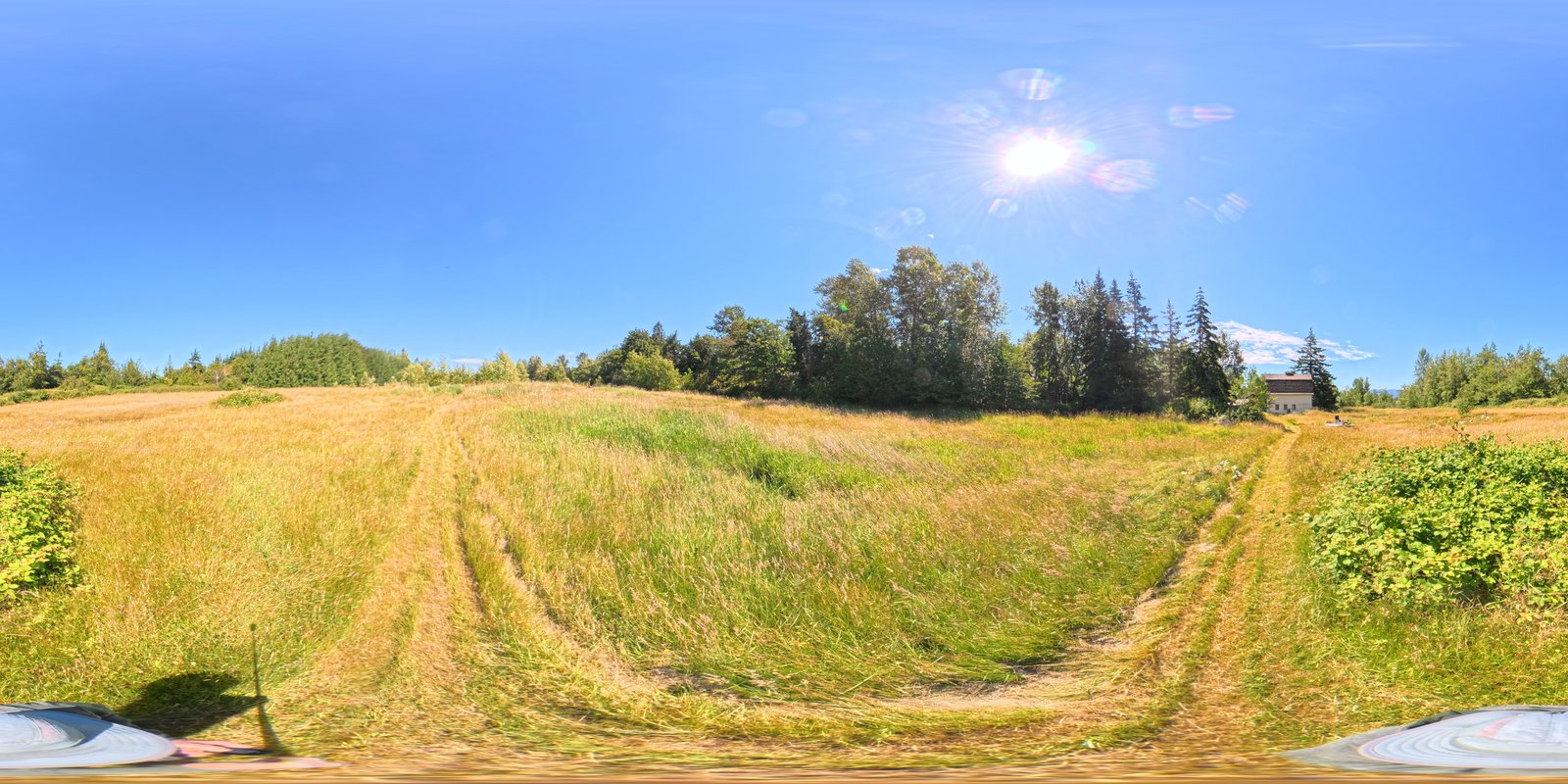
There is a particular sound a Himalayan blackberry cane makes when someone finally wins — a wet green snap, somewhere below the soil line, that lies to you about whether you actually got the crown. At the Owl Farm, where my partner Merry coaxes a living out of solar panels and stubborn ground north of Bellingham, that sound is the soundtrack of summer. Merry and the young people who pass through her place have made it a few thousand times; I have mostly made it by watching them, which is its own honest kind of fieldwork. On my last visit, wielding a pair of loppers and gingerly nipping 1/2" thick barked tendrils that were attempting to take over the deck that I intended to launch my drone from, I found myself doing the thing field ecologists do instead of being useful: I started asking why this one. Why does the Himalayan blackberry own the edge of every Northwest woodland, every culvert, every neglected fence line, when a dozen native bramble cousins quietly hold their corners and ask for nothing? What does the winner know that the locals don't?
It turns out Charles Darwin asked the same question, and — characteristically — answered it twice, in opposite directions, and then left the contradiction sitting on the table for the rest of us to argue about for the next century and a half.
In the Origin of Species, Darwin (1859) noticed that introduced plants closely related to the native flora ought to do well, because shared ancestry implies shared adaptation to the local climate — a kind of pre-fitted key for the local lock. But he also noticed, looking at the naturalized flora of the United States, that an awful lot of successful invaders belonged to genera with no native representatives at all. If close relatives compete most fiercely for the same niche, then being a stranger — owing nothing, overlapping with no one — might be the advantage. Similarity helps. Distinctiveness helps. Both, said the great man, and moved on.
We have been stuck there ever since. Generations of invasion biologists have gone into the field, run the numbers, and come back waving evidence for whichever horn of the dilemma their study happened to catch. The most popular escape hatch, for a while, was scale: Park and colleagues (2020) showed that you tend to see "similarity" when you zoom out to whole regions and "distinctiveness" when you zoom in to a single meadow, so maybe the paradox was just a trick of the magnification. Fan and colleagues (2023) added a lovely wrinkle, finding that the answer tracked latitude across the world's flowering plants — belonging winning in the cold high latitudes, standing out winning in the warm tropics. The paradox was loosening. But latitude is a stand-in, a shadow on the wall. Nobody had pinned the thing to the wall itself.
The map under the paradox
This spring, a team led by Tadeo Ramirez-Parada (2026) pinned it. They assembled something close to a census of the whole problem — more than 2.7 million museum and citizen-science records, 2,544 native and 266 invasive plants, mapped across the lower 48 states on a single fine grid — and then asked one unusually sharp question. Not "are invaders different from the natives?" but "are invaders more different from the natives than the natives are from each other, right here in this spot?" That second framing is the whole game, because the natives themselves grow more or less alike as the climate changes, and earlier studies kept mixing the two effects together.
The answer is a map, and the map has a seam running roughly down the 100th meridian, where the humid East gives way to the arid West. In the warm, wet Southeast, the invaders are misfits: they flower dramatically earlier than the natives — by as much as a month and a half in the hottest, wettest country — they flower out of sync with everyone else, and they sit on distant branches of the family tree. That is Darwin's competition story, clean as a bell. Cross into the cold or the dry, and the pattern doesn't just weaken, it flips. There the invaders flower in step with the locals, at the same time or a little later, and they turn out to be close cousins of the natives they've joined. That is Darwin's preadaptation story, equally clean.
So both men were right, including the two of them who were the same man. The contradiction was never a paradox; it was a continuum, and the dial is climate.
The reason this happens is one of the sturdiest findings in plant ecology. Callaway and colleagues (2002), working the high alpine of mountain ranges around the world, showed that as conditions get harsh, plants stop fighting each other and start helping — competition gives way to cooperation under stress. Carry that logic into the weeds: where the climate is brutal, the weather itself does the sorting, and only plants already built for the local rhythm of frost and drought make it through — which leaves the winners looking like the natives. Where the climate is easy, that pressure relaxes, neighbors start elbowing each other for light and pollinators, and the edge goes to whoever can slip into an empty slot in the season — the early bloomer, the stranger. Harsh country rewards belonging. Easy country rewards being weird. (There is one trick the weeds run almost everywhere, at both ends of the gradient: they stay in flower longer than the natives — about ten extra days, a window nearly a fifth wider. Stay open for business longer than your neighbors and you'll move more product. Even Darwin would have smiled at that one.)
How we know — and the part that should worry us
Here is where I want to slow down, because the satisfying part of this story is the science, and the important part is what the science is made of.
That continental map exists only because someone stitched it together out of a continent's worth of scattered glimpses — pressed plants in museum drawers going back to the 1800s, phone snapshots uploaded to iNaturalist, satellite passes, a handful of field plots. And a companion paper from much the same team, Amador and colleagues (2026), spends its length on an uncomfortable admission: these glimpses sit in separate piles, and each pile is half-blind. The museum specimen has deep history and names every plant to species, but it's a single frozen instant, and it can't tell you whether that pressed flower was caught early, on time, or late for its neighborhood. The satellite sees the whole continent but can't tell one species from another. The phone snapshot has reach but no discipline. Each kind of record is strong exactly where the others are weak — and the real knowledge doesn't live in any one pile, but in the seams between them, which is precisely where they're hardest to join.
And there is one kind of record that nothing else can replace. To know whether this plant, this individual, is blooming early or late for its own neighborhood — the very thing the whole grand effort is trying to estimate — you need someone who came back to the same plant, week after week, through a season, and wrote down what they saw. The networks that do this, the long-running field plots and the trained volunteers, are the one irreplaceable source, and they are also the rarest and the most expensive. The machine can infer the continent. It cannot, on its own, produce the single patient observation the whole continental picture is built to approximate.
This is the part of the story I keep circling back to, and it's the opposite of what we keep being told about AI making the naturalist obsolete. The more powerful the inference engine, the more valuable becomes the one input it can't fabricate: a person standing in front of a plant, being honest about what is actually happening. As the modeled world gets vast, ground truth gets scarce — and scarce things get precious.
But precious is not the same as renewable, and here my optimism grows a hard edge. The trained naturalist isn't a fixed resource we can simply draw down; she is a grown one, and the growing is exactly what we've been quietly defunding. You cannot conjure on demand a twenty-year-old who can tell a Himalayan blackberry from its native cousin at forty paces, who knows a patch in full bloom from one already going over, who has spent enough mornings in the field to get bored in the productive way that makes you notice the one thing that's off. The young people pulling crowns at the Owl Farm are halfway to being that person already, just by paying attention to the same ground all season. The rest of the way is made — by biology taught as living organisms and not only as slides, by the unfashionable field "ologies," by courses that put students on their knees in the brambles long enough to learn to actually see. Strip those out of how we train the young, the way we've been busily doing, and you don't just lose a few botanists. You quietly mine out the ground truth itself — and everything downstream that leans on it, every continental map, every forecast, the whole emerging ecological-nomics that wants to put a price on what the living world is doing, slowly starves for lack of anyone left who can check its work. The network of Macroscopes I'm about to describe is only ever as honest as the people standing at its edges. The camera records the flower; it still takes a trained eye to know it's the right flower, and a trained mind to know what the record means.
What a federated Macroscope would go looking for
This is where my own long project stops being a metaphor and turns into a plan. Picture that one irreplaceable kind of record — a trained human watching the same plants through a season — not as a few lonely research plots scattered across the country, but as a network: a Macroscope at every reserve, every field station, every stubborn little nature laboratory like mine, each one a fully wired-up witness that does its thinking on the spot.
Hang a row of weatherproof cameras at each site — phenocams, the very instrument Amador's group calls the missing link between the satellite overhead and the specimen in the museum drawer. They watch the same plants open and fade, day after day, year after year, and so they produce the one thing that's otherwise almost impossible to get at scale: not a single frozen snapshot, but the whole season unrolling. Add a walking three-dimensional scan of the vegetation — the ecoSLAM survey I've been building, where an off-the-shelf 360-degree camera and a slow walk through the site become a model you can fly through afterward — so that who is blooming, and who is standing right next to whom stops being a guess and becomes something you can measure. Then let STRATA, the part of the system that minds the context, label every observation with the three things you need to make sense of it later: where it was taken, what took it, and what we already knew going in. The record arrives explained, instead of orphaned.
And let SOMA listen to the whole network at once. I built SOMA on an idea borrowed from recent brain science: the most interesting systems — minds, ecosystems — don't do their best work sitting in calm balance. They do it while tipping restlessly back and forth between cooperation and competition, never quite settling. Which is, if you squint, exactly what Ramirez-Parada found out in the weeds: an invasion strategy that flips from fitting in to standing out as you cross from one climate into another. A network of Macroscopes wouldn't just confirm that flip from a satellite's distance; it could catch the thing actually happening on the ground — the jostling, the early bloomer beating everyone to the pollinators — at the only scale where the shoving is real.
And the tool for stitching the few careful records to the millions of rough ones already exists. Mostert and O'Hara (2023) built and gave away a method that takes the abundant, sloppy sightings and the scarce, painstaking field measurements and treats them, honestly, as glimpses of one underlying reality — correcting as it goes for the particular blind spot of each. That is the statistical handshake between a continental map and a reserve full of cameras. The rest is plumbing, but the plumbing matters: if every site files its observations in the same format — the shared structure that O'Brien and colleagues (2021) designed, speaking the common plant-phenology vocabulary that Stucky and colleagues (2018) assembled — then a Macroscope in Oregon City, a research plot in Maine, and a flower pressed in 1887 can all turn out to be saying the same kind of sentence about the same world.
Back at the Owl Farm, the blackberry still wins more rounds than it loses; the crowns go deep, and the snap below the soil line keeps on lying. But I think I finally understand what the plant knows: it knows where it is. It read the climate, picked the right move for the neighborhood, and stayed open for business a week and a half longer than anyone polite. The map of that cleverness now stretches across a continent. The one who can keep it honest is still just a young person on their knees in the brambles, paying attention — and we are going to need a great many more of them, taught early and wired into the network, than we currently have, or are currently bothering to grow.
References
- - Darwin, C. (1859). *On the Origin of Species by Means of Natural Selection*. John Murray.
- - Ramirez-Parada, T. H., Park, I. W., Peng, S., Nishino, M., Kartesz, J. T., Record, S., Davis, C. C., & Mazer, S. J. (2026). "Climate mediates phenological and phylogenetic differentiation in plant invasions." *PNAS*, 123(21), e2536192123. https://doi.org/10.1073/pnas.2536192123 ↗
- - Amador, L. G., Ramirez-Parada, T. H., Park, I. W., Mazer, S. J., Ellison, A. M., O'Brien, M., Sokol, E. R., Smith, C. A., Davis, C. C., & Record, S. (2026). "Bridging data silos to holistically model plant macrophenology." *New Phytologist*, 251(2), 625–636. https://doi.org/10.1111/nph.70249 ↗
- - Fan, S., et al. (2023). "A latitudinal gradient in Darwin's naturalization conundrum at the global scale for flowering plants." *Nature Communications*, 14, 6244. https://doi.org/10.1038/s41467-023-41607-w ↗
- - Park, D. S., Feng, X., Maitner, B. S., Ernst, K. C., & Enquist, B. J. (2020). "Darwin's naturalization conundrum can be explained by spatial scale." *PNAS*, 117(20), 10904–10910. https://doi.org/10.1073/pnas.1918100117 ↗
- - Callaway, R. M., et al. (2002). "Positive interactions among alpine plants increase with stress." *Nature*, 417, 844–848. https://doi.org/10.1038/nature00812 ↗
- - O'Brien, M., Smith, C. A., Sokol, E. R., Gries, C., Lany, N., Record, S., & Castorani, M. C. N. (2021). "ecocomDP: A flexible data design pattern for ecological community survey data." *Ecological Informatics*, 64, 101374. https://doi.org/10.1016/j.ecoinf.2021.101374 ↗
- - Stucky, B. J., Guralnick, R., Deck, J., Denny, E. G., Bolmgren, K., & Walls, R. (2018). "The Plant Phenology Ontology: A new informatics resource for large-scale integration of plant phenology data." *Frontiers in Plant Science*, 9, 517. https://doi.org/10.3389/fpls.2018.00517 ↗
- - Mostert, P., & O'Hara, R. B. (2023). "PointedSDMs: An R package to help facilitate the construction of integrated species distribution models." *Methods in Ecology and Evolution*, 14(5), 1212–1220. https://doi.org/10.1111/2041-210X.14091 ↗