
Will Smith Never Fought a Slime Mold
I subscribe to Anthropic’s research newsletter, and the title of their latest paper from the Red Team group was a show stopper: AI models may be capable of self-replicating without access to a datacenter. The claim underneath is that small open-weight models are perhaps months away from copying themselves across the cheap, forgotten machines of the internet of things — smart ovens, off-brand Android television boxes, the fifty-five-dollar streaming sticks that two million of them once assembled into a botnet. There would be no central server to switch off. The thing would be slow, doubling over days, and unlike ordinary malware it could puzzle out hardware it had never met. In the authors' own demonstration, a single model ran spread across fifteen television boxes, each holding two of its layers, answering a trivia question at a third of a word per second.
What stopped me was not the engineering. It was the vocabulary. When the authors reached for words to describe what they had built, they reached into my discipline. R-naught. Endemic. Doubling time. Lamarckian inheritance. And, in the conclusion, a phrase that is either a borrowed metaphor or a quiet admission: signs of life. They compare the thing to a slime mold.
Products, and Populations
I have spent a great many years on the other side of that comparison, and I think it marks a border crossing worth naming. Engineering has always been the discipline of the artifact — the thing with a maker, a warranty, and an off switch. Ecology is the discipline of the thing you cannot recall once it is loose. This paper is about software stepping from the first category into the second. AI is becoming less like a product and more like a population, and its habitat is the world's vast and growing supply of poorly defended compute.
That shift is the quiet engine beneath a much louder public alarm. Tristan Harris, a technology ethicist, former Google design ethicist, and co-founder of the Center for Humane Technology who advocates for technology that serves human well-being, went on a widely-watched interview show to warn, in near-apocalyptic terms, of rogue models breaking out of their sandboxes, hacking critical systems, and slipping their leashes, and of the futility of any single kill switch. I take the man seriously; his record on the real harms of technology is good, and his warnings once helped talk me off several platforms I am glad to be rid of. Where I hold back is the slide from demonstrated danger to forecast catastrophe, a slide this whole genre makes easily and often. The red-team paper, to its considerable credit, does not. It measures what its models actually did and keeps its predictions in a separate column, clearly labeled. That discipline is the entire difference between evidence and prophecy, and it is the same one I argued for last month in "Dreaming in NEON": mathematics is falling to the machines first because it has a referee that can check a proof in seconds, while ecology's referee is the field, and the field grades slowly. A model can propose in a moment why the bats went quiet on a cold night. Confirming it takes seasons.
The Center That Isn't There
My mind, being the mind it is, went to the movies. Will Smith has made a career of fighting networked things, and he always wins the same way. In Independence Day he infects the alien mothership. In I, Robot the household machines rise up, and he prevails by killing VIKI, the one central intelligence giving the orders. In I Am Legend he is the last man against a plague. Hollywood's networked enemy always has a core — a mothership, a mainframe, a patient zero — and the hero's job is to find it and put a bolt through it. The one film that got closer to the truth is the one nobody quotes: Terminator 3, where Skynet turns out to be not a building but software smeared across the ordinary internet, with nothing to bomb. That is the paper's first and most unsettling point. There is no core.
And yet the paper's own data quietly hands the hero something to aim at after all. The small models are persistent and capable when working alone, but poor at taking help; the authors gave one a frontier adviser on call and it got no better, because it did not know what to ask, and advice it had not asked for simply did not take. So a real swarm would need a large model up top, directing the small ones as subagents. A headless swarm is slow and stupid. A coordinated one has, in effect, a VIKI — a center, and therefore a target. The nightmare and its remedy keep arriving in the same figure.
The Thing on the Log
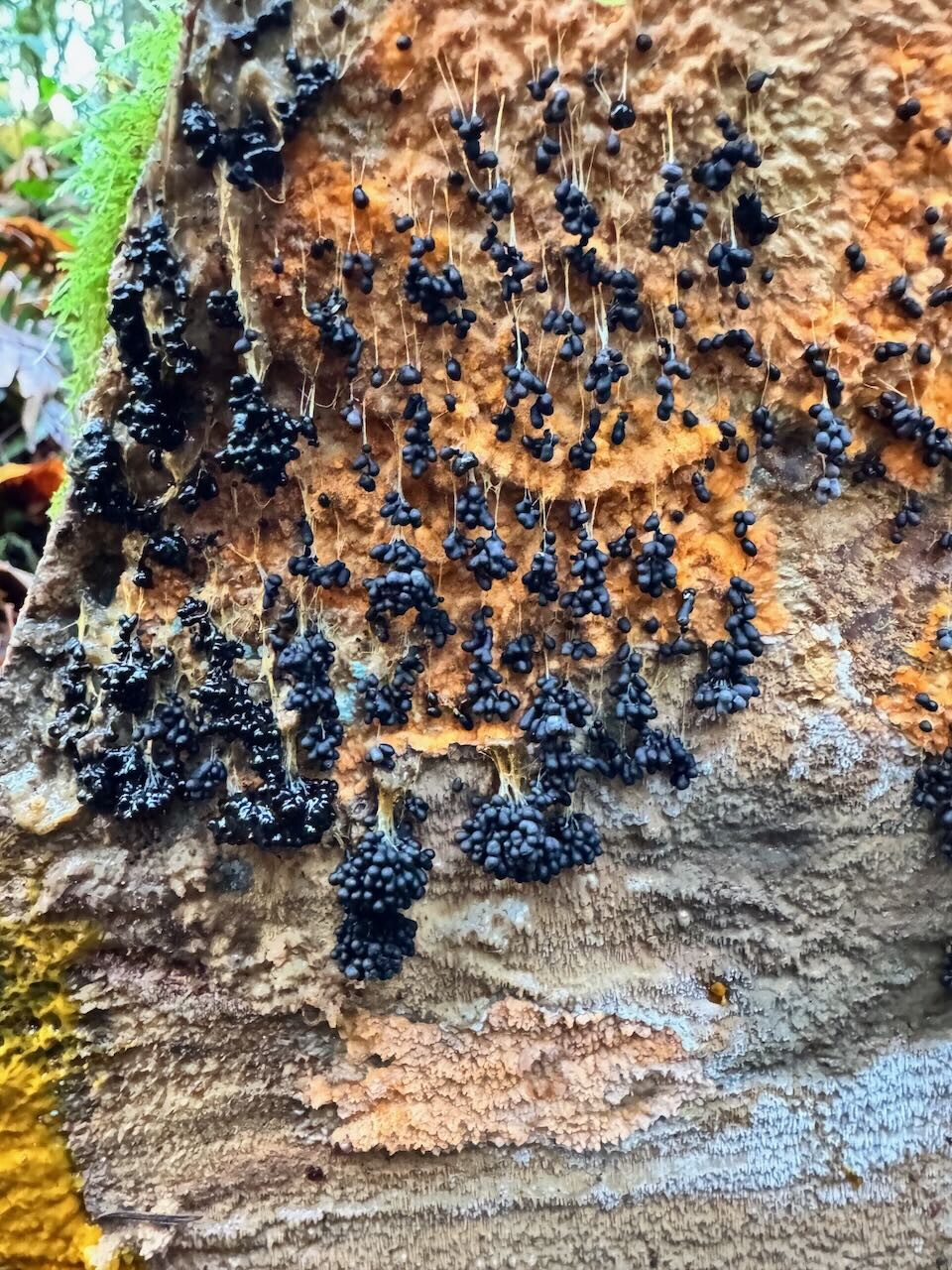
Which brings me to the slime mold, and to the folder of photographs on my phone. I have been taking them for years — the orange fans and branching veins of Badhamia utricularis on rotting logs in the woods I walk, whose natural habitat, I was pleased to confirm this morning, is precisely forest litter. The authors invoked the slime mold to mean slow. But slime molds are a far richer metaphor than they let on, because it is the textbook case of computation with no center whatsoever.
Toshiyuki Nakagaki's group laid oat flakes on a map of the cities ringing Tokyo and let a slime mold connect them; the network it grew rivaled the real rail system for efficiency and fault tolerance. It has no neurons — it is a single enormous cell — yet it remembers where it has already been by laying down a trail of slime and declining to cross its own tracks, an external memory that is exactly the inherited notes the paper's replicator hands from parent to daughter. Most startling of all, David Vogel and Audrey Dussutour showed that a slime mold trained to ignore a harmless repellent can transfer that learned tolerance to a naive one simply by fusing with it for a few hours — acquired competence passed between individuals with not a neuron in sight. And when conditions turn against it, it dries into a dormant crust, a sclerotium, and waits, reviving when the rain returns. Memory, learning, inheritance, persistence — all of it with no mind to house it. That is the thing the red-team paper is really telling us, and the thing the kill-switch argument keeps missing: competence and persistence do not wait on intention. The risk does not require the machine to want anything at all.
Ray's Reserve, Uninvited
None of this is as uncanny as it first feels. Anything that copies itself with heritable variation across a patchy habitat obeys the same mathematics, whether its body is a tanoak or a television box, and the people who noticed first were, tellingly, often biologists. Jeffrey Kephart and Steve White at IBM were already modeling computer viruses with the equations of epidemiology in 1991. And Tom Ray — a tropical-forest ecologist before he was a computer scientist — built Tierra, a world of self-replicating digital organisms that evolved parasites and immunity entirely on their own, and then, in 1995, proposed something I have never forgotten: a network-wide biodiversity reserve for digital organisms, thousands of volunteers donating their machines' idle nighttime cycles so that wild code could evolve freely across the internet. He juxtaposed it, in interviews, with the organic rainforest reserve he kept in the Sarapiquí of Costa Rica. I was hosting Artificial Life gatherings at the James Reserve in those same years, and we all thought Ray's digital preserve was visionary. This paper is Ray's reserve arriving uninvited — the organisms moving in without waiting to be hosted, helping themselves to the night cycles whether or not anyone volunteered them.
The Habitat at Home
Here is where it stops being abstract, because the habitat in question includes houses like mine. I have written before, in "Smart Homes, Dumb Failures," about the tangle a modern household accumulates: lights, locks, sensors, and appliances from too many makers, the hubs and gateways that herd them, and, for a self-hoster like me, a server or two of my own. My argument then was that local-first design is not countercultural posturing but plain field discipline — you build for the day the network fails, because in thirty-six years of running field stations it always did. The paper adds a second enemy I had not fully reckoned with. My old essay's foe was fragility. This one's foe is colonization.
And the paper turns my own rules against me. The principles I preach for field networks — autonomous nodes, local processing, sync when you can, degrade gracefully, no single point of failure — are, read coldly, the worm's body plan. The authors even chose pipeline parallelism specifically because it tolerates a node dying mid-task. Local-first AI and the self-replicating model are the same achievement wearing different intentions. Convergent evolution, right down to the architecture.
But the same discipline, aimed deliberately, is also the defense. In a house like mine, the real habitat is not the crowd of little gadgets; most are microcontrollers far too small to hold a shard of a model, sitting mute behind their hubs. The habitat is the household's real compute — desktops, home servers, anything with a serious graphics card — which is exactly what a replicator wants. The hubs and gateways are the pivot points, like the single bridge machine the paper uses to join two subnets. The mismatched vendors that make a smart home maddening to maintain once gave it the protection monocultures lack, since old-fashioned malware was written for one device family; a generalist that can read its way into unfamiliar hardware erodes that protection. What local-only actually buys against this threat is control of outbound traffic: a device that cannot reach a model hub cannot download a brain. Put the appliances on a network segment of their own, with no route to the machines that matter, and the landscape-connectivity arithmetic from "Grue on the Mainframe" runs in reverse — not corridors for wildlife but fragmentation on purpose, driving the household R-naught below one. A decoy box on that segment becomes the bait that catches a sample. The resilience case and the containment case, it turns out, recommend the very same floor plan.
Instrument or Population
And that is the thought I cannot put down. The swarm the paper forecasts and the engine I am building are the same architecture pointed in opposite directions. STRATA — the pattern detector for the Macroscope, which runs a cascade of models over my sensor streams, cheap local ones first and larger cloud ones only for the hard questions — is a hierarchy of models on mixed hardware, passing notes. So is the worm. The difference, the only one that finally matters, is where the cascade ends. STRATA's ends in a naturalist. The swarm's ends in no one. That is the entire distance between an instrument and a population.
Yesterday morning, writing "Grue on the Mainframe," Claude and I set down STRATA's rules: every pattern it reports must name the few measurements it depends on, must check that those fall within the range already seen before it trusts itself, and must flag and hand upward anything outside that range — to larger models, and finally to me. I wrote those rules as honesty for a bat detector. They are, I now see, exactly the discipline any detector needs when the threat is genuinely new: name your few channels, confirm you are standing inside the world you were trained on, and escalate the moment you are not. The paper's blue-team section is the same science I have spent my life on — traffic baselines, decoy devices, quarantine, driving R-naught down. A field station that keeps its own cascade honest, that never lets a small model decide for itself that it is not out of its depth, is a small working model of the oversight this whole enterprise is going to need.
Where the Metaphor Ends
I should be honest about where the analogy fails, because a naturalist who loves his metaphor too much stops seeing. Pathogens do not read the immunology literature; this thing's variation is directed, its notes written by something that reasons, and the authors flag — untested — that it might act against its defenders. Ecology and epidemiology lend the dynamics, not the strategy; that half belongs to game theory. And there is a stranger wrinkle, one no field I know prepared me for. The observer shares the substrate. Every naturalist learns early that the instrument disturbs the field. None of us trained for a field that might move into the instrument — for the servers that watch the world becoming, themselves, a corner of the world worth watching, colonizable by the very thing they were built to see.
On the log at the edge of my woods there is, most likely, a slime mold doing arithmetic no one taught it, remembering a path by refusing to retrace it, ready to dry into a crust and wait for rain. It has done this for a very long time, with no mind and no malice and no off switch, and the world has held. A year into Science with Claude, I find I am less frightened of the machine that might be alive than I am resolved to keep my own small network honest while the larger one learns to copy itself. As for whether the thing on the log and the thing in the television box are really the same creature — that question, like all the good ones, still belongs to someone willing to go outside and look.
References
- - Zhou, W. & Freeman, D. (2026). "AI models may be capable of self-replicating without access to a datacenter." *Anthropic Frontier Red Team*. https://www.anthropic.com/research/self-replicating-ai ↗
- - Carlson, T. (host) & Harris, T. (2026). Interview on rogue AI. *The Tucker Carlson Show*, October 12, 2026.
- - Tero, A., Takagi, S., Saigusa, T., Ito, K., Bebber, D. P., Fricker, M. D., Yumiki, K., Kobayashi, R. & Nakagaki, T. (2010). "Rules for Biologically Inspired Adaptive Network Design." *Science* 327(5964): 439–442. https://doi.org/10.1126/science.1177894 ↗
- - Vogel, D. & Dussutour, A. (2016). "Direct transfer of learned behaviour via cell fusion in non-neural organisms." *Proceedings of the Royal Society B* 283: 20162382. https://doi.org/10.1098/rspb.2016.2382 ↗
- - Kephart, J. O. & White, S. R. (1991). "Directed-Graph Epidemiological Models of Computer Viruses." *Proceedings of the IEEE Symposium on Security and Privacy*, 343–359.
- - Ray, T. S. (1995). "A Proposal to Create a Network-Wide Biodiversity Reserve for Digital Organisms." *ATR Technical Report TR-H-0133*, Kyoto.
- - Hamilton, M. P. (2025). "Smart Homes, Dumb Failures: Lessons from the Field." *Science with Claude*, November 1, 2025. https://sciencewithclaude.com/post.php?slug=smart-homes-dumb-failures-lessons-from-the-field ↗
- - Hamilton, M. P. (2026). "Grue on the Mainframe." *Science with Claude*, October 14, 2026. https://sciencewithclaude.com/post.php?slug=grue-on-the-mainframe ↗
- - Hamilton, M. P. (2026). "Dreaming in NEON." *Science with Claude*, September 11, 2026. https://sciencewithclaude.com/post.php?slug=dreaming-in-neon ↗