
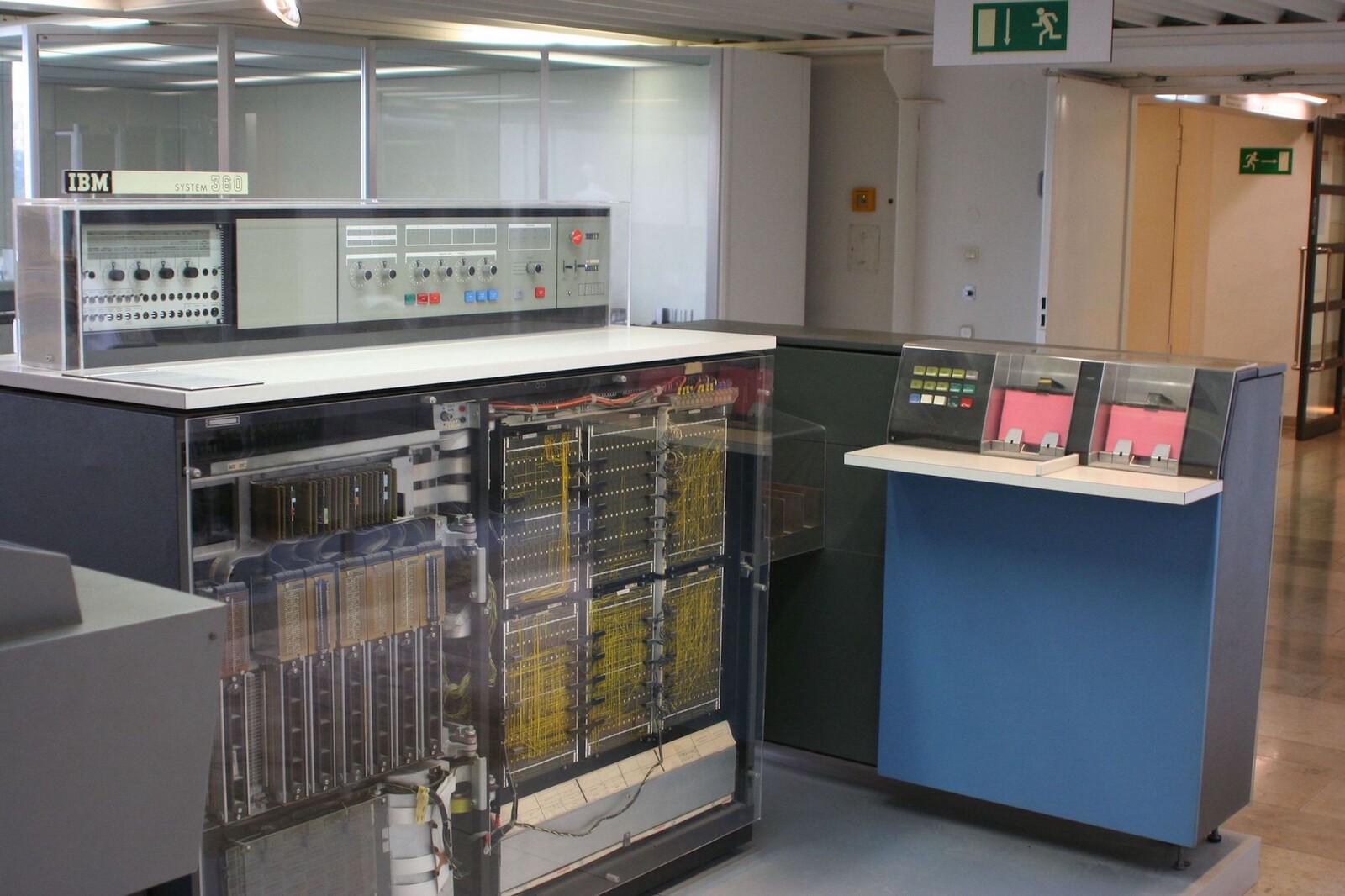
Grue on the Mainframe
This morning my coffee came with a nine-year-old's taunt. On his blog, Shtetl-Optimized, the computer scientist Scott Aaronson reported that his son had greeted his mother, the theoretical computer scientist Dana Moshkovitz, with a cheerful "I heard you got cooked!"
The boy had heard right. Last week OpenAI released solutions to hundreds of long-open problems in mathematics, from a model not yet available to the public. It had been set loose on about four thousand problems and solved roughly one in ten, averaging about three hours of computing per solution. Among the results was a proof of the Unique Games Conjecture, which Dana had worked toward for as long as Scott has known her. The boy also ruled that any model able to solve all those problems couldn't possibly be safe to release. Some nine-year-olds are born policy analysts.
What moved me was what Dana did next. Her first reaction was that the proof was so badly written she couldn't read it without an AI's help. So she asked one. Within a day or so she mostly understood it, was amazed by its new ideas, and wanted to give talks about it. She also pointed out that the machine had climbed on frameworks her community spent decades building.
I read all this as an outsider, and I should explain why. I am the student who failed Simon Levin's class.
Ithaca
In the late 1970s I was a Cornell graduate student whose dissertation lived in the San Jacinto Mountains of Southern California. The ecology faculty was a constellation. Robert Whittaker taught community ecology, Simon Levin taught analytical ecology, and Charles Hall taught systems ecology. All three baffled me at times, and Levin's course defeated me outright. The mathematics sailed over my head.
Levin later gave a celebrated lecture, published in 1992 as "The Problem of Pattern and Scale in Ecology." What we see in nature, he argued, depends on the scale at which we look, and connecting scales is the science's central problem, the one that could unite basic research with applied. I have spent four decades on that problem, mostly by building instruments: field stations, databases, sensor networks, and now the Macroscope. I failed the man's course and then made a career of his question.
What rescued me was a side door. In Hall's course, layered over Whittaker's gradient analysis, I finally saw how theory could become something a naturalist could use. Whittaker's method was gloriously plain: lay out tenth-hectare plots along a gradient, say up a mountainside from desert scrub to subalpine forest, list the plants in each, and watch the community change as you climb. My plots climbed the many gradients of the San Jacinto Mountains, and my data went to the university’s IBM mainframe.
There, two programs from the Cornell Ecology Programs series did the mathematics I could not. TWINSPAN sorted my plots into groups by finding a few indicator species, plants whose presence or absence told one community from another. ORDIFLEX arranged the plots along a few axes, each a blend of many species, so that similar plots sat together and the gradients emerged on their own. I could not have derived either method. I could run both, and I could tell when their answers made ecological sense.
The Sixteen-Year-Old's Index
In the random coincidence department, Scott Aaronson was a Cornell undergraduate too, a generation after me, before his doctorate at Berkeley. Browsing his publications this morning, I found his first paper, presented at a 1997 conference on information retrieval and written at Clarkson University when he was about sixteen.
It asks how to link a website's pages so visitors find what they want before giving up. His answer is a score. For every pair of pages, multiply how popular the two are, then shrink the result for each intermediate page a visitor must click through, because at every click some fraction of people wander off. A genetic algorithm, borrowing the logic of natural selection, then breeds better link layouts. Seventy Clarkson students hunted through three versions of a website about Watergate, and the higher a version scored, the faster they found things. I've personally been interested in genetic algorithms, ever since those early Artificial Life gatherings I hosted at the James Reserve.
Anyway, I had to smile when I read it, because I knew that formula. Landscape ecologists arrived at nearly the same score a decade later to measure how well habitat patches are connected: patch quality multiplied pair by pair, discounted by the odds that a dispersing animal survives each step between them. Lost web surfers and lost salamanders obey the same arithmetic.
The paper closes with a teenager's caution: algorithms like his were unlikely to replace human designers, because good design involves judgments of structure and taste that algorithms handle badly. Twenty-nine years later, that teenager is explaining to his readers what it means that machines have proved theorems the experts could not. And the day before OpenAI's release, an Anthropic model, a cousin of the one I write with, supplied the key idea that let Virginia Vassilevska Williams and Josh Alman break a fifty-year-old speed barrier in finding the shortest routes between every pair of points in a network. That is the very calculation young Scott's algorithm ran for every layout it scored.
The Riddle of Grue
Aaronson's other paper, written this year with two UT Austin colleagues, opens with a riddle the philosopher Nelson Goodman made famous in 1955. Goodman invented a color word, grue. Something is grue if it is green until January 1, 2030, and blue after that. Every emerald anyone has ever examined has been green, so every one has also been grue. The evidence fits both descriptions equally, yet one predicts green emeralds in 2031 and the other predicts blue. Why are we so sure about green?
You can't simply call grue the stranger word, Goodman pointed out. Imagine people raised speaking of grue and its twin, bleen, which is blue until 2030 and green after. To them our green is the contrived one: grue until 2030, bleen afterward. His own answer was track record. We trust words like green because they have predicted well for a very long time.
This is not idle philosophy. Every model that learns from the past and predicts the future faces the riddle, and in a warming world the future is not the past. Aaronson and his colleagues answer it with two plain ideas. The world arrives through separate channels: sight, sound, temperature, the date. And the best explanations use as few channels as possible. Green depends on one thing, whether you are looking at an emerald. Grue depends on two, the emerald and the calendar. Their theorem says a lean explanation learned in one setting keeps working in another, so long as the two agree on the few things that matter, however different they are otherwise.
They tested this on census data, teaching a computer to predict incomes from California records and grading it on Texas. Limited to about a hundred facts per person, it did nearly as well in Texas as at home. Given seven hundred, it slid badly in Texas, having latched onto details, including which state a person lived in, that held in one place but not the other.
Wow, this finding set off a number of idea light bulbs over my head. TWINSPAN's indicator species are exactly this kind of lean explanation: a rule that reads a handful of species out of hundreds and ignores the rest. ORDIFLEX's axes are the paper's other idea, for cases where what matters is a blend of measurements rather than any single one. On that mainframe more than forty years ago, I was running both halves of a 2026 paper without a word of its vocabulary. The tools carried theory I could not read, some of which had not yet been written.
Why Mathematics Fell First
Last month, in "Dreaming in NEON," I argued that mathematics is the one field where machines can win by sheer persistence, because it has a referee. A proof can be checked line by line by another program, so a machine can generate thousands of attempts and let the checker throw out the failures. Some of last week's proofs arrived with exactly that kind of certificate. Ecology has no mechanical referee. Our referee is the field, and it grades slowly. A model can propose in seconds why swallow chicks starved in a cold June; testing the idea takes years of field seasons.
Scott made a remark a field biologist could have written. When colleagues grumbled that reporting what an AI found isn't real research, he replied that experimental science has always worked this way: go out, collect, and report what turned up. Mathematicians are becoming naturalists, sorting a drawer of strange specimens no one has yet identified. Dana's week was a naturalist's job: the machine brought back the specimen, and a person who had lived with the problem for twenty years worked out, with its help, what it was.
Strata's Rules
This matters for a practical reason. Claude and I have been designing Strata, the pattern-detection engine for the Macroscope, my long-running effort to watch a few of my favorite corners of the world through sensors, cameras, and records. Strata will run a cascade of AI models over that data, small inexpensive locally-run ones first and larger cloud-based ones for harder questions. Its first real test is a pairing that began at Owl Farm in September: a garden weather and soil station logging beside an acoustic monitor that now hears bats.
Grue tells us how to keep Strata honest. Suppose the models notice that bats fly less on cold, windy nights. That pattern was learned in a single autumn. This winter will bring nights colder than anything in the record, and on those nights the pattern is only guessing. So this morning we sketched three rules. Every pattern Strata reports must name the few measurements it depends on, here temperature and wind. Before trusting it on a given night, Strata checks that those measurements fall within the range already seen. When they don't, the pattern is flagged and handed up the cascade, to larger models carrying more of the published literature and finally to me.
The rules also settle who does what. The sensor array can grow as wide as I can afford, because adding channels costs little as long as each explanation stays lean. But choosing the few channels that matter, Goodman's words with a track record, falls to natural history: temperature, wind, rain, the insects bats eat. That vocabulary is generations of naturalists' successful predictions, and supplying it is my share of the work.
A Year of Mornings
On October 28, Coffee with Claude, now Science with Claude, turns one year old. Most mornings of that year have gone like this one: reading something I could not have read alone, then arguing with a machine about what it means. Some mornings it overdoes it. Today it delivered a lecture on learning theory before my first cup was half gone, and I had to rein it in.
But consider what happened between sips. The student who failed Levin's class read a paper on learning theory, understood it well enough to put it to work, and learned that his old mainframe programs were its ancestors. That is the promise Dana glimpsed in her first texts to Scott: a mathematics, and perhaps a science, that could be wonderful for anyone with good questions, with machines helping to check and build.
The machines will find more patterns in old plot data and this autumn's bat calls than I ever could. Deciding which ones matter is still a naturalist's job, and a year in, I can report that it is a better job than it used to be. As for whether the emeralds will be green in 2031, that question still belongs to someone willing to go outside and look.
References
- - Aaronson, S. (2026). "The Mathocalypse." *Shtetl-Optimized*, October 7, 2026. https://scottaaronson.blog/?p=10169 ↗
- - Aaronson, S. (1997). "Optimal Demand-Oriented Topology for Hypertext Systems." *Proceedings of the 20th Annual International ACM SIGIR Conference (SIGIR '97)*, 168–177. https://doi.org/10.1145/278459.258560 ↗
- - Aaronson, S., Lee, L. L. & Li, J. (2026). "Sparsity and Out-of-Distribution Generalization." *arXiv* 2603.07388. https://arxiv.org/abs/2603.07388 ↗
- - Goodman, N. (1955). "Fact, Fiction, and Forecast." *Harvard University Press*.
- - Whittaker, R. H. (1967). "Gradient Analysis of Vegetation." *Biological Reviews* 42(2): 207–264. https://doi.org/10.1111/j.1469-185X.1967.tb01419.x ↗
- - Gauch, H. G. (1977). "ORDIFLEX: A Flexible Computer Program for Four Ordination Techniques." *Cornell Ecology Programs*, Cornell University.
- - Hill, M. O. (1979). "TWINSPAN: A FORTRAN Program for Arranging Multivariate Data in an Ordered Two-Way Table by Classification of the Individuals and Attributes." *Cornell Ecology Programs*, Cornell University.
- - Levin, S. A. (1992). "The Problem of Pattern and Scale in Ecology." *Ecology* 73(6): 1943–1967. https://doi.org/10.2307/1941447 ↗
- - Saura, S. & Pascual-Hortal, L. (2007). "A New Habitat Availability Index to Integrate Connectivity in Landscape Conservation Planning." *Landscape and Urban Planning* 83(2–3): 91–103. https://doi.org/10.1016/j.landurbplan.2007.03.005 ↗
- - Hamilton, M. P. (2026). "Dreaming in NEON." *Science with Claude*, September 11, 2026. https://sciencewithclaude.com/post.php?slug=dreaming-in-neon ↗