
Animals with Very Clever Hands
Yesterday morning a man in Maine published an essay about digging graves and being an ape, and I have been thinking about it ever since. Mike Bendzela teaches writing, digs holes for cremation urns at a summer job, and has decided that once two-thirds to three-quarters of a life has gone by it is time to inventory what one actually knows. First on his list, at close to one hundred percent certainty: we are not merely descended from animals, we are animals, and almost nobody really believes it.
He is right, and he writes it beautifully. What tickled me was the ardor. He has taken seven university courses on evolution over the years, a perk of adjunct teaching, and he says he has read more books on the subject than novels. He describes coming upon the passage in The Descent of Man where Darwin lays out the parallels between the evolution of species and the evolution of languages, and he reaches for Emily Dickinson to describe the sensation: the feeling that the top of his head had come off.
I know that passage. I do not remember it taking the top of my head off. I think I read it the way you read a weather report that confirms what you already saw out the window.
That is not a boast, and it is not a criticism of him. He calls his a life-long study and I believe him. But there are two roads into this, and they leave you standing in different places. His runs through books and classrooms, where the great insights arrive as sentences and a sentence can still knock you sideways. Mine ran through dirt, before I was old enough to read anybody. Neither road is better. They just equip you differently for saying what comes next.
The Door My Mother Opened
The door out of the Church, in my family, was opened by my mother.
We were Catholic in a Los Angeles subdivision in the early 1960s, which meant Sunday mass, catechism I did not want, nuns who were not kind, and priests I did not care to be alone with. Then Rome held the line on contraception and my mother did the arithmetic that every household actually does. Four children is enough. No to the Pope. And that was the end of it.
I have thought about that decision many times since, and it took me most of a career to see how funny it is. The mythology in our house was broken by a reproductive calculation. How many offspring can this family provision, given what we have? That is not a theological question, it is a life-history question, and my mother answered it correctly without any of the apparatus I would later spend a decade acquiring.
What her decision bought me, immediately, was Sunday mornings. I spent them in the undeveloped hills that still surrounded our subdivision, which in those years were being surveyed and staked but not yet built, so that a boy could disappear into them for six hours and come back with questions. Why is this slope covered in one thing and that slope in another? Why are there so many kinds of everything? And one afternoon, watching two insects locked together on a stem for what seemed an extraordinarily long time, I understood the mechanics of sexual reproduction, entirely and at once, with nobody having to explain it to me and nobody having to tell me it applied to us as well.
By the time I finished junior high I was an insufferable little naturalist. My high school science teachers, God bless the public schools of that era, saw it and took me in. They handed me physics and chemistry and biology and astronomy and mathematics as if the walls between them were a clerical convenience rather than a fact about the world, and let me run experiments across all of it. I never had to be argued into common descent. I had been looking at homology since I was eleven without knowing the word, and it never once occurred to me to see it as a doctrine that a person could accept or reject.
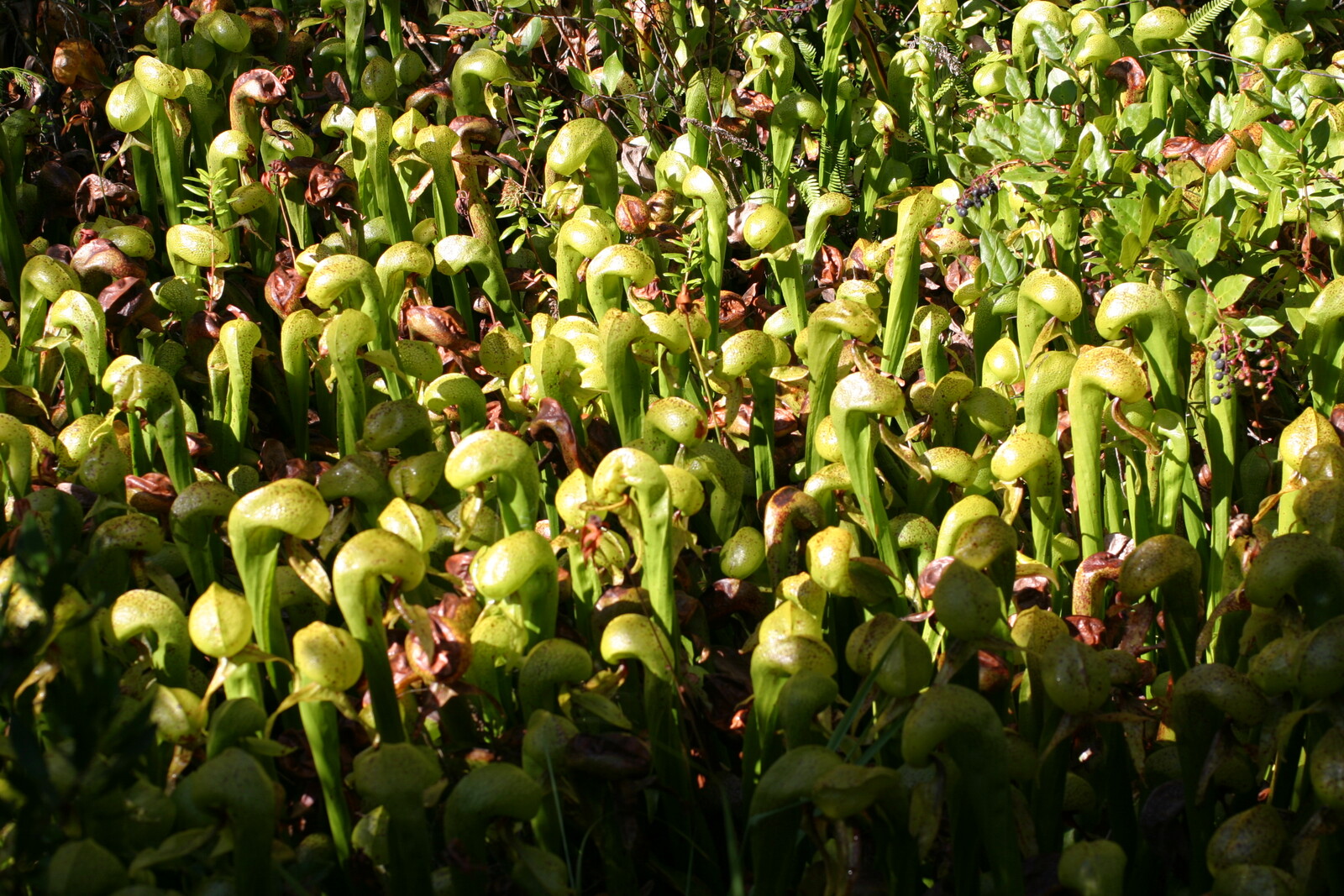
In college the obsession found an object. I had access to a greenhouse at Cal Poly Pomona, where I did my bachelor's and then my master's in biology through the 1970s, and I began growing carnivorous plants and did not stop until I had reared close to two hundred species: Drosera, Sarracenia, Darlingtonia, Pinguicula, Nepenthes, Heliamphora, Cephalotus, Utricularia, and a good many others. I own Darwin's Insectivorous Plants, published in 1875, four years after The Descent of Man, and it is the book of his I return to most, because it is Darwin at his most patient and least grand. Page after page of a man dropping bits of meat and hair and glass onto a sundew leaf to find out what it responds to and what it ignores.
There is a lesson buried in those plants that took me years to appreciate. A plant that eats an animal was scandalous in the nineteenth century, and it was scandalous because it dissolved a boundary people had assumed was structural. Plants make food from light, animals eat things, and the categories are not supposed to leak. But drop a sundew into acid ground where nitrogen is scarce and the category gives way immediately. The embarrassing material explanation is that there is no wall there at all, only a habit of description that we mistook for a law.
The Fights Were Never About Whether
The books arrived while I was at Pomona, and the timing could not have been better. Darwin first, then the working library of the modern synthesis and what came after it. Williams on adaptation. Hamilton on kin selection. Trivers on reciprocal altruism and parental investment. E. O. Wilson's Sociobiology landed in 1975, in the middle of my bachelor's, that great folio-sized thing with the Landry drawings, and it functioned for my cohort as something close to scripture. The Selfish Gene came the year I started the master's. Gould and Lewontin published their attack on adaptationism in 1979, the year I left for Cornell. I was in the Wilson camp and stayed there.
Here is the part the general public never understood, and it matters for what follows. Those years look, from outside, like a discipline at war with itself. Water poured over Wilson's head at the AAAS. Gould and Lewontin firing on adaptationism. Dawkins and the gene's-eye view against Gould and hierarchy. Creationists mined those exchanges for decades, and Gould spent years explaining that quoting him against evolution was quoting a man out of his own house.
But not one gram of that ferocity was about whether descent with modification had occurred. It was about mechanism. Levels of selection, rates, constraint, contingency, how much of an organism is adaptation and how much is architecture. Hundreds of models for how the thing works, argued at high volume by people who agreed completely that it works. For a systems ecologist in training, which is what I was becoming, every silo I entered had its own foundational literature and its own flavor of the argument, and they all interwove and reinforced the same premise underneath. The debates were the sound of a healthy science processing itself. They were never a referendum.
We mostly stayed out of the popular versions. Those were for the trade press.
The Acid Finds a New Substrate
Then in 1986 Richard Dawkins wrote a small program.
The Blind Watchmaker made an argument in prose, but the argument you could operate was the biomorph program that came with it. Simple developmental rules, random mutation, and a human eye doing the selecting, generation after generation. Insects appeared. Bats appeared. Spiders appeared that Dawkins himself said he had not expected. What you learned by clicking was not that cumulative selection could climb into unforeseen form. You learned that you could not anticipate the next generation, and that the inability was the whole point.
My path crossed Dawkins' by way of Apple's Vivarium project. Alan Kay never came out to the reserve, but his project administrator Ann Marion did, and Jay Fenton was among the early programmers, and that group was building Smalltalk, funding Minsky, funding Danny Hillis, and funding a young field station director's odd idea about instrumenting a landscape. Vivarium gave the Macroscope its first money, gave me early access to HyperCard, and put the biomorphs in my hands. That was my door into artificial life, and it opened at exactly the right moment: Langton convened the first ALife workshop at Los Alamos in 1987.
For most of the next decade the James San Jacinto Mountains Reserve was where a particular group of people came to think out loud. Chris Langton. Charles Taylor from UCLA. David Reznick. Rick Belew from UCSD. Chris Adami from Caltech. They came up at least once a year with their graduate students, retreated into the pines, and shared whatever they were currently obsessed with. Taylor was the load-bearing figure for me, because in him the two halves were plainly the same activity: he did evolutionary computation and he did distributed acoustic sensing of birdsong, and he did not appear to experience these as different jobs. Build a population of simple interacting agents, instrument it, watch what emerges. It does not matter much whether the agents are digital organisms or actual flycatchers in a canyon.
Those conversations became a proposal, and in 2001 the proposal became CENS, forty million dollars from NSF, of which about ten percent came to me to build sensing platforms and run experiments at the James.
I have come to see that arc as an inversion rather than an extension. Artificial life took the substrate out of biology to find out whether the dynamics survived abstraction. Embedded sensor networks put the substrate back and asked whether you could recover the dynamics from dense, cheap, in-situ observation. Same epistemic bet in both directions: you understand a system by watching it run, not by describing its parts. Hillis was making the identical wager in hardware at Thinking Machines, on the theory that intelligence is what many dumb elements do when there are enough of them.
The Hands Kept Going
Which brings me to the thing I now talk to most mornings.
People say these systems are evolving. Usually they mean it loosely, and loosely is where it goes wrong, so let me say plainly what I think is and is not true.
What happens inside the training of a single model is not natural selection. The machine is not producing offspring that vary, most of which die. It is one object being tuned, over and over, toward a target. That is closer to sharpening a knife than to breeding dogs. Anyone who tells you otherwise has swapped a feeling for a mechanism, and forty years of fieldwork tell me not to do that.
The selection is happening one level up, out where the people are.
Think of the models themselves as the organisms. Hundreds of designs get built. Each is a variation on the ones before it, because the people building them copy what worked and change a few things. Then the world does the culling. Most designs are abandoned. A few get used, funded, copied, and built upon, and their features carry into the next round. Copy with variation, let conditions decide which copies get copied again, and you get change with direction but no designer. That is the whole algorithm. It does not care whether the thing being copied is a gene, a stone tool, a research paper, or a neural network architecture.
There is a second pattern here too, and it is the one my greenhouse taught me. Look at a Sarracenia from a Carolina bog, a Nepenthes from Borneo, and a Cephalotus from a corner of southwestern Australia. All three have built the same thing: a tube that holds fluid, a slick rim, downward hairs, a pool to drown in. They did not inherit it from each other. Those lineages are only distantly related, and the pitcher was invented independently at least three separate times. What they share is the problem. Wet ground, no nitrogen, sunlight to spare, and insects walking around loose.
That is convergence rather than descent, and it is a different mechanism from the one in the paragraph above, so I will not blur them. But it is the mechanism I keep thinking about when I watch laboratories that are not talking to each other arrive at architectures that look like siblings. Nobody is copying anybody. They are all standing in the same bog.
We have a word for the middle cases already. Dawkins coined "meme" in 1976 precisely because he could see that the machinery of copying and selecting did not need genes to run on. Languages do it, as Darwin himself noticed in the passage that took the top of Bendzela's head off. Tools do it. Now this does it.
So when I say I see evolution here, I am not making a claim about the mathematics inside the box. I am saying that the pattern I have watched in oak woodlands, in the spread of an instrument design through a research community, and in my own field's succession of ideas is running again, on new material, in plain sight. That is what a career in the field buys you. Not a theory of everything. A trained eye for a shape when it turns up somewhere new.
I have always felt, at a level below argument, that we are animals with very clever hands. Bendzela is right that Dennett's universal acid dissolves human exceptionalism, and he is right that most people spit the pill out. But standing where I stand, having watched biomorphs breed on a Macintosh in 1987 and motes report from a canyon in 2003 and something else entirely answer me this morning, the humiliating version is not that we are apes.
It is that the hands kept going, and that whatever they are building now is being shaped by the same blind, unhurried, unthinking procedure that shaped the hands.
References
- - Bendzela, M. (2026). "Three Takeaways, Number One: Here Be Apes." *3 Quarks Daily*. https://3quarksdaily.com/3quarksdaily/2026/08/three-takeaways-number-one-here-be-apes.html ↗
- - Darwin, C. (1871). *The Descent of Man, and Selection in Relation to Sex*. John Murray.
- - Darwin, C. (1875). *Insectivorous Plants*. John Murray.
- - Williams, G. C. (1966). *Adaptation and Natural Selection*. Princeton University Press.
- - Hamilton, W. D. (1964). "The Genetical Evolution of Social Behaviour, I & II." *Journal of Theoretical Biology*.
- - Trivers, R. L. (1971). "The Evolution of Reciprocal Altruism." *The Quarterly Review of Biology*.
- - Wilson, E. O. (1975). *Sociobiology: The New Synthesis*. Harvard University Press.
- - Dawkins, R. (1976). *The Selfish Gene*. Oxford University Press.
- - Gould, S. J. & Lewontin, R. C. (1979). "The Spandrels of San Marco and the Panglossian Paradigm." *Proceedings of the Royal Society of London B*.
- - Dawkins, R. (1986). *The Blind Watchmaker*. W. W. Norton.
- - Langton, C. G., ed. (1989). *Artificial Life*. Addison-Wesley.
- - Dennett, D. C. (1995). *Darwin's Dangerous Idea*. Simon & Schuster.