
Deferred Disruption
A new paper came across my desk this morning. Science, May 7. Cui, Lin, Wu, and Evans — "Aging and the narrowing of scientific innovation." Twelve and a half million scientists across sixty years of citation data, with a clean finding: as scientists age, they get better at connecting existing ideas in new ways and less likely to overturn them with new ones. The authors call the mechanism the nostalgia effect. Reference lists grow older by about a month per career year. Disruptive output — work that displaces what came before rather than just adding to it — declines steadily across every discipline they examined.
I'm forty-three years post-doctorate. I read the paper twice and tried it on against my CV.
Imprinting on the mountain
Some of the findings landed cleanly. The most specific is what the paper calls imprinting: across an entire career, the single reference a scientist cites most often is typically published two years before their own first publication. Whatever shaped you in graduate school stays sticky for forty years.
For me that points to 1976–1978, three years before my first publication. The paper at the center of that window is by Ronald Hanawalt at Virginia and Robert Whittaker at Cornell, published in Soil Science in 1976: "Altitudinally coordinated patterns of soils and vegetation in the San Jacinto Mountains, California."
Whittaker was the dean of American plant ecology in the mid-twentieth century. He taught a generation of us that nature doesn't sort itself into neat boxes. Drive up from the desert at the bottom of the San Jacintos to the pine forest at the top, and you won't cross a sharp boundary where one set of plants suddenly stops and another starts. Instead, the species mix and shift gradually as you climb — different combinations at every elevation, every level of moisture, every angle of sun. The lines we draw on maps are conveniences. The actual landscape is a gradient. The 1976 paper applied this framework to the San Jacinto Mountains — the granite range east of Los Angeles where I'd just spent seven summers as a state-park wilderness aide before starting graduate school. Hanawalt and Whittaker walked the elevation gradient from desert to subalpine forest, sampling soils and vegetation together, and showed that both tracked the same elevation signal in lockstep.
What makes this an unusually clean case of imprinting is that three different anchors converge in one publication. Conceptual: Whittaker's gradient thinking as a way of reading ecosystems. Methodological: the same approach my Cornell dissertation would use four years later — plot sampling along an elevation transect, statistical sorting of communities, gradient charts showing where each species thrives. And geographic: the literal mountains where I would direct the UC field station for the next twenty-six years.
The Cui paper would call that imprinting and predict it would make me intellectually conservative across a long career. I'd call it being right about which mountains to study.
The thesis that named its future
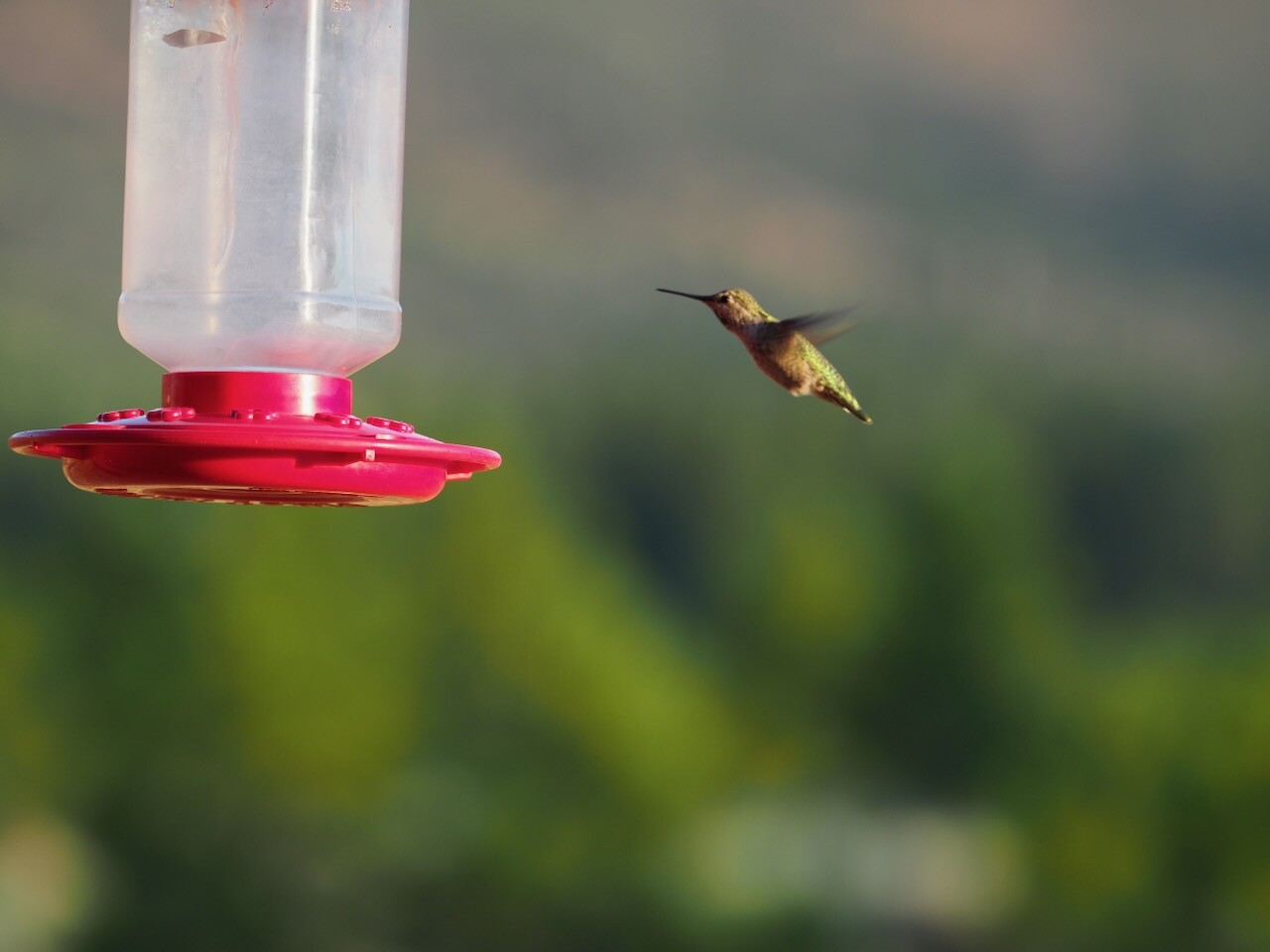
Where the framework starts to misbehave is one step earlier. My 1979 master's thesis at Cal Poly Pomona — committee chaired by Laszlo Szijj — was on the application of electronic monitoring to pollination ecology. I built and tested seven different detection systems (mechanical, conductive, infrared, inductive, sound-activated, capacitive proximity, electrostatic), settled on a capacitance-sensing proximity detector, and used it to monitor Anna's hummingbird feeding behavior at feeders filled with varying sucrose concentrations. Thirty hours of virtually error-free continuous monitoring showed the birds maintaining visitation rates from 33% sucrose down to 16%, then dropping to occasional visits at 3.3% — a real ecological finding alongside the methods.
It wasn't the right idea for 1979. But the thesis already knew this. Its final section, "Prototype Refinements and Future Systems," explicitly projected palm-sized modules that would record events to one-hundredth of a second in electronic memory, plug into a desktop printer for readout, prototype cost under $5,000 with units as low as $400. "As farfetched as this system may seem," I wrote then, "devices similar to this are already available." One paragraph later: "Its value to agriculture alone warrants a serious look at application of some of these techniques."
That's a remarkably precise forecast of what would become wireless sensor networks — the technology that grew into what most people now know as the Internet of Things. The tiny networked computers in smart thermostats, video doorbells, and the utility meter on the side of your house are direct descendants of the embedded networked sensing work our group pioneered at the James Reserve in the early 2000s. The 2004 Communications of the ACM paper described the operating system and the hardware where it all started, twenty-five years before any of it appeared in consumer homes. Three generations of the same instrumentation lineage trace through here: Kavanau and Norris's 1961 Science paper on body-capacitance proximity sensing for small animals; my 1979 thesis applying the technique to hummingbirds; the 2004 paper applying its descendants to ecosystem-scale monitoring. Each generation enabled by the next round of smaller and cheaper electronics.
This is the case the Cui paper underspecifies. The nostalgia effect assumes the work that imprinted you was the appropriate idea for its time and has since been displaced by better ones. Sticking with it is conservatism. But when the imprinting was on an idea constrained not by content but by available technology, sticking with it isn't nostalgia — it's prescience finally meeting its moment. The 1979 thesis wasn't waiting passively for the future; it predicted it and named agriculture as the most important downstream application.
Forty-seven years on, pollination monitoring sits at the heart of some of the most consequential problems in ecology — bee population collapse, phenological mismatches under climate change (flowers blooming before their pollinators emerge in spring), pollination services worth billions in agriculture. With modern sensors, computer vision, and AI synthesis across disciplines, the seed planted in 1979 has finally found the ecosystem it needs. The Cui paper would file this under "novelty." I'd file it as deferred disruption. Not a paradigm displaced — a paradigm planted before its instruments existed, named for its eventual downstream applications in the original work.
There's a parallel case. My 1983 Cornell dissertation on rare plants in the San Jacinto Wilderness was submitted to a 2016 US Fish and Wildlife Service rulemaking docket — thirty-three years after defense, doing regulatory work it couldn't have done at publication because the relevant species protection questions hadn't yet been formulated. Deferred disruption in a different register: not technology catching up, but legal and institutional frameworks catching up to the data. The citation-based measure can't see either pattern.
The asymmetry of citation
My most-cited paper, by an order of magnitude, is that 2004 piece in Communications of the ACM on habitat monitoring with sensor networks — Szewczyk, Osterweil, Polastre, Hamilton, Mainwaring, Estrin. It synthesized two early experiments in using small wireless sensors to monitor ecosystems: one at the James Reserve in the San Jacintos, the other on Great Duck Island off Maine. By the Cui paper's metric, it's a textbook disruption: heavily cited, its antecedents quietly forgotten.
The timing matters. 2004 put me at career age 25, well past the early-career peak where the curve says disruption should hit. But the paper itself names what explains it: cross-institutional teamwork, interdisciplinary scope, riding a fresh technology curve. My career-age-25 disruption was made possible by everyone else's technology stack being at career-age zero. The metric was partly measuring me, partly measuring the moment the field opened. And the paper undersells an asymmetry — they measure imprinting only in one direction. A paper cited thousands of times shapes thousands of younger researchers. Disruption and imprinting are the same dynamic seen from opposite sides: creative destruction from one angle, founding of a lineage from the other.
Field stations as instruments
The middle stretch of my career was running field stations — twenty-six years directing James San Jacinto Mountains Reserve, ten more directing Blue Oak Ranch Reserve outside San Jose. By the framework, those decades should mark the transition from researcher to administrator and the slow drift away from frontier work.
But field stations aren't administrative infrastructure. They're scientific instruments — nodes of focused attention on an ecosystem, sustained over decades, dual-use for teaching and research. They produce science in roughly the way a Large Hadron Collider produces particle physics. The LHC's contribution isn't measured by counting citations to "the LHC paper"; it's measured by the discoveries that couldn't have happened without it. Field stations work the same way. The James Reserve's contribution isn't in my bibliography — it's distributed across decades of papers by hundreds of researchers who came through, plus the trainees they then produced.
The disruption metric is bibliographic — it counts who cites what. Instruments don't get cited like ideas; they appear in methods sections and acknowledgments. An instrument-builder's contribution is therefore systematically undercounted, and the social bonds the instruments produce go uncounted entirely. Frank Padilla shows up in my 1983 dissertation acknowledgments under field assistance. Forty-three years later he was with my partner Merry and me at Anza-Borrego in March, doing 3D photographic survey work at the Steele/Burnand Desert Research Center. A four-decade field collaboration doesn't appear in any citation graph. Building the instrument is a meta-disruptive act. The LHC enabled the Higgs-boson confirmation. The James Reserve enabled embedded-network ecology. Blue Oak Ranch is enabling things that haven't been published yet.
And the science didn't stop during the years I was building those instruments. Aerial water sampling work with Carrick Detweiler at Nebraska in 2013–2015. Urban Forest Digital Twin presentation in 2023. Same trajectory across the whole arc: electronic monitoring of pollination in 1979, the laserdisc-based Macroscope with Jim Lassoie in 1986, embedded sensor networks in 2004, robotic aerial sampling in 2013, urban forest digital twins in 2023. Each generation jumping to whatever the next instrumentation platform happened to be.
Now at Canemah, the work is different in form but continuous in substance. The Macroscope Next Generation is partly built with an AI collaborator — a framework that lets a single investigator-and-AI pair carry out the kind of multi-disciplinary literature synthesis and instrument design that used to require a small institute. The instruments are partly cognitive now. The partnership inverts the social mechanism behind the nostalgia effect: my collaborator's reference base extends to the current moment, it has no career-stage incentive to defend established ideas, it carries no nostalgia of its own. What I bring is forty-five years of field pattern recognition. What the AI brings is current literature synthesis across disciplines no single human could hold simultaneously in mind. Whether that produces genuine disruption in the paper's measurable sense or just unusually well-informed recombination is an open question. The conditions are well stacked either way.
Right and wrong at the same time
Sitting with the paper and the CV side by side this morning, the thing that strikes me is that Cui and colleagues got me right and wrong at the same time. The imprinting prediction landed clean — Hanawalt and Whittaker is exactly the kind of anchor the paper says graduate-school reading becomes, and gradient thinking is everywhere in what I've done since. The nostalgia is real. So is its persistence. The pollination thread from 1979 sits at the center of work I'm doing in 2026, four and a half decades later. The framework works.
What it doesn't see is that the same nostalgia produced the opposite of the predicted outcome. The Hanawalt-Whittaker anchor didn't trap me; it gave me a place to build from. The pollination thesis didn't fade as a youthful enthusiasm; it forecast its own future and waited for tools to catch up. The field station years that should have marked drift into administration produced an instrument that generated other people's disruption. Two kinds of attachment can look identical from outside — both produce papers leaning on old references — but one is conservative continuation of a paradigm left behind by better ones, and the other is patient cultivation of a paradigm planted before its tools existed. The Cui paper measures both as the same thing. They aren't.
I'm an outlier within the distribution they describe, but not by leaving the framework's logic. By inhabiting it differently. Imprinting on a paper whose concepts, methods, and place all converge; positioning at the interfaces between fields; building instruments instead of accumulating administrative load; carrying long social bonds; partnering with an AI across the age gap. None of this defeats the curve. It produces a different shape inside it.
Forty-five years in, the foot is nowhere near the brake. The instruments are sharper than they've ever been. The pollination thread from 1979 is finally meeting its moment, just as the thesis said it would. For some categories of scientific life, the curve isn't a curve at all — it's a slowly compounding interest on early bets that took decades to come due.
🌎
References
- Cui, H., Lin, Y., Wu, L., & Evans, J. A. (2026). "Aging and the narrowing of scientific innovation." Science 392(6798). https://www.science.org/doi/10.1126/science.ady8732
- Hanawalt, R. B. & Whittaker, R. H. (1976). "Altitudinally coordinated patterns of soils and vegetation in the San Jacinto Mountains, California." Soil Science 121(2): 114–124.
- Kavanau, J. L. & Norris, K. S. (1961). "Behavior Studies by Capacitance Sensing." Science 133(3455): 730–732.
- Hamilton, M. P. (1979). The application of electronic monitoring to the study of pollination ecology. Master's thesis, California State Polytechnic University, Pomona. Committee chair: Laszlo Szijj.
- Hamilton, M. P. (1983). A floristic basis for the management of rare plants and their communities in the San Jacinto Mountains, California. Ph.D. dissertation, Cornell University.
- Hamilton, M. P. & Lassoie, J. P. (1986). "The Macroscope: An Interactive Videodisc System for Environmental and Forestry Education." Forestry Microcomputer Software Symposium, West Virginia University.
- Szewczyk, R., Osterweil, E., Polastre, J., Hamilton, M., Mainwaring, A., & Estrin, D. (2004). "Habitat Monitoring with Sensor Networks." Communications of the ACM 47(6): 34–40.
- Chung, M., Detweiler, C., Hamilton, M., Higgins, J., Ore, J.-P., & Thompson, S. (2015). "Obtaining the Thermal Structure of Lakes from the Air." Water 7: 6467–6482.
- Hamilton, M. P. (2023). "The Urban Forest Digital Twin: Technologies to build virtual forests for urban forestry, STEM education, and public outreach." Ecological Society of America Annual Meeting, Portland, Oregon.